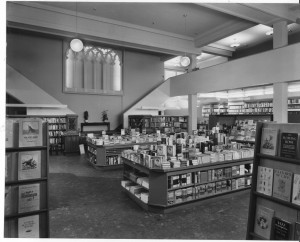
In 1931, Paul Elder Jr. began working in his father’s bookstore. He gradually assumed management roles as his father neared retirement. In the early 1940s, Paul Sr.’s health declined, and Paul Jr. become president and manager in 1943. Paul Jr. was joined in the business by his wife Eloise (1909-1973). Eloise was a former artist, and she coordinated the continuing series of book readings and art exhibits at the Paul Elder Gallery. When Paul Jr. was called away during World War II, she assumed an even larger role.
After many months of ill health, Paul Elder Sr. died on 23 January 1948. Four months later, on the first of June, Paul Elder & Company moved for the final time, a block-and-a-half away to 401 Sutter St., at the southwest corner of Stockton. Paul Jr. and Eloise were putting their own stamp on the fifty-year-old business.
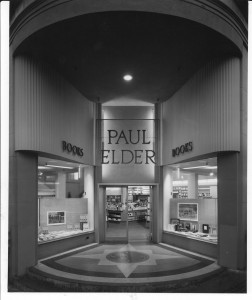
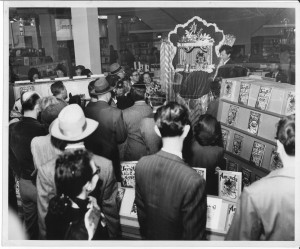
The new bookstore was a dramatic departure from the previous shops, where atmosphere had been the overriding concern. Gone were the smaller rooms, dark walls, and an Arts & Crafts emphasis on unpainted wood. Post-war Mid-century Modern ruled the day: architect Bolton White created a modern, open design, using extensive street-front windows and a bright—one might even say gaudy—color scheme. There were no longer any stairs, a fact that Elder prominently advertised. Instead, an elevator brought customers to the mezzanine.
As happened in 1909 and 1921, some furnishings were brought along from the old stores in a nod to the long history of Paul Elder & Company. Two of Bernard Maybeck’s carved screens from the 1909 store were installed at the base of the stairway, and a row of gothic windows from the 1921 store were placed on the wall above. The heavy wood bookcases and medieval chandeliers were either sold or discarded; Arts & Crafts was long out of fashion.
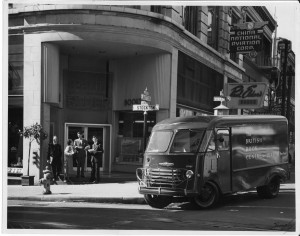
In October 1968, Paul Elder Jr sold the two remaining bookstores to Brentano’s. “My wife Eloise and I have been working too hard, too long,” he told the San Francisco Chronicle. He decided to sell “because of an accumulation of things: the field is overcrowded, the competition is tremendous… automation calls for big-business organization.” He wouldn’t say what he had in mind, but “it won’t be another bookstore. But I’ll be enjoying myself. I always do.”1San Francisco Chronicle, 4 October 1968, p3
Brentano’s, however, did not close the bookstore at Sutter & Stockton, nor did they change the name. Paul Elder’s Books remained open for business, even after Brentano’s opened an eponymous bookstore in June 1969, in the old White House department store building at Sutter & Grant, just one block away. Crowell-Collier, Brentano’s parent company, insisted that there were no plans to shutter Paul Elder’s.2San Francisco Examiner, 8 Jun 1969, p60
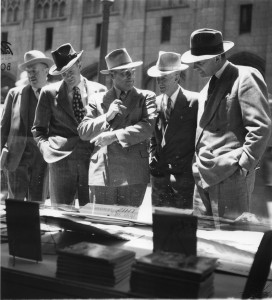
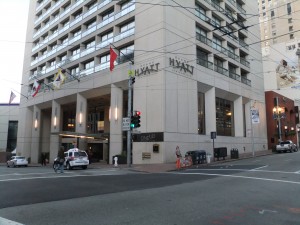
That promise lasted just six months. On Monday, 29 December 1969, Paul Elder’s Books closed for good. The Chronicle reported that the stock would be transferred down the street to Brentano’s3San Francisco Chronicle, 30 December 1969, p34, although within three weeks, Books Inc. on Geary was advertising the sale of 13,000 volumes from Paul Elder’s, as well as books from Newbegin’s Book Shop, which had also recently closed.4San Francisco Chronicle, 25 January 1970, “This World” section, p47. The building was soon demolished to make way for construction of the 38-story Grand Hyatt Union Square hotel, which opened in 1972.
Updated 4 December 2025
- 1San Francisco Chronicle, 4 October 1968, p3
- 2San Francisco Examiner, 8 Jun 1969, p60
- 3San Francisco Chronicle, 30 December 1969, p34
- 4San Francisco Chronicle, 25 January 1970, “This World” section, p47.