Behind the Garden Wall

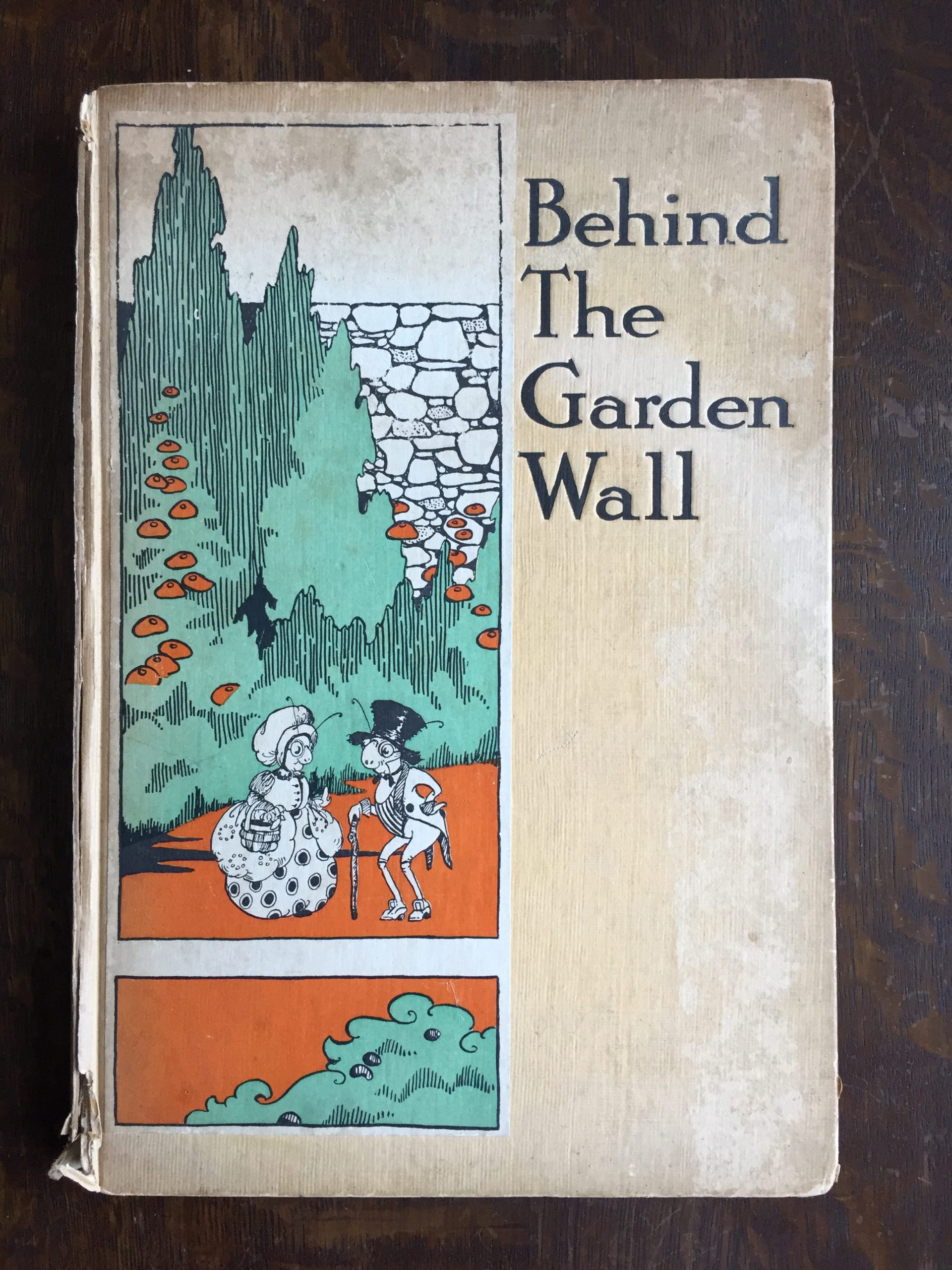
Cover of Behind the Garden Wall

It is 1912, and a lonely woman in Vermont illustrates children’s books to take her mind off a stifling marriage. Three years later, she is an impoverished single mother, working as a mucker alongside grimy men in a lonely gold mine in the Sierra foothills. Three years after that, she is a nationally-known columnist and the highest-paid woman in the Hearst newspapers.

Who was this remarkable woman? The life story of journalist, artist, and memoirist Elsie Robinson is finally being told in full, thanks to the marvelous 2022 biography Listen, World!, by Julia Scheeres and Allison Gilbert. Our spotlight book today, one of Elder’s best children’s stories, has a small part in that tale.

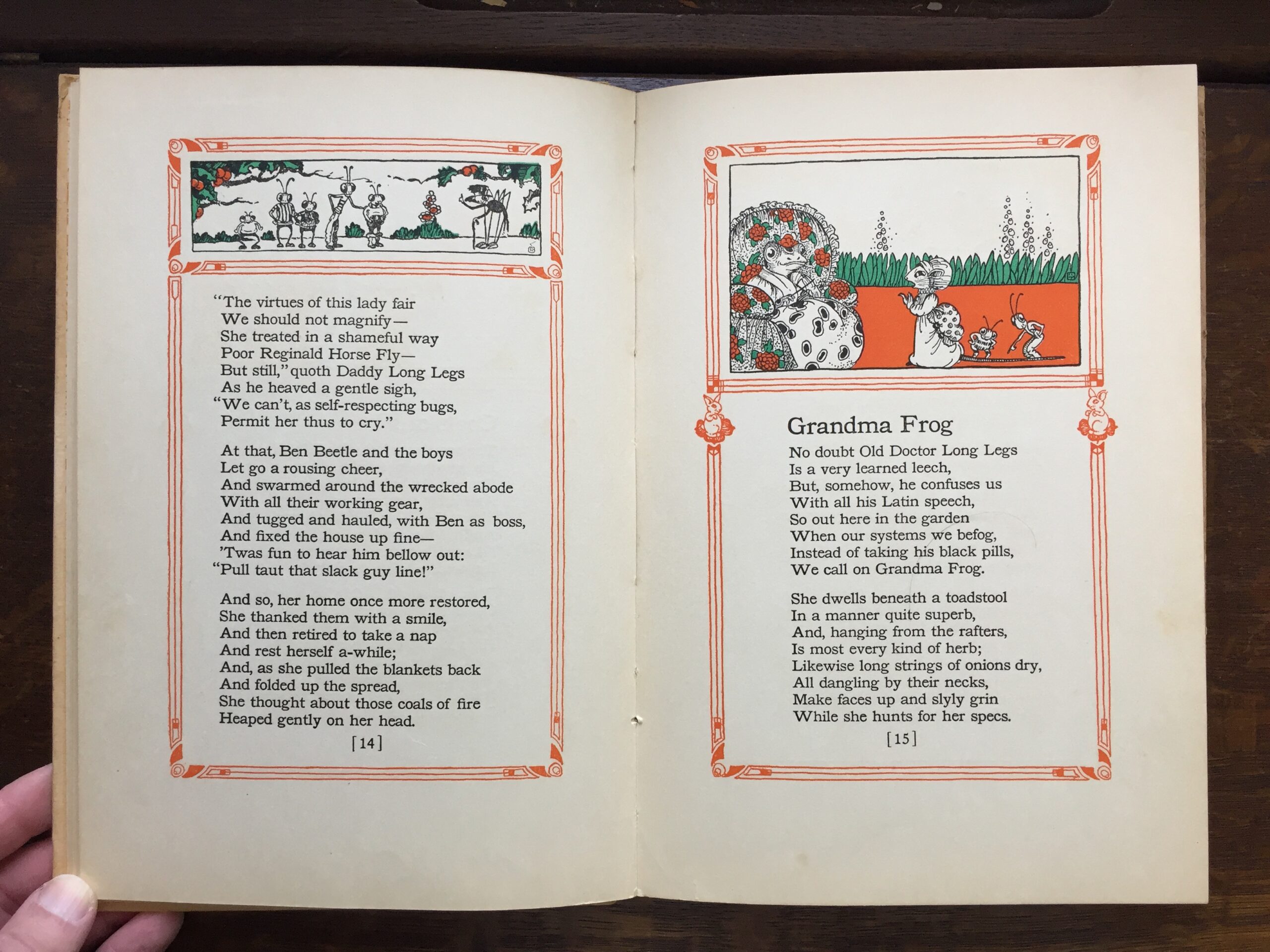
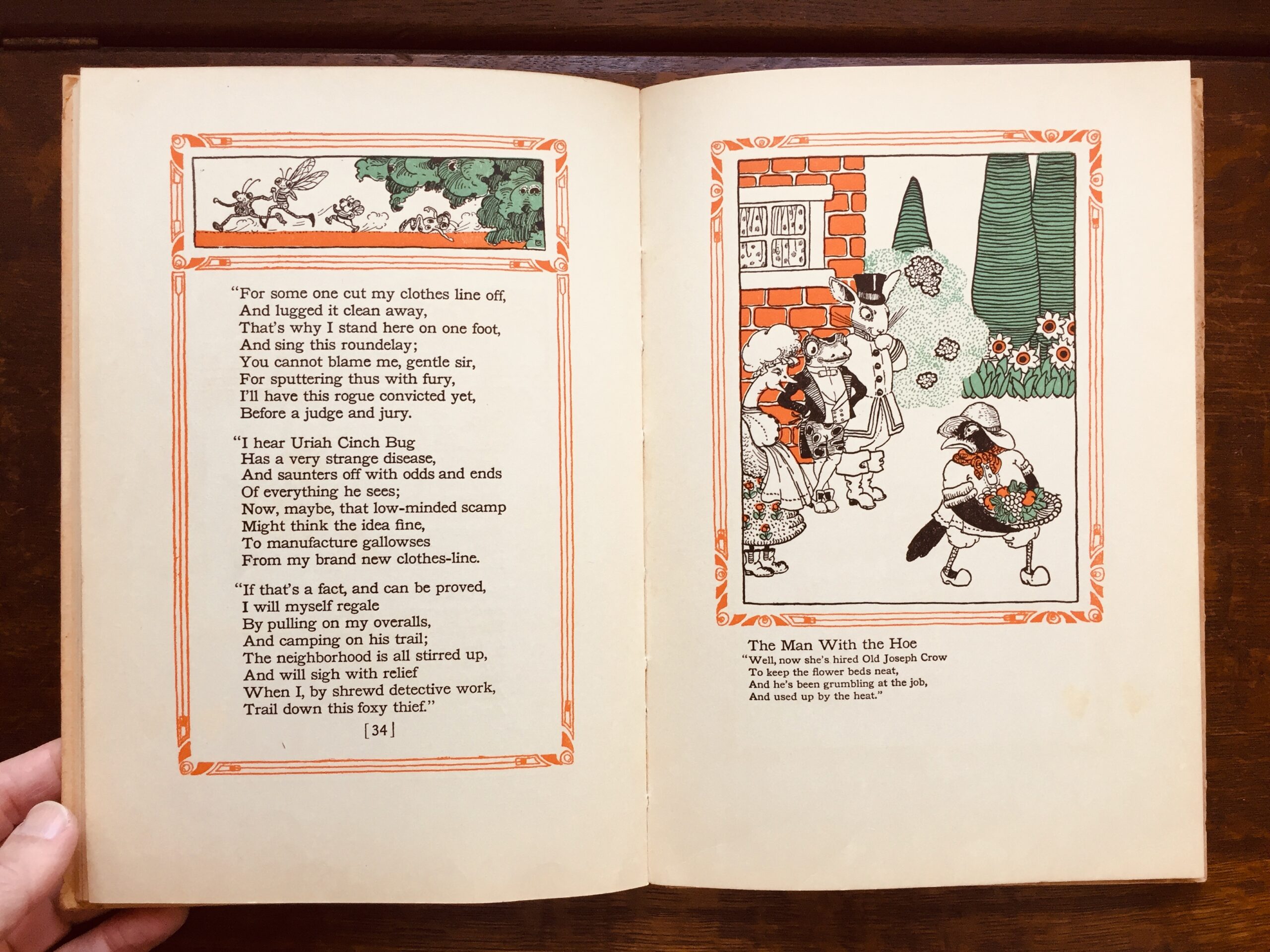
Behind the Garden Wall is a delightful children’s book, with verses by Robert Wallace and illustrations by Elsie Robinson. Her artwork is replete with all manners of animals: geese, crows, rabbits, mice, guitar-playing frogs, dancing beetles, even mosquitos. Printed in three colors, it would still be a perfect book, 110 years after publication, to read to a young child.

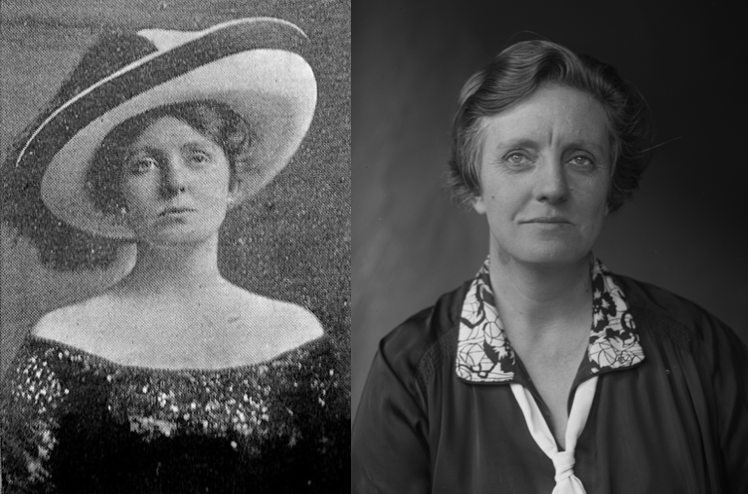
Left: Elsie Robinson Crowell about 1912, when Behind the Garden Wall was published. Right: Elsie circa 1940, when she was a famous columnist.

Elsinore Justinia Robinson was born in 1883 in Benicia, California. Thirty years before, Benicia had briefly been the California state capitol—the old capitol building still stands—but by 1883 it had become a ‘frontier town’ with saloons and bordellos. When Elsie was nineteen, she met a visiting easterner named Christie Burnham Crowell, ten years her senior.1This and other biographical details are from Listen World!, by Julia Scheeres and Allison Gilbert, Seal Press, 2022

Elsie was eager to escape into the wider world, and Christie was on the rebound from the death of his first wife from an abdominal tumor at the age of 24. Their long courtship was spent convincing Christie’s parents to agree to the marriage: the devout Crowells thought her a sloppy, emotional teenager, completely unable to run a New England household. The Crowells finally agreed on the condition that Elsie spend a year at a nearby boarding school, where she would learn manners, household management, and the Bible. Elsie and Christie were married in his home town in Brattleboro, Vermont, and she gave birth to their son George in 1904. But George’s birth did not improve their marriage. When George developed asthma, Elsie pleaded to move to a warmer client for his health, but Christie refused. Elsie now realized that she was trapped: Christie would always be loyal to his parents first.

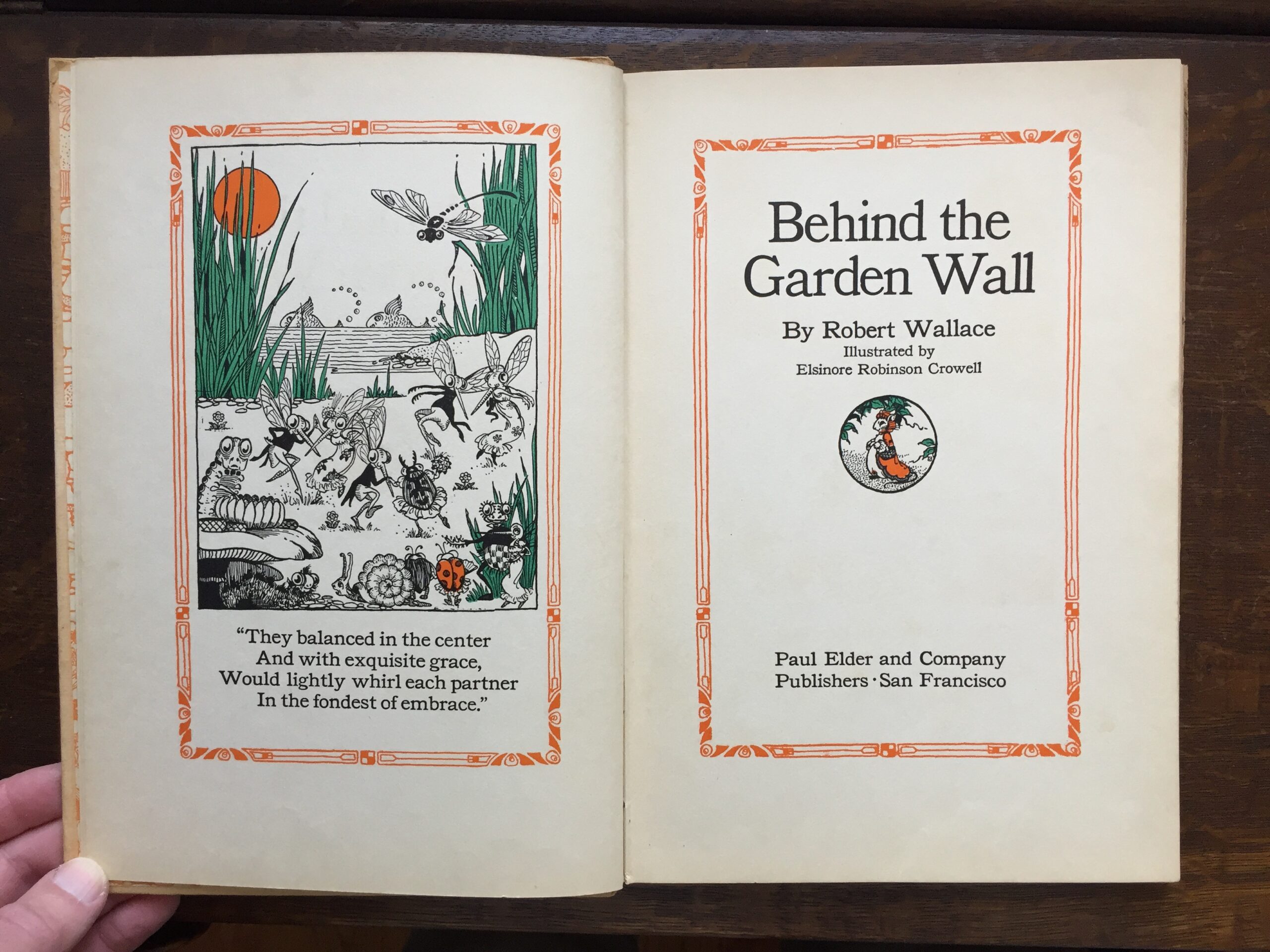
Frontispiece and title page of Behind the Garden Wall

Elsie proceeded to put all her emotional energy into raising George, who was often home sick from school. She kept many children’s magazines at his bedside, including a brand-new title that would become his favorite: John Martin’s Letters. It was published by none other than Morgan Shepard, now living back in his home town of New York City after his years with Paul Elder in San Francisco. Elsie also began writing her own stories for George, and illustrated them with children and animals. She screwed up the courage to write to Shepard, asking whether her stories might be good enough to publish. She was astonished when Shepard replied, saying that yes, he’d very much like to publish her story, and more like it. Elsie began to write regularly for John Martin’s Letters in 1911 under the pseudonym “Comfy Lady.”

Pages 14-15 of Behind the Garden Wall

In 1912, Elsie was contacted by Robert Wallace, an inmate at the Brattleboro Retreat, a former insane asylum. He was trying to cure his alcoholism, in part by writing children’s stories, and he was looking for an illustrator. Elsie visited him at the Retreat, and they began working on a book together, which would become Behind the Garden Wall.

Elsie and Robert realized that they attracted to each other. They were also both married to people who paid little attention to them. As the book neared completion, they devised an escape plan. Robert wanted to get out of the asylum, and Elsie could file a petition to be a guardian. Elsie wanted to return to California, both for her son’s health and for her own sanity. Robert casually proposed a trip to California over a chess game with Christie, Elsie and George coming along to visit her family in Benicia. Christie agreed, oblivious of their scheme. Within a few weeks, Elsie, George, and Robert were on a train to California, never to return. Eventually, it became clear to Christie that Robert and Elsie were living together, and he initiated divorce proceedings. But for more on Elsie’s life story, you’ll need to read Listen, World!

Pages 34-35 of Behind the Garden Wall

It’s unknown why Paul Elder ended up publishing Behind the Garden Wall, but the most likely scenario is that Morgan Shepard referred Elsie to Elder, knowing that Elder had the means to properly publish and market the book. Once in California, Elsie and Robert wrote another children’s book, Within the Deep Dark Woods, published later in 1913, but by Blair-Murdock, not Paul Elder. Perhaps Morgan Shepard referred Elsie to both publishers and they agreed to do one book with each?


Cover of “Listen, World!” the new biography of Elsie Robinson by Julia Scheeres and Allison Gilbert


  • 1
    This and other biographical details are from Listen World!, by Julia Scheeres and Allison Gilbert, Seal Press, 2022

Islanded

Special binding of “Islanded” with copper foil over boards, and gold-stamped title and author.

In early 1934, a monthly literary magazine called Dune Forum appeared out of Oceano, a tiny, unincorporated seaside community in San Luis Obispo County, California. Oceano had hitherto been known as the home of a utopian Theosophical religious community called Halcyon, founded in 1903. Dune Forum was sold at a select few of California’s literary hotspots, including Paul Elder’s bookstore, UC Berkeley and Stanford University, and bookstores in Santa Cruz, Carmel, Ojai, Santa Barbara, and Los Angeles. The magazine only lasted seven issues, but included contributions from such notables as poet Robin Lampson, musician John Cage, and poet John Varian of the Halcyon community.

The February 1934 issue of Dune Forum contained this note in a section called “Northern Lights:”

San Francisco never ceases to delight us. As this magazine is printed there, we have to attend its monthly rebirth, and each time we journey thither, further proofs of its fascination crowd in upon us, each with a new surprise. This trip is already full of memories. Mrs. Maflo [Mary Florence] Ryan gave a benefit reception for young Dwight Strickland, a cynical poet in the contemporary stream of defeatism, yet curiously remindful of the mauve decade. His book of verse, “Islanded” has recently been brought out by Paul Elder, and for much of its contents, is worthy of your attention. Better still if you could hear him recite his Swinburnianly modernistic lyrics. A born showman, this Strickland never misses a chance to flabbergast or charm, or otherwise capture the attention of his audience.1Dune Forum, vol. 1, no. 2, 15 Feb 1934, p56.

Frontispiece and title page of “Islanded”

That same week, the Mill Valley Record reported:

Dwight Strickland, the young California poet whose work is earnestly noted by bay region people, is soon to tour the south, where he will appear before distinguished clubs in dramatic presentation of his latest volume of verse “Islanded.” He is to be the guest of and entertainer for the Chelsea Circle in San Francisco tomorrow night. Mr. Strickland expresses himself in highly colorful imagery and distinctive rhythms. In these two qualities, the mantel of Vachel Lindsay seems to have fallen upon him. Lindsay pioneered in a new style which won great acceptance. Strickland is receiving complimentary support from the press. A limited number of autographed copies of his work may be had at Paul Elder’s.2Mill Valley Record, Volume XXXV, Number 51, 9 February 1934

Presumed standard binding of “Islanded,” with silver paper over boards, title and author name stamped in black.

And in April, the Los Angeles Times noted:

From San Francisco comes young Dwight Strickland, whose volume of verse, “Islanded,” has been issued by Paul Elder. Mr. Strickland believes in the importance of reading verse aloud, and he follows Vachel Lindsay in this faith. But, unlike the midwestern poet, he reads from the work of other poets as well as from his own.3Los Angeles Times, 8 Apr 1934

Islanded was issued in at least three bindings: silver paper on boards with title and name stamped in black, cloth on boards without stamped title, and, most unusually, copper foil over boards with gold-stamped title and author—the only such binding that Paul Elder & Company ever issued. The poetry inside is often printed with the avant-garde typography pioneered by E. E. Cummings in the 1920s, and one imagines that our born showman’s reading style attempted to convey that typography to his listeners.

Alternate cover of “Islanded,” with orange and black cloth over boards, but with no words stamped on the cover.

Due to financial difficulties, Paul Elder retired from publishing in 1918. At rare intervals afterwards, he issued an occasional title: three in the 1920s, and six in the 1930s.  Presumably they were all vanity publications, but few records survive so it is difficult to be certain. When Islanded was published in 1933, it was the middle of the Great Depression, and Paul Elder still had money problems behind the scenes, so it’s hard to imagine Elder fronting the costs for this book, especially with the multiple cover designs.

Dwight Jensen Strickland was born in Niles, Michigan on 18 June 1907, the third of four children of the Rev. Arthur Strickland and Carolyn Jensen. Little is known about him aside from what can be pieced together by public documents. The family moved often, and as a boy Dwight also lived in Indiana, Rhode Island, and New Jersey. After his poetry reading tour in 1934, he moved to New York City, but in 1940 was living with his father in Philadelphia. In 1946, he married Louise I. Wetherby (1909-64) in California. Dwight Strickland died on 22 August 1963 in Los Angeles at the age of 56, and is buried alongside Louise at Forest Lawn Memorial Park in Glendale, California.

Pages 8-9 “Islanded,” with the final stanzas of the title poem “Islanded” at left, and distinctive typography.
Signed limitation page, and table of contents
  • 1
    Dune Forum, vol. 1, no. 2, 15 Feb 1934, p56.
  • 2
    Mill Valley Record, Volume XXXV, Number 51, 9 February 1934
  • 3
    Los Angeles Times, 8 Apr 1934

Matins and Vespers

Cover of “Matins and Vespers,” demonstrating John Henry Nash’s expertise with mitred rules.

Matins and Vespers is one of the rarest Elder titles, both because of its ephemeral nature and the notoriety of its author. Violet M. Firth (1890-1946) was a prominent British author, psychologist, teacher, artist, occultist, and mystic. However, she is known primarily by her pseudonym Dion Fortune, inspired by her family motto Deo non fortuna (Latin for “by God, not fate”), originally the ancient motto of the Barons and Earls Digby. She was a prolific writer of the supernatural and the occult in both novels and non-fiction works. According to Wikipedia, Fortune “is recognised as one of the most significant occultists and ceremonial magicians of the early 20th century. The Fraternity she founded survived her and in later decades spawned a variety of related groups based upon her teachings. Her novels in particular proved an influence on later occult and modern Pagan groups such as Wicca.”

Violet Mary Firth, circa 1915?
Violet Mary Firth as a teenager, c. 1905

The text consists of four poems: Morning Hymn, Morning Prayer, Evening Hymn, and Evening Prayer. The cover recto includes a quote from Robert Louis Stevenson, and the verso a quote from Sir Edwin Arnold. Firth’s name only appears in the colophon.

Matins and Vespers, written and published while Fortune was still known as Violet Firth, is a small pamphlet, composed of four sheets folded once and tied with string, making a quire of eight folios. The compositing is by John Henry Nash, and I can think of no greater example of his widely admired skill with the precise perpendicular lines known as mitred rules: in three colors, no less. The actual printing would have been farmed out to a local press shop, despite the colophon reading “printed for them by their Tomoyé Press, at their Shop in the City of San Francisco, which lieth at the Gateway to the Golden West.” Whereas similar unbound Elder titles were almost always issued with matching envelopes (e.g. Charity), Matins and Vespers appears to have been issued with a matching cover  consisting of a simple, loose, folded sheet printed on the front.

Matins and Vespers,” page 1

Violet Mary Firth was born in 1890 to wealthy English family in Llandudno, Wales, where her father ran a hydrotherapy (then called hydropathy) clinic. As a teenager, she lived in the southwest of England, and later studied at the University of London. During World War I, she was a part of the Women’s Land Army, an organization designed to employ women in agriculture in order to replace the men who were fighting in France. For details on Dion Fortune’s extensive career in the occult, I refer the reader to her Wikipedia page. Fortune died of leukemia in 1946 in Middlesex, London, at the age of 55, and is buried at St. John’s Church, Glastonbury.

Matins and Vespers,” page 4
Matins and Vespers,” page 7
Matins and Vespers,” page 10
Colophon of “Matins and Vespers”
Matching cover

A Cycle of Gleanings

Green leather cover of “A Cycle of Gleanings”

One of my latest Paul Elder acquisitions is A Cycle of Gleanings (1909), by Ella Blake Stone. It joins a small stack of other Elders where the copy I own is the only copy I’ve ever seen, even after thirty years of searching. The text is a compilation of quotations, one for each day of the year. Books of quotations were a time-honored Paul Elder device—they must have sold well because he kept publishing them—but they can hardly be called great literature.

The title page reads “A Cycle of Gleanings – from El Labla Kest – One for each day in the year,” but “El Labla Kest One” is simply “Ella Blake Stone” with the spaces in different locations. The printing on the frontispiece tissue guard reads “Aloha Oe e Ke Onaona Noho Ika Lipo” (“farewell to thee, the charming one who dwells in the shaded bowers”), which are words from the well-known Hawaiian song “Aloha ‘Oe,” written by Princess (later Queen) Lili’uokalani in 1878.

Printed on a high-quality English rag paper named “Arnold Unbleached” with a green leather cover embossed in gold, it’s an attractive and well-made book. The book is undoubtedly a vanity publication, given the limited press run of 100 copies and the use of expensive paper: Elder did not lavish such paper on his ordinary trade books. The cover decoration and interior borders are designed by Harold Sichel, one of Elder’s favorite artists. The border on the verso is a mirror-image of the recto (including a mirror-image of Sichel’s HS monogram). The borders were reused by Elder in 1910 for Lillyan Shaffner’s Love & Friendship.

Frontispiece of “A Cycle of Gleanings,” with a portrait of Ella Blake Stone (1837-1919)

Ella Blake Gordon Stone (28 Jun 1837, Louisville, Kentucky – 28 Dec 1919, Santa Barbara, California), was the oldest of six children of John Gardner Gordon and Sarah Reinhard. When she was seven years old, her father moved the family to Muscatine, Iowa. In 1857, she married William Reade Stone (1827-1915) in Muscatine. They lived in Duluth, Minnesota for many years before moving to Santa Barbara, California, where they died and are buried.

Everything so far would make a nice uneventful story of a handsome book… if it weren’t for my discovery of the other book that Ella Stone wrote.

Stone was also the author of O-So-Ge-To the Hopi Maiden, and Other Stories, published by W. B. Conkey Co. in 1907. This book makes for excruciating reading. It is a collection of eight children’s stories that range from patronizing and misogynistic to unapologetically racist. The title story is a sadly typical one from a white author about native peoples: a young Hopi maiden named O-Se-Ge-To is left in the desert as a sacrifice to the “Fiery Spirit” so that desperately needed rain will come. She is found by Padre Esteven (“blessed be his memory”), who is leading a group of priests into the desert to Christianize the Indians, and they baptize her into the Church and rename her Eufrasie. After being taken to Mission Santa Barbara in California, she falls in love with a sailor named Miguel. They are soon married, but he is drowned in a storm at sea. Eufrasie dies of grief after tossing her silver Hopi bracelets into a cauldron that is forging a new bell for the Mission.

The truth, of course, is that the Hopi do not practice human sacrifice, and that as early as 1540, the Spanish were brutally persecuting and sometimes enslaving the Hopi, both for maintaining their own religious customs and for resisting conversion. This eventually prompted the Pueblo Revolt of 1680, one of the few instances where native tribes were able to successfully evict the colonizers. Paul Elder was not immune from publishing material now viewed as racist, but all the same I am happy that it was not he who published this highly offensive book.


Nina Jones: Her Book

Cover of “Nina Jones: Her Book”

Is it presumptuous to name a book after yourself? Nina Jones: Her Book (1916) is the only eponymous title in Paul Elder’s catalog. This attractive book of poems divulges no hints of the High Society life of the author. It was not a life that Nina Jones was born into, nor one that anyone expected her to have.

Nina Maude Jones was a California native, born on 13 June 1885—though she would later claim 1893. Her mother, Nellie Murphy, also a California native, was born in 1868 and married an Englishman named Jones at the age of 17, perhaps because she was already pregnant with Nina. At some point Jones died, leaving Nellie to raise Nina as a single mother—not a trivial matter in the 19th century. In 1896, when Nina was eleven years old, Nellie was hired as a housekeeper at Milo Potter’s Van Nuys Hotel at the corner of 4th & Main in downtown Los Angeles.

Title page of “Nina Jones: Her Book”

Milo Potter was one of the more colorful characters in turn-of-the-century Southern California. Born in Michigan on the 19th of May 1854, he worked in Florida first as a fruit farmer, and then as a cotton broker, but neither experience ended well. He finally found his calling as a hotelier, and built a 100-room hotel called the Potter House in Crescent City, Florida which was a success until it was destroyed in a fire. After a few years at a hotel in New Jersey, he moved to to Los Angeles and began working at the Westminster Hotel on 19 October 1888.

Potter had by then decided that the 19th of any month was his “lucky day,” and he arranged for all his important events to happen on the 19th. When the Van Nuys Hotel was built across the street from the Westminster, Potter signed a lease on 19 September 1896, left the Westminster on 19 October, and opened the Van Nuys on 19 January.

Nina Jones Vescei in 1921

The next twist of the story shocked everyone in town: the 47-year-old Milo Potter—flashy businessman, risk-taker, self-promoter, and confirmed bachelor—married the hotel housekeeper Nellie Jones! The private ceremony was held on the 19th (of course) of November, 1901. The society columnists were beside themselves in surprise:

Cupid has conquered him at last! Maids and matrons on matrimony bent had about given Mr. Potter up as a confirmed bachelor who would not be caught with any feminine bait however tempting. But Mr. Potter would not be human did he not have some vulnerable spot in his heart where a shaft from Cupid’s bow could enter. The dart has found its mark, and Milo M. Potter, the successful boniface, popular clubman, fancier of fast horses, semi-millionaire and enterprising business man, has become a benedict. Mr. Potter is the kind of careful man who does not take the whole world into his confidence when he is about to take an important step. After he makes up his mind to do a thing he goes ahead and does it with neatness and dispatch, without any flourish of trumpets or beating of tom-toms to call attention to his acts. That has been his invariable rule in the conduct of his business. and he did not establish a new precedent for himself In the manner of his courtship and marriage. Not more than half a dozen people outside of the contracting parties knew that Mr. Potter contemplated matrimony, up to the moment the ceremony was performed, and the happy couple will be miles away on their bridal tour before even the scores of inmates of his own house will hear the news. The wedding was one of the quietest and most unostentatious, considering the prominence of the pair, ever celebrated in this city. It took place at 4:15 o’clock yesterday afternoon in the private apartments of Mr. Potter in the Van Nuys Hotel. The charming lady who caused Mr. Potter to forsake his bachelor ways was Mrs. Nellie M. Jones, who for five years has been housekeeper of Mr. Potter’s hotel, and who by her efficiency, culture, grace and tact has made herself an indispensable governess of the splendid caravansary. [Los Angeles Times, 20 Nov 1901]

Milo Milton Potter ca. 1880. Photo courtesy of Neal Graffy.

The marriage to Nellie Jones was not the only surprise up Milo Potter’s sleeve. A few weeks after the wedding, Potter purchased a 30-acre oceanfront parcel in Santa Barbara called “Burton’s Mound.” The mound was in fact a Native American shellmound, built over centuries by the Chumash people, who called the area “Syukhtun.” Potter was betting large, and within a year he had built the six-story 390-room Potter Hotel, which opened on 19 January 1903. Its elevation on the mound gave it spectacular views of the city, mountains, ocean, and Channel Islands. Potter was helped immeasurably by the completion of the Santa Barbara section of the Southern Pacific coast railway: now trains stopped on their way between San Francisco and Los Angeles. There was plenty to do at the Potter Hotel: immaculately landscaped grounds, tennis courts and a zoo, a nine-hole golf course, horse racing track and polo grounds, sailboats, and a farm which raised the poultry and livestock that appeared on the menus of the hotel’s three dining rooms.

Desider Josef Vecsei in 1919

When Nellie Jones married Milo Potter in 1901, Nina Jones was sixteen years old. The daughter of a hotel housekeeper was transformed overnight into a wealthy society teenager. For a time Nina served as a hostess at the Potter Hotel, and we can only imagine the wealthy and famous guests that Nina met.

And then, in 1916, at age thirty-one, Nina Jones published her book of poetry. Presumably a vanity publication, she dedicates it to her step-father Milo, “a poor offering for so much kindness.” It is an attractive little book, with gold-stamped lettering on the spine and cover, decorated endpapers, coated stock, and initial capitals in orange ink. It was probably issued with a dust jacket, but this has not been seen. The poetry is sincere but not memorable. One extolls her mother Nellie’s blue eyes, and several bemoan the carnage of World War I raging in Europe.

When we next hear from Nina, it is April 1920 and she is about to marry the Hungarian concert pianist Desider Josef Vecsei, whereupon they “will leave very soon for New York, from which port they will sail within a short time for France, where they will make their home for the present in Paris.”

The Potter Hotel. Photo courtesy of Neal Graffy.

Milo Potter sold the hotel in 1919, whereupon it was renamed the Belvedere, and later the Ambassador. The hotel burned to the ground on 13 April 1921 and was not rebuilt. Nellie and Nina remained wealthy after Milo’s death in 1925, and they seemed to have escaped the ravages of the 1929 stock market crash. In 1930, Nellie Potter lived in a home in Montecito valued at $100,000, equivalent to $1.6 million today.

The Van Nuys hotel survives at the corner of 4th & Main, and is now called the Hotel Barclay. It has had quite a colorful history, but has seen hard times in recent decades, as it now straddles the border between the Historic Core of Los Angeles and “Skid Road.”

Nina Jones’s Cinderella story sadly did not include a long lifespan. Nina died on 4 July 1935 at the age of fifty. Her mother Nellie Murphy Potter died on 2 April 1946, aged seventy-six. Desider Vecsei died on 1 March 1966, aged eighty-three.

Decorated endpapers of “Nina Jones: Her Book.” The racy Art Deco bookplate of Eve in the Garden of Eden by Rudolph Guzzardi (1903-1962) was clearly pasted in at a later date
Page 7 of “Nina Jones: Her Book”
Page 39 of “Nina Jones: Her Book”
Colophon of “Nina Jones: Her Book”