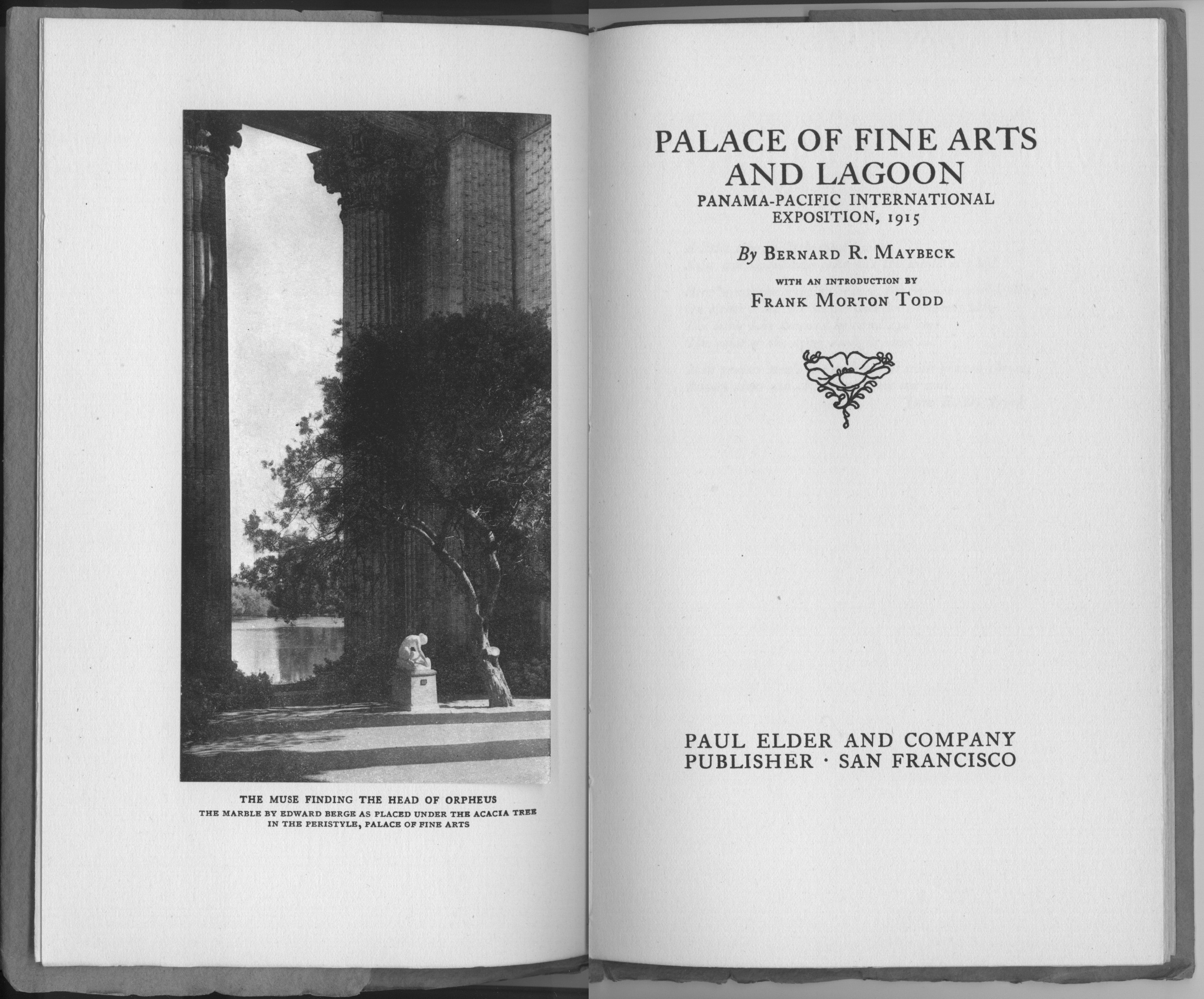
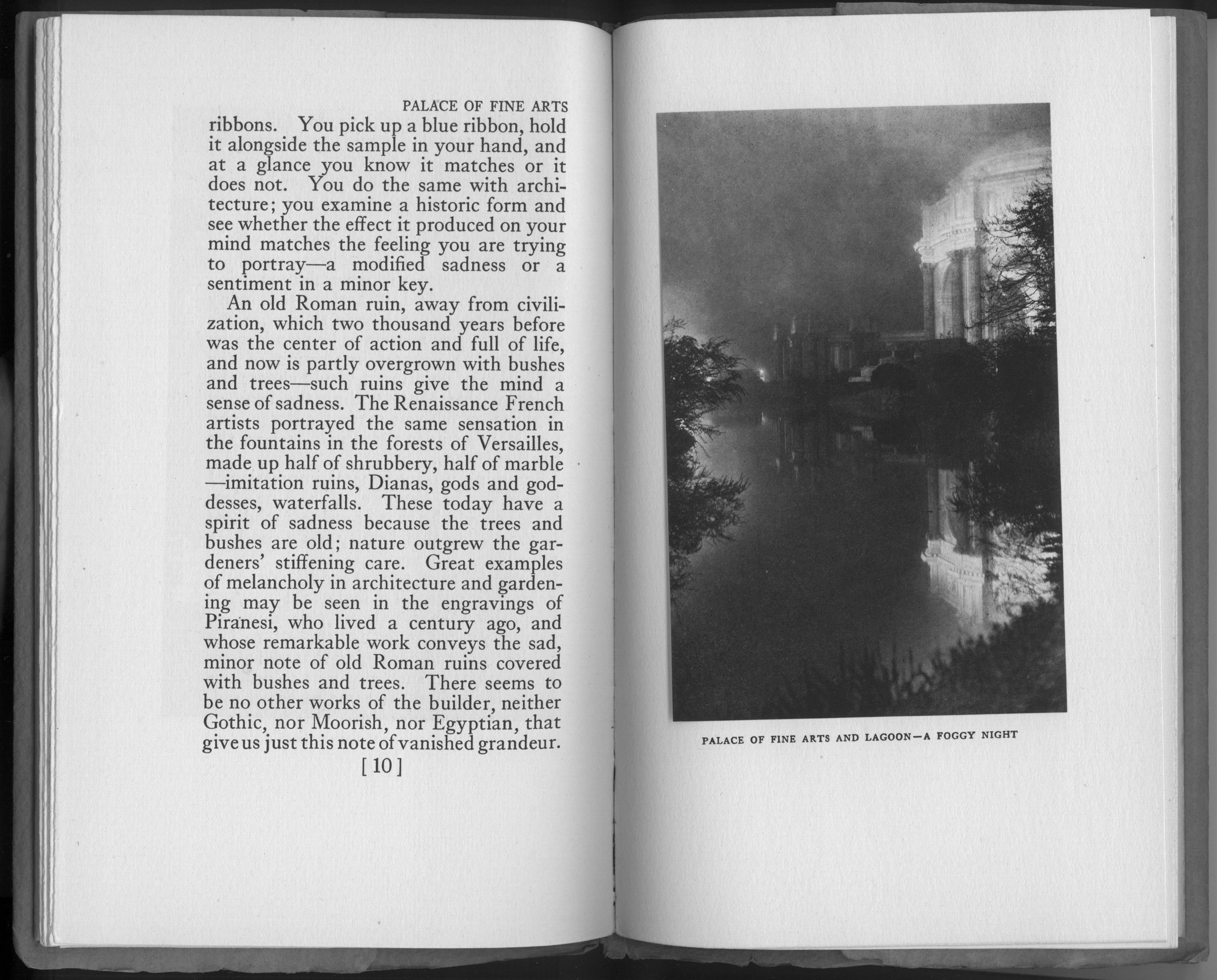
One of Paul Elder’s most collectible titles, Palace of Fine Arts and Lagoon (1915) has often been described as Bernard Maybeck’s only book. It is a slim volume though, coming in at just 24 pages. In it Maybeck describes his approach to designing the Palace of Fine Arts, perhaps his most recognizable building and the only surviving structure from the 1915 Panama-Pacific International Exposition. The text is a revised version of a speech that Maybeck gave to the Commonwealth Club of California. The introduction by Frank Morton Todd, official historian of the Exposition, is as florid and grandiose as Maybeck’s speech is thoughtful and subdued.
In addition to the orange wraps shown below, this title was also issued in a deluxe version with gilt-embossed dark-green leather over boards.
Cover, "Palace of Fine Arts and Lagoon"Frontispiece and title page, "Palace of Fine Arts and Lagoon". (Not shown: tissue-guard with printed poem)"Palace of Fine Arts and Lagoon", page 10
I recently found online a digitized version of The Graphics Arts and Crafts Year Book 1908 (Republican Publishing Company, Hamilton Ohio; Joseph Meadon, editor), which has several examples of John Henry Nash’s typographical work at the Tomoye Press. See pages 122 through 134.
In 1902, May E. Southworth wrote a cookbook for Elder & Shepard called One Hundred & One Sandwiches. It was sold very well, and Elder asked Southworth to write more. In the 1904 Catalog From a Western Publisher (catalog C20), he writes:
The many who have experienced the gustatory joys of 101 Sandwiches will give a hearty reception to four additional volumes, affording them that multiple of the famous 101 Epicurean Thrills
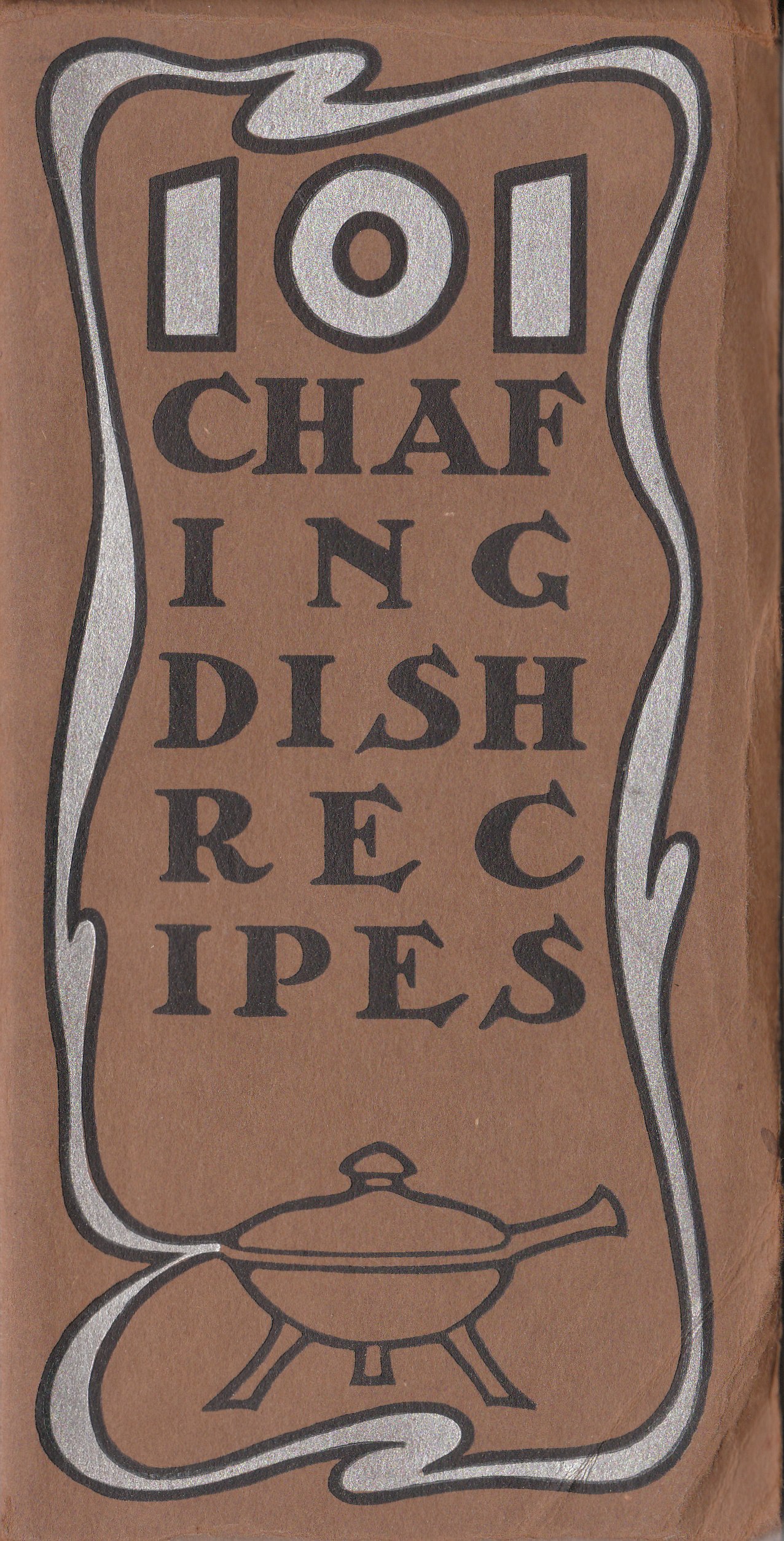
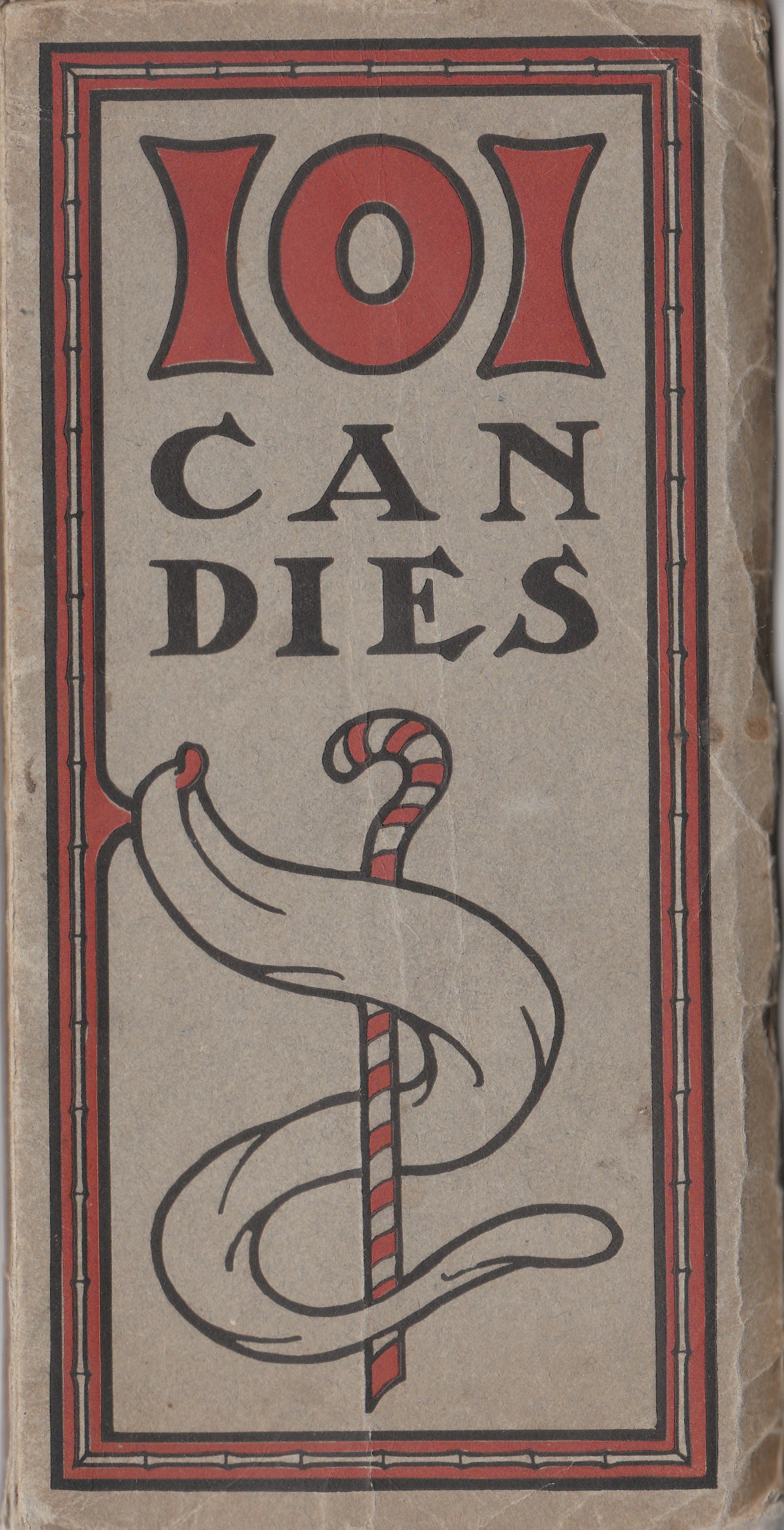
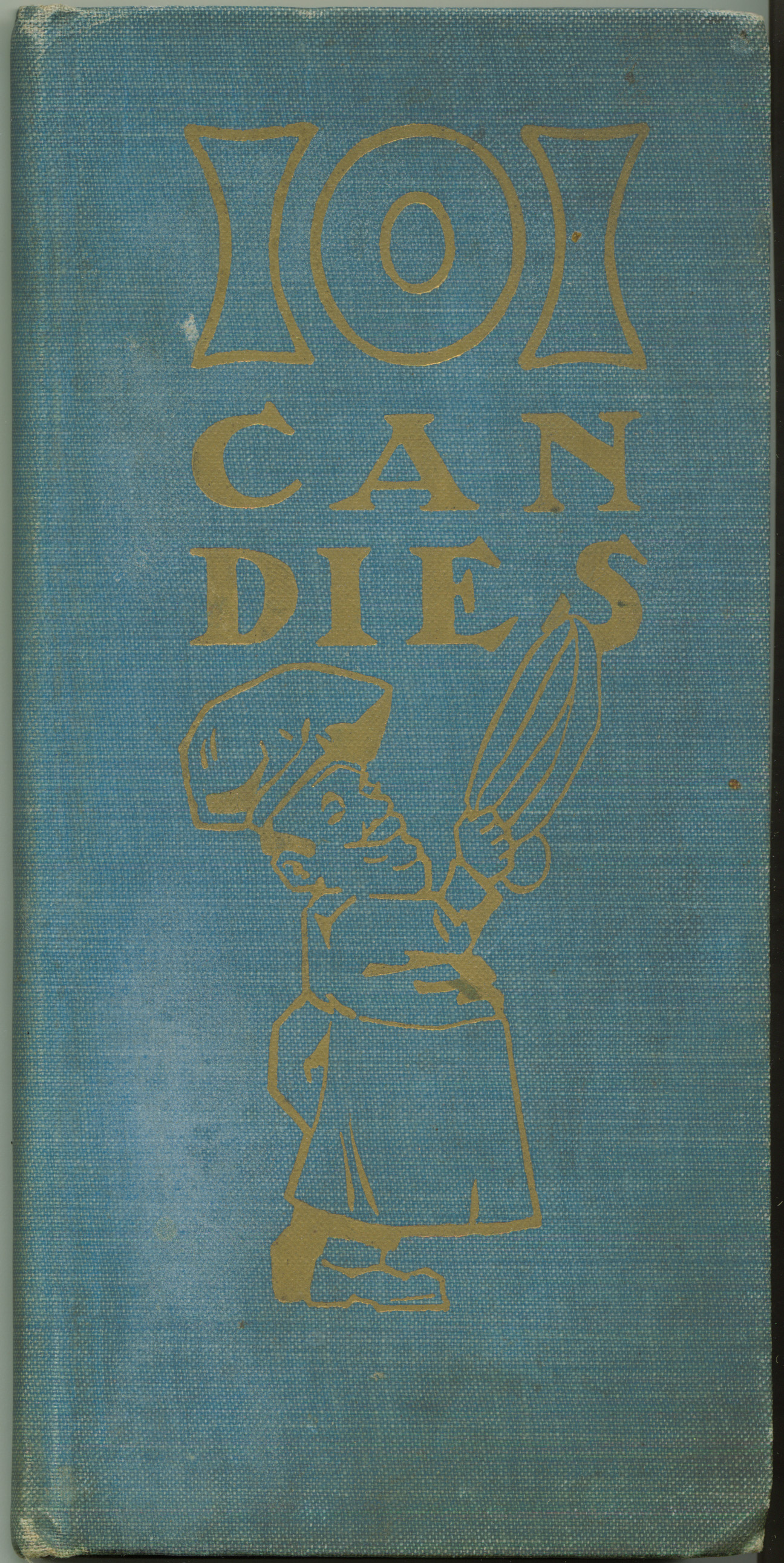
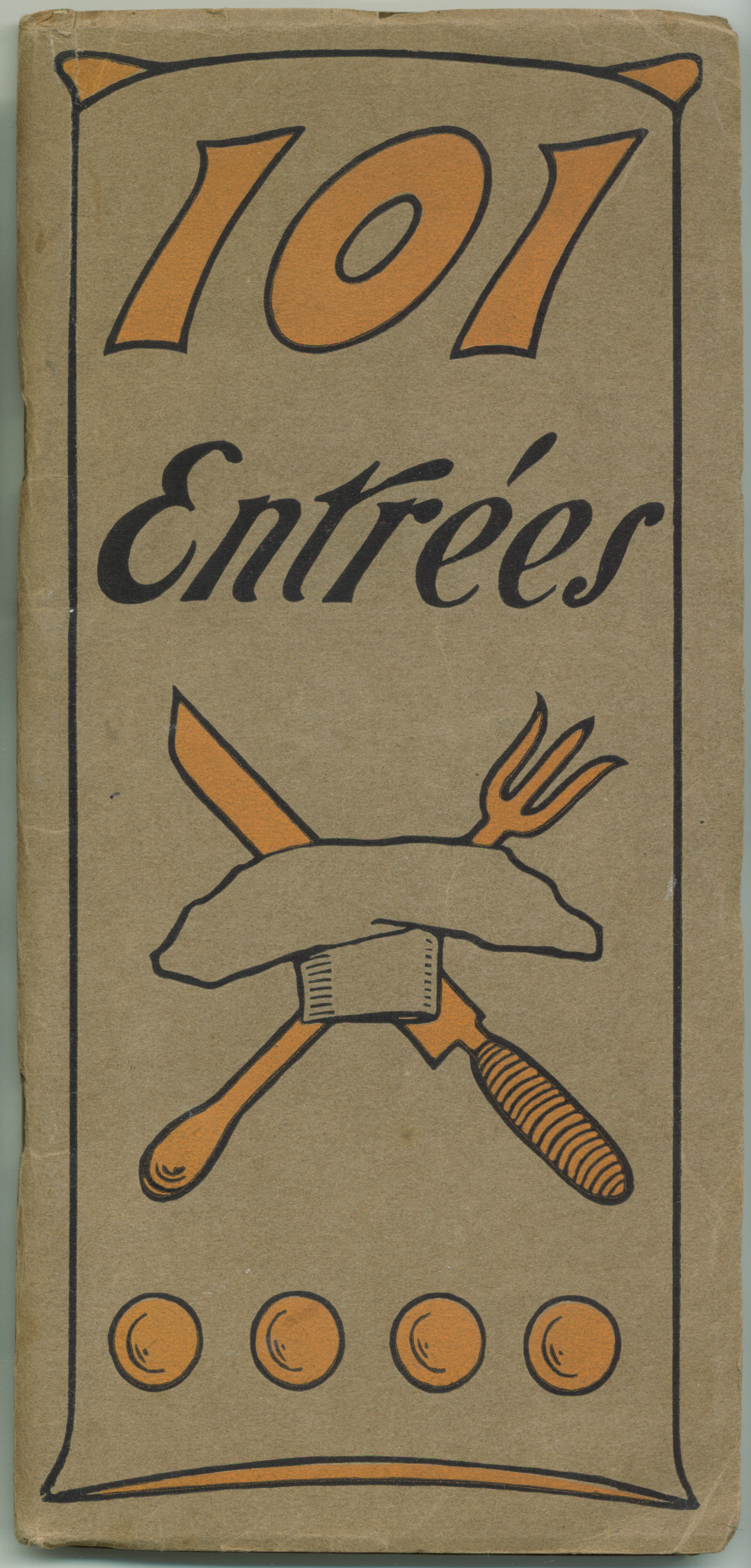
The four new cookbooks were Salads, Chafing-Dish Recipes, Beverages, and Candies. The five cookbooks, including Sandwiches, were reprinted with a Tomoye Press title page and whimsical cover art by Spencer Wright. They were issued in two bindings: paper wraps, and the “Kitichen edition” of canvas over boards. Elder named the series “101 Epicurean Thrills,” and by 1908 there were eleven titles in the series:
One Hundred & One Beverages
One Hundred & One Candies
One Hundred & One Chafing-Dish Recipes
One Hundred & One Desserts
One Hundred & One Entrées
One Hundred & One Layer Cakes
One Hundred & One Mexican Dishes
One Hundred & One Salads
One Hundred & One Sandwiches
One Hundred & One Sauces
One Hundred & One Ways of Serving Oysters
In 1914, Southworth followed up the series with a cookbook entitled Midnight Feasts: 202 Salads and Chafing-Dish Recipes.
101 Sandwiches, 1902 cover artwork.101 Sandwiches, 1904 revised cover artwork, in cloth over boards101 Salads101 Chafing Dish Recipes101 CandiesAlternate cloth cover of “101 Candies”101 Desserts101 Entrees101 Mexican Dishes101 Layer Cakes, cloth over boards101 Ways of Serving Oysters
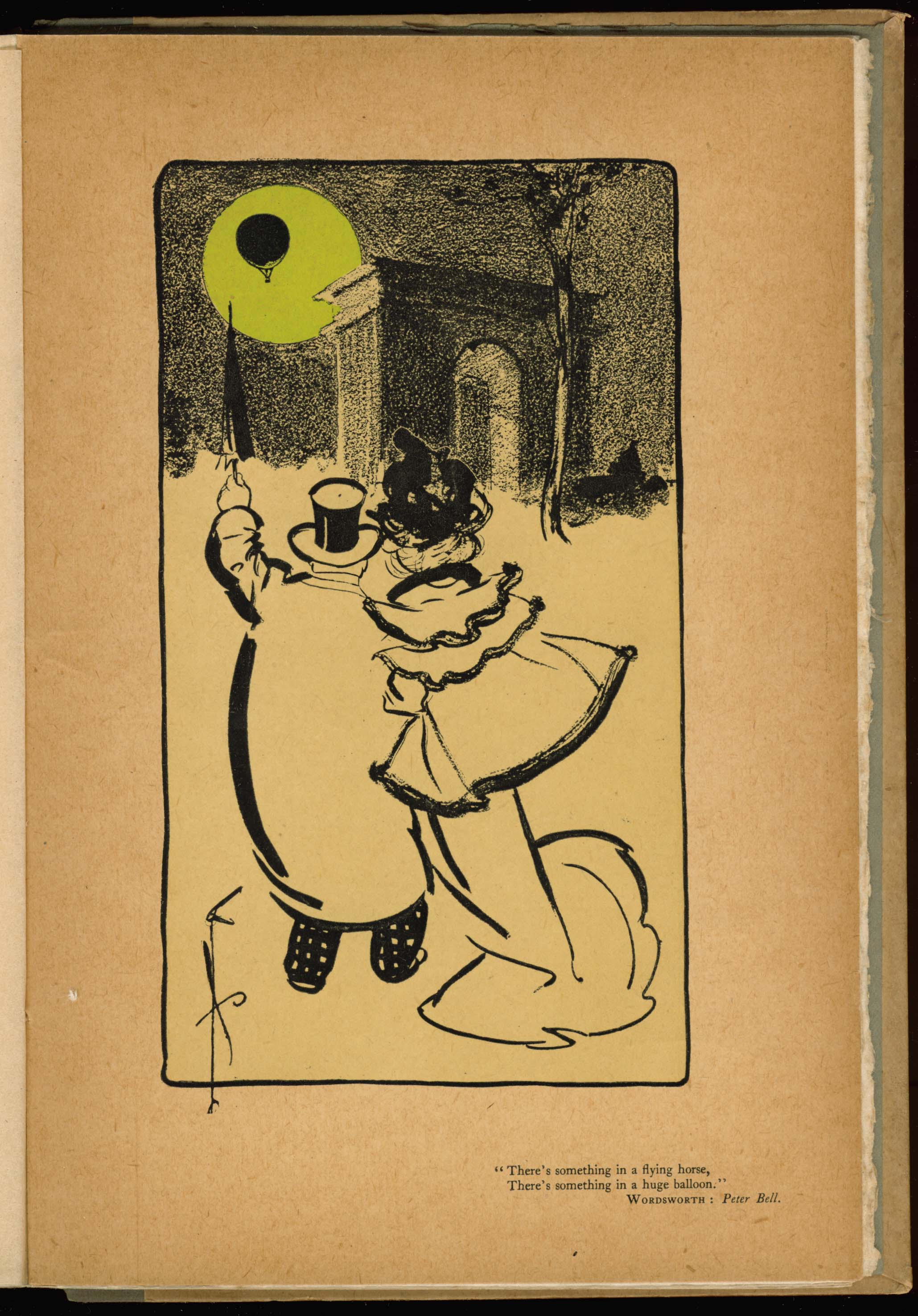
My favorite illustrations from the Elder & Shepard years can be found in George Eli Hall’s 1902 story A Balloon Ascension at Midnight. In 1901, Hall was invited by a friend on a dramatic adventure: a night-time balloon ride over Paris. His companion is an “athletic young Frenchman” who has has discovered ballooning:
After having exhausted all the sensations that are to be found in ordinary sports, even those of “automobiling” at a breakneck speed, the members of the “Aéro Club” now seek in the air, where they indulge in all kinds of daring feats, the nerve-racking excitement that they have ceased to find on earth.
Hall’s courage is tested while climbing into the very small basket, but he soon is overwhelmed by the scene below him:
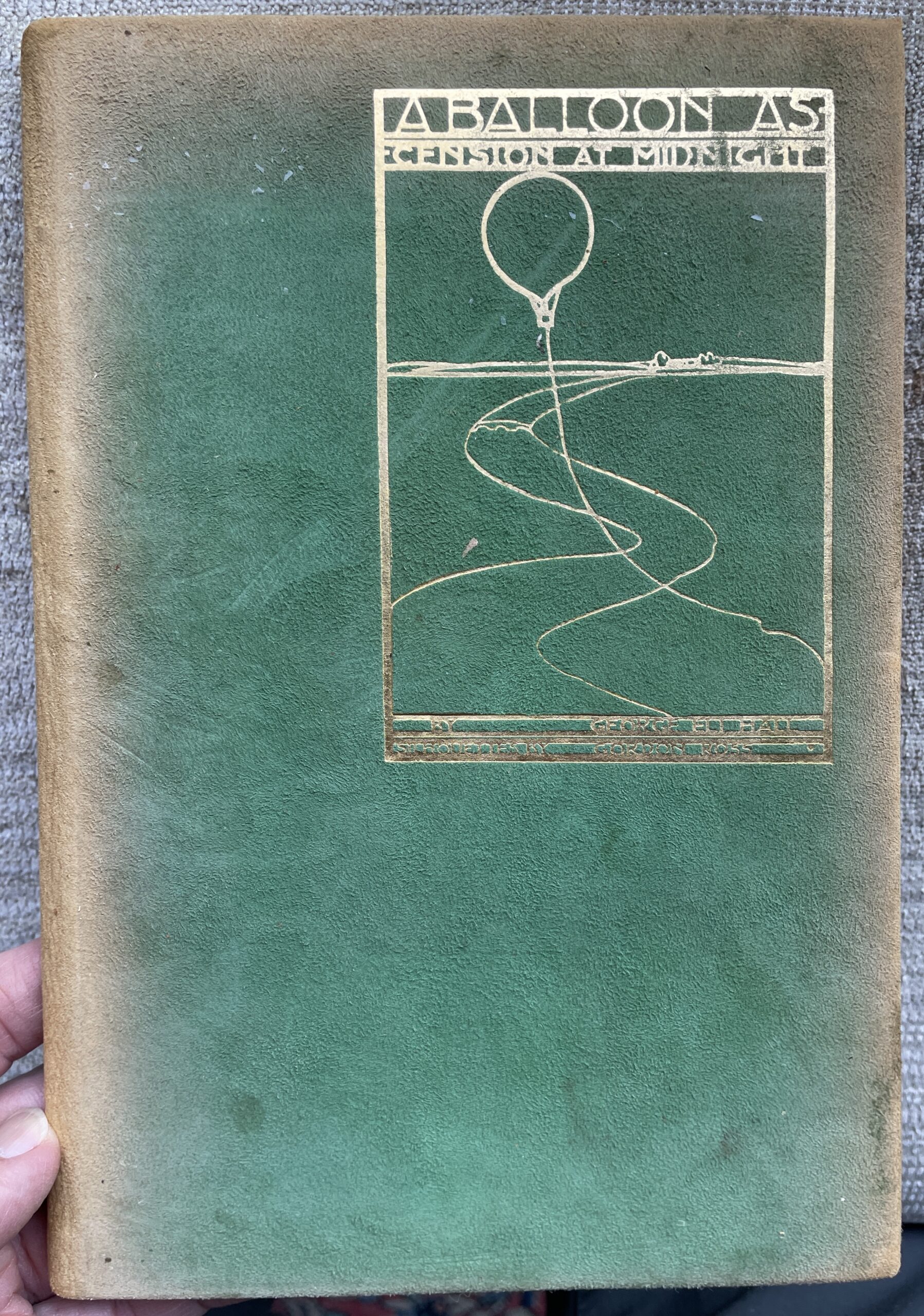
Cover of the deluxe edition of A Balloon Ascension at Midnight
It would have taken the pen of a Carlyle to describe our mysterious flight over Paris at midnight. The impression was so startling that for an hour we never spoke above a whisper…
The great boulevards roll out in every direction like ribbons of fire; we can hear, as we sail over them, the muffled rumbling of a thousand carriages, and we watch them as they dodge each other in their complicated course. A cry, a call, from time to time, reaches our ears; but the others are lost in the mighty silence above us.
At sunrise, they find they have drifted 80 kilometers over the French countryside. They make a scary landing near the village of Sens, as the balloon “bounds on several hundred feet, rolling like a huge football.” They are banged up and bruised, and their wine bottles are smashed, but they are alive and on dry land.
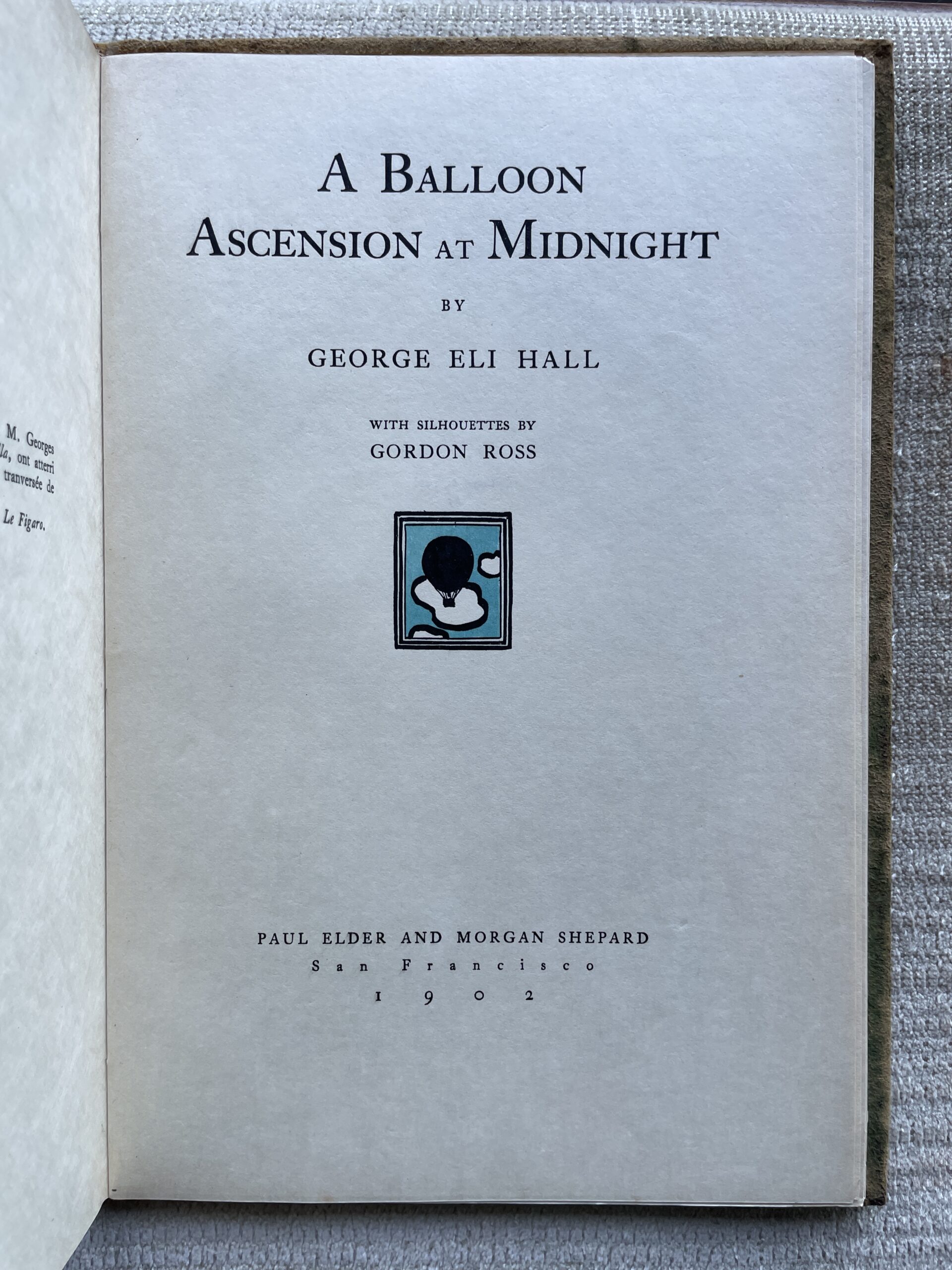
Title page of A Balloon Ascension at Midnight
Gordon Ross’s color illustrations, including several of Notre-Dame cathedral, immediately sweep the reader back to the Belle Epoque. The book was published in two bindings: paper on boards, and a deluxe edition with green suede with gold trim, printed on vellum.
George Eli Hall was born on 17 March 1863 in Nice, France, the son of Charles Olmstead Hall and Mary Abby Dale. His first occupation was agent and importer, but about 1895, he became the Consul General of Turkey and Persia in San Francisco. The job evidently included some danger and intrigue: on 8 November 1898, the San Francisco Call, in a note entitled “Lurking Death for Turkey’s Consul,” said that Hall “had been receiving anonymous packages for the past week containing high and deadly explosives. At first the matter did not seem of much consequence to him, but as these munitions of war continued to constitute a portion of his daily mail, he became apprehensive and reported the matter to Chief of Police Lees.”
In September 1907, Hall arrived in Lima, Peru, no longer a diplomat but working in the oil business. On 12 June 1910, Hall married a local Peruvian woman named Maria Elena Rafaela Ludowieg y Cantuarias. They apparently had one child, but George died of heart failure in Lima just seventeen months later on 28 November 1911, only 48 years old, and was buried in the Cementerio General.
Gordon Alfred Ross was born in Collessie, Fife, Scotland on 15 March 1872, the oldest of six children of Reverend Hugh Ross and his wife Isabella. In the 1891 Scottish Census, he is 19 years old and listed as an “apprentice lithographic artist.” He emigrated to San Francisco in 1894, and studied at the Mark Hopkins Institute. About 1899, he married Helen G. Beatie; their daughter Helen Campbell Ross was born in 1901. Gordon Ross worked at the San Francisco Chronicle art department until 1904, when the family moved to New York and he became a full-time book illustrator. Ross died in Manhattan on 26 December 1946.1https://www.bobforrestweb.co.uk/The_Rubaiyat/N_and_Q/Gordon_Ross/Gordon_Ross.htm
Updated 2026-01-25
Frontispiece of A Balloon Ascension at Midnight. The sculpture is the famous “Le Stryge” on the parapet of Notre-Dame cathedral.The balloon soars over the Arc du TriompheThe balloon catches in a tree as they try to land in the countryside