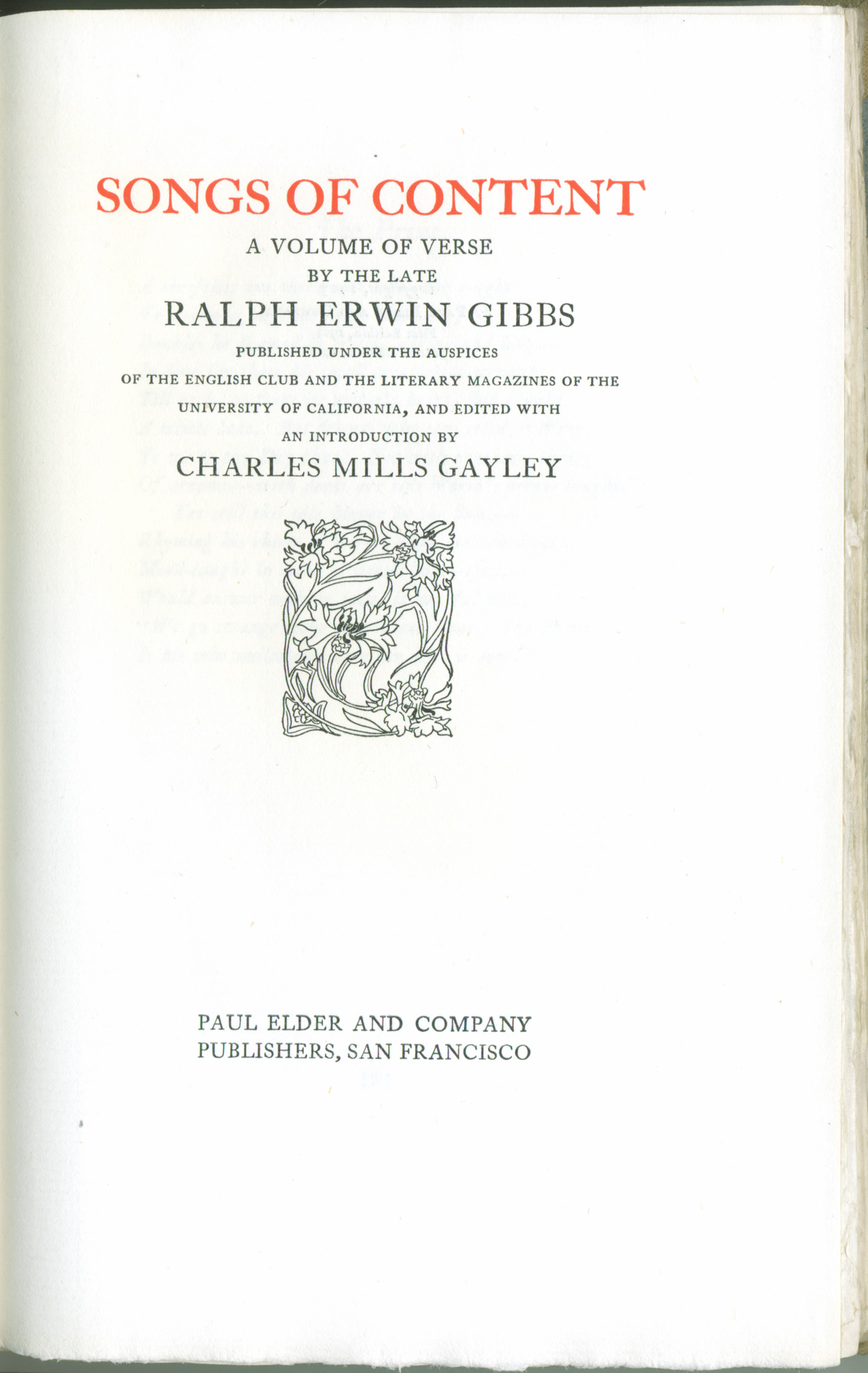
In April 1903, the young author Ralph Erwin Gibbs was at his desk in his study when he heard a loud crack: a tree was falling over in his yard. Knowing his pet dog was outside, he rushed outside to save it, but was himself killed by the falling tree. He was just 27 years old.
Gibbs was born in San Francisco on 22 March 1876 and attended public schools in Oakland. He graduated from the University of California in 1898, and continued on to earn a master’s degree in science in 1900. For some time, he had been writing stories and poems for two University publications, the Occident and the Magazine. He gradually became more interested in literature and poetry, and soon turned to writing full-time. In 1900, he became an assistant at the University Library and in the English department, where he became a protégé of Charles Mills Gayley (1858-1932), professor of Classics and English (and for whom Gayley Road on the UC campus is named). After Gibbs’s death, Gayley received the family’s permission to gather up the manuscripts and publish them as Songs of Content. In his moving introduction to Gibbs and his poetry, Gayley wrote:

I had not worked deep into his manuscripts before the conviction came that not to have preserved the best of them for the public would have been no mere mistake, but an injustice. Of his lyrics the more beautiful, and of his poems of life and death the more seriously considered, deserve an honorable place in the estimation of Californians. If my interest in the author does not deceive me, they will win their way not only where promise untimely stricken is deplored but where the comfort and the grace of art are for their own sakes welcomed.
Elder published a second edition in 1911, with the identical text but higher-quality binding and imported laid paper. Such a second edition was very unusual for Elder; the only other example is Charles Keeler’s Bird Notes Afield.
Updated 2026-01-18