
Pick up a book that was sold at Paul Elder’s bookshop, and open to the inside back cover. Quite often, in the lower-left corner, you will find—for want of a better term—a “postage stamp.” The size of an actual postage stamp and moistened in the same manner, they were affixed to all books sold in the shop, not just Elder’s own publications. The practice seems to have been far from universal, though, because it’s common to find Elders without stamps in the back. The stamps were probably affixed by the salesman while wrapping up the book.
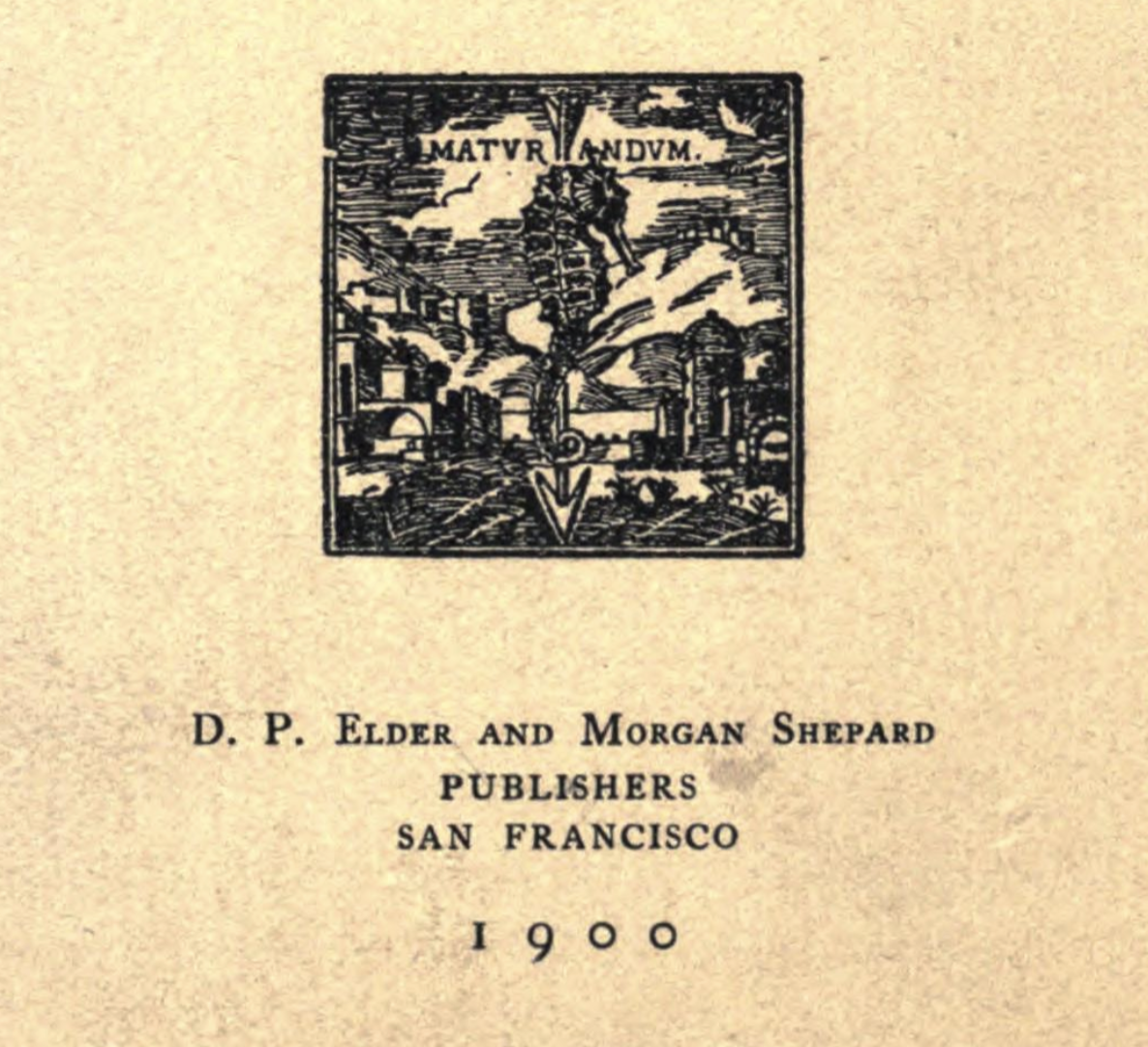
The earliest known stamp (A) dates from 1899, before Elder and Shepard began to use the tomoye. At this time, Elder was still calling himself “D. P. Elder.” The significance to Elder & Shepard of the seahorse-and-arrow design is unknown, but an interesting variant appears on the title page of Charles Ferguson’s Religion of Democracy, checklist #258. A seahorse appears over a vertical arrow, but with a village scene in the background and the motto “Maturandum” printed above. Literally, maturandum is Latin neuter singular gerundive of maturo and means for “that which is to be matured,” or “something requiring haste or maturing,” but is often coloquially rendered as “carefully” or “cautiously.”
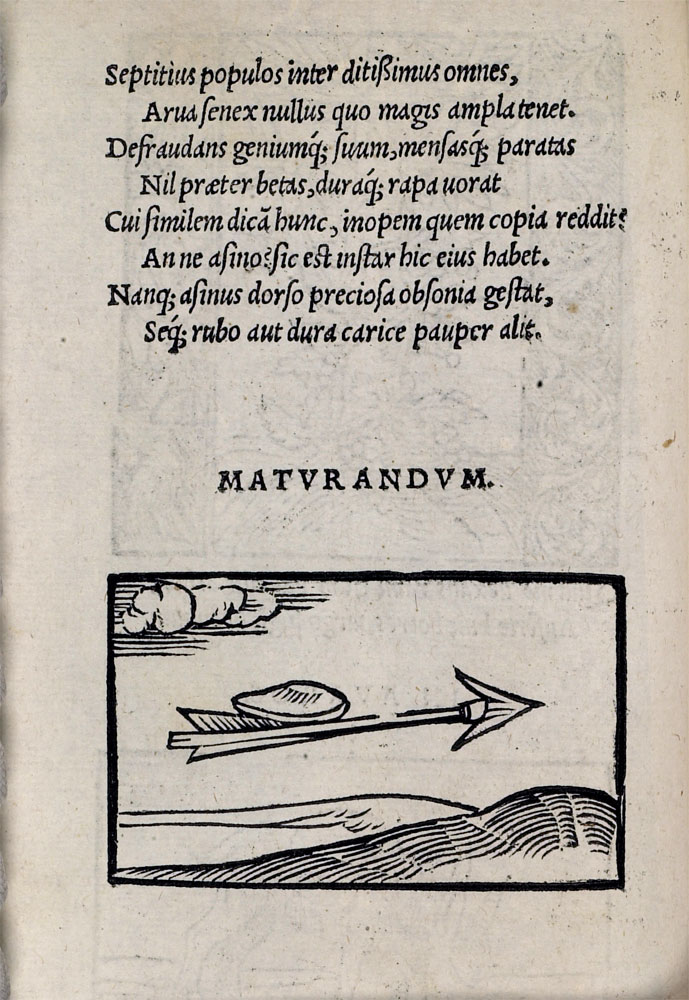
The image may ultimately derive from Emblematum liber, a book of emblems published in Augsburg, Germany in 1531. Here a mollusc is shown on a flying arrow with the text:
Maturare iubent propere et cunctarier omnes
Ne nimium praeceps neu mora longa nimis
Hoc tibi declaret connexum echneide telum
Haec tarda est, volitant spicula missa manu.
…which translates as: “Everyone tells us to deal with things quickly, but they also tell us to hold back – not to be impetuous, nor yet to wait too long. A missile linked with a sucking-fish can demonstrate this for you: the fish is slow, but arrows fly fast when they leave the shooter’s hand.”
In any case, the seahorse-on-arrow era did not last very long. Elder and Shepard switched to the tomoye design in February 1900, principally on the title pages of their books and Impressions magazine. The earliest known example of the first tomoye stamp (B) is from 1901.
Stamp C dates from 1902, when Elder began calling himself “Paul Elder.” This stamp was discovered in 2023 and is known from just this one example.
The San Francisco stamp had two variants, which I’m calling D1 and D2. I have seen only one example of D1 and assume therefore that it is the earlier of the two. The Santa Barbara branch bookstore (E) also had its own stamp. It’s possible, though unlikely, that the New York store had had a stamp, as one has never been found.
Stamp F, featuring a tomoye surrounded by delicate tracery, had the longest lifespan; it has been seen as early as 1911 and as late as 1946.

By the 1950s, much had changed. Paul Sr. died in 1948, and Paul Jr. moved the bookstore to the corner of Sutter & Stockton. The company now used self-adhesive stickers (G) with a decidedly modern look to match the decidedly modern store.
Updated 2026-03-27