Behind the Garden Wall

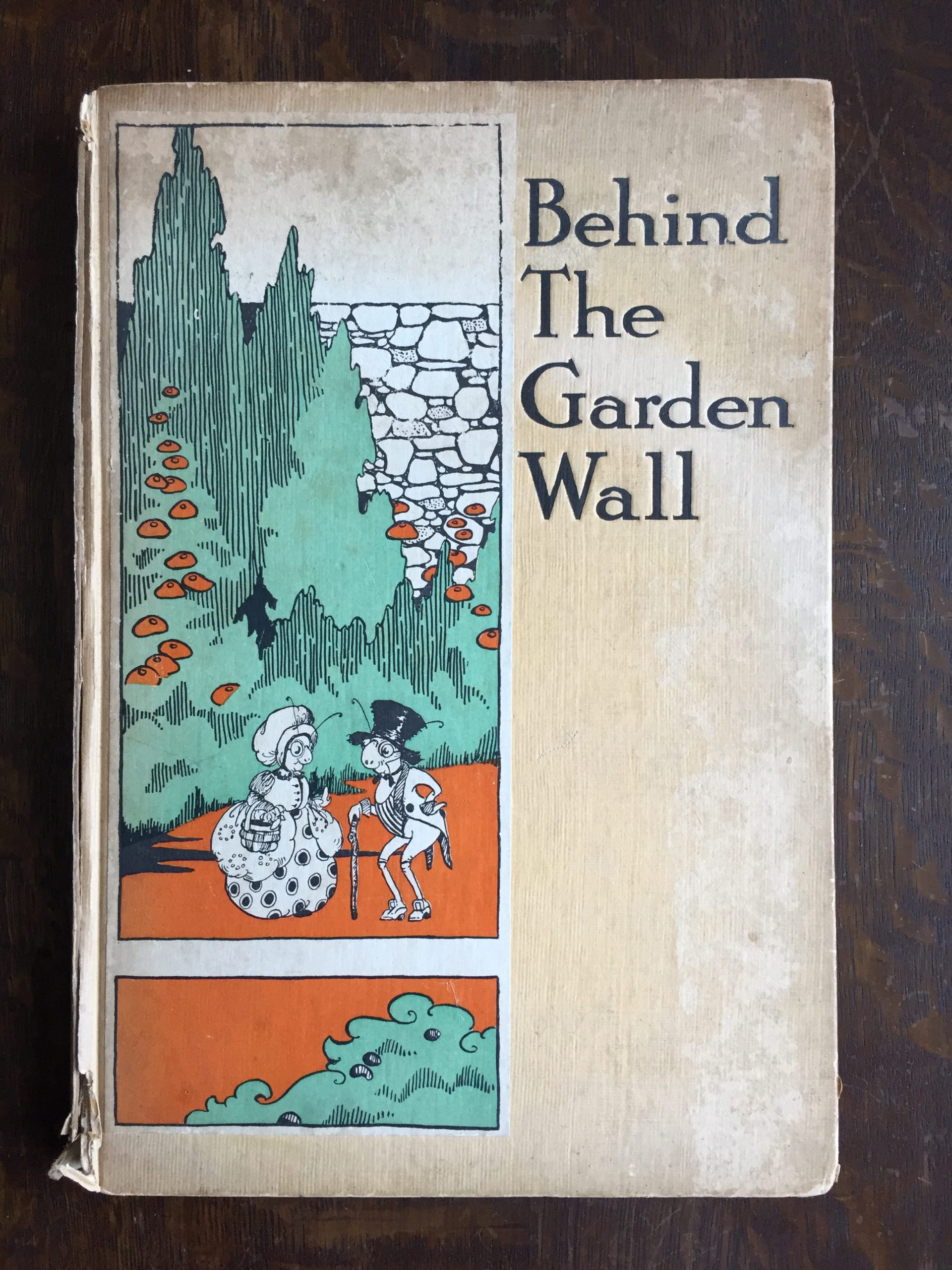
Cover of Behind the Garden Wall

It is 1912, and a lonely woman in Vermont illustrates children’s books to take her mind off a stifling marriage. Three years later, she is an impoverished single mother, working as a mucker alongside grimy men in a lonely gold mine in the Sierra foothills. Three years after that, she is a nationally-known columnist and the highest-paid woman in the Hearst newspapers.

Who was this remarkable woman? The life story of journalist, artist, and memoirist Elsie Robinson is finally being told in full, thanks to the marvelous 2022 biography Listen, World!, by Julia Scheeres and Allison Gilbert. Our spotlight book today, one of Elder’s best children’s stories, has a small part in that tale.

Behind the Garden Wall is a delightful children’s book, with verses by Robert Wallace and illustrations by Elsie Robinson. Her artwork is replete with all manners of animals: geese, crows, rabbits, mice, guitar-playing frogs, dancing beetles, even mosquitos. Printed in three colors, it would still be a perfect book, 110 years after publication, to read to a young child.
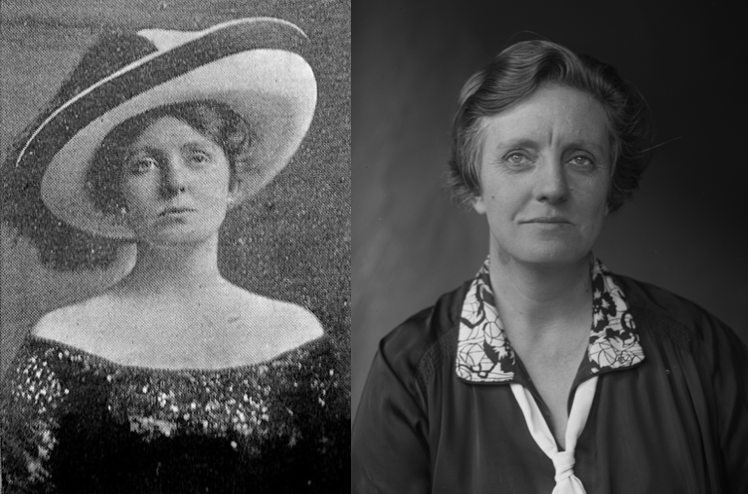
Left: Elsie Robinson Crowell about 1912, when Behind the Garden Wall was published. Right: Elsie circa 1940, when she was a famous columnist.

Elsinore Justinia Robinson was born in 1883 in Benicia, California. Thirty years before, Benicia had briefly been the California state capitol—the old capitol building still stands—but by 1883 it had become a ‘frontier town’ with saloons and bordellos. When Elsie was nineteen, she met a visiting easterner named Christie Burnham Crowell, ten years her senior.1This and other biographical details are from Listen World!, by Julia Scheeres and Allison Gilbert, Seal Press, 2022

Elsie was eager to escape into the wider world, and Christie was on the rebound from the death of his first wife from an abdominal tumor at the age of 24. Their long courtship was spent convincing Christie’s parents to agree to the marriage: the devout Crowells thought her a sloppy, emotional teenager, completely unable to run a New England household. The Crowells finally agreed on the condition that Elsie spend a year at a nearby boarding school, where she would learn manners, household management, and the Bible. Elsie and Christie were married in his home town in Brattleboro, Vermont, and she gave birth to their son George in 1904. But George’s birth did not improve their marriage. When George developed asthma, Elsie pleaded to move to a warmer client for his health, but Christie refused. Elsie now realized that she was trapped: Christie would always be loyal to his parents first.
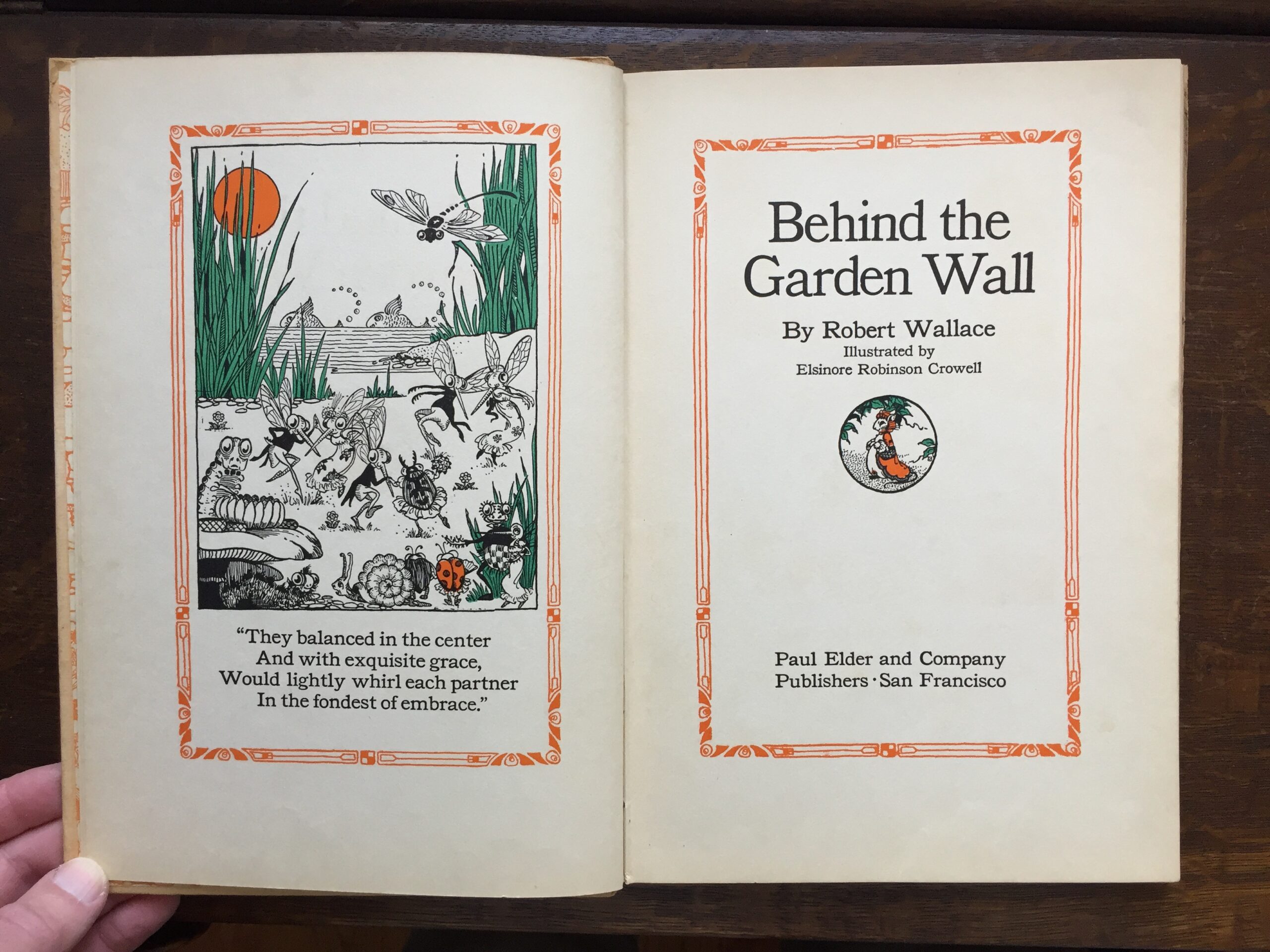
Frontispiece and title page of Behind the Garden Wall

Elsie proceeded to put all her emotional energy into raising George, who was often home sick from school. She kept many children’s magazines at his bedside, including a brand-new title that would become his favorite: John Martin’s Letters. It was published by none other than Morgan Shepard, now living back in his home town of New York City after his years with Paul Elder in San Francisco. Elsie also began writing her own stories for George, and illustrated them with children and animals. She screwed up the courage to write to Shepard, asking whether her stories might be good enough to publish. She was astonished when Shepard replied, saying that yes, he’d very much like to publish her story, and more like it. Elsie began to write regularly for John Martin’s Letters in 1911 under the pseudonym “Comfy Lady.”
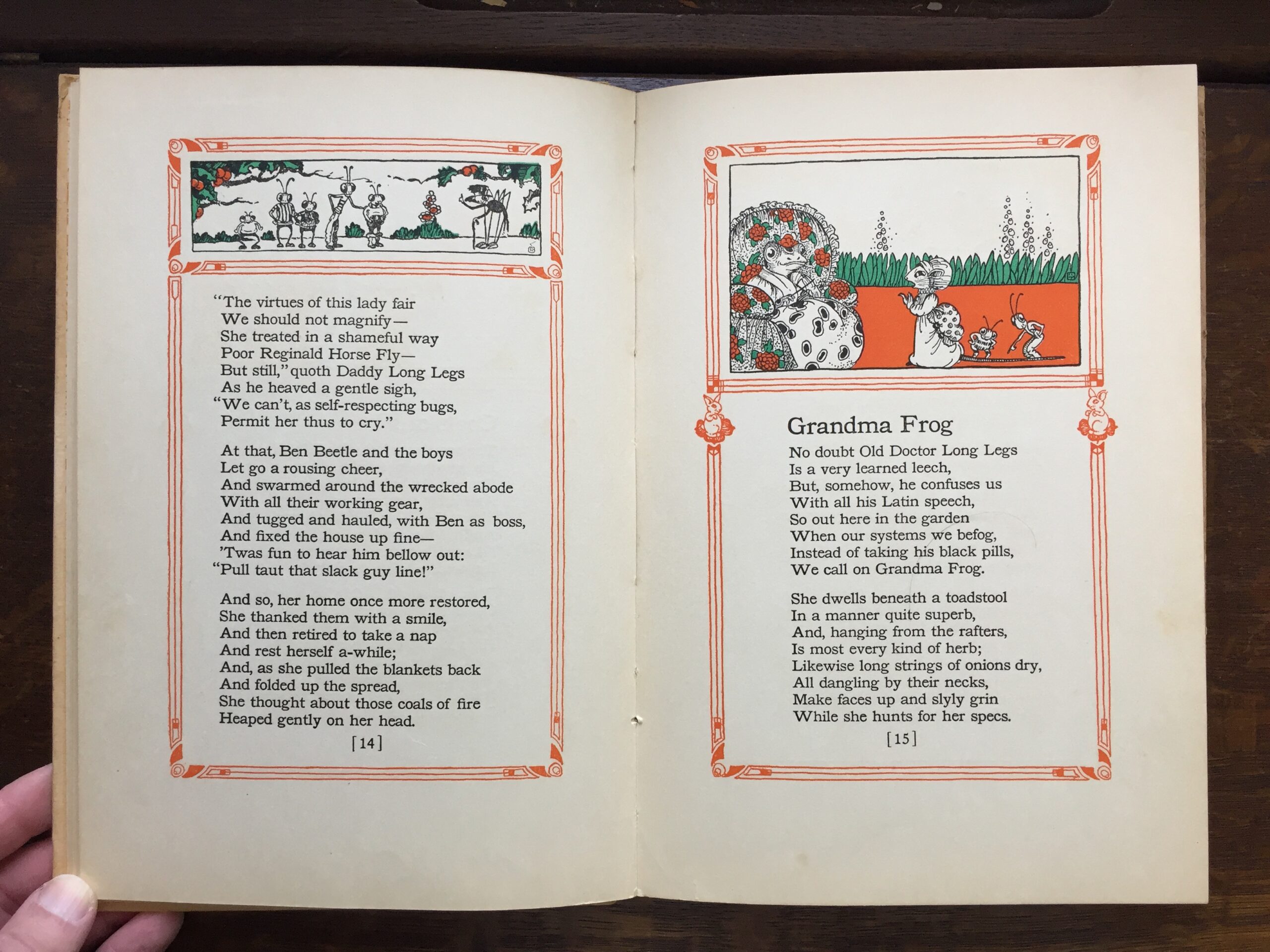
Pages 14-15 of Behind the Garden Wall

In 1912, Elsie was contacted by Robert Wallace, an inmate at the Brattleboro Retreat, a former insane asylum. He was trying to cure his alcoholism, in part by writing children’s stories, and he was looking for an illustrator. Elsie visited him at the Retreat, and they began working on a book together, which would become Behind the Garden Wall.

Elsie and Robert realized that they attracted to each other. They were also both married to people who paid little attention to them. As the book neared completion, they devised an escape plan. Robert wanted to get out of the asylum, and Elsie could file a petition to be a guardian. Elsie wanted to return to California, both for her son’s health and for her own sanity. Robert casually proposed a trip to California over a chess game with Christie, Elsie and George coming along to visit her family in Benicia. Christie agreed, oblivious of their scheme. Within a few weeks, Elsie, George, and Robert were on a train to California, never to return. Eventually, it became clear to Christie that Robert and Elsie were living together, and he initiated divorce proceedings. But for more on Elsie’s life story, you’ll need to read Listen, World!
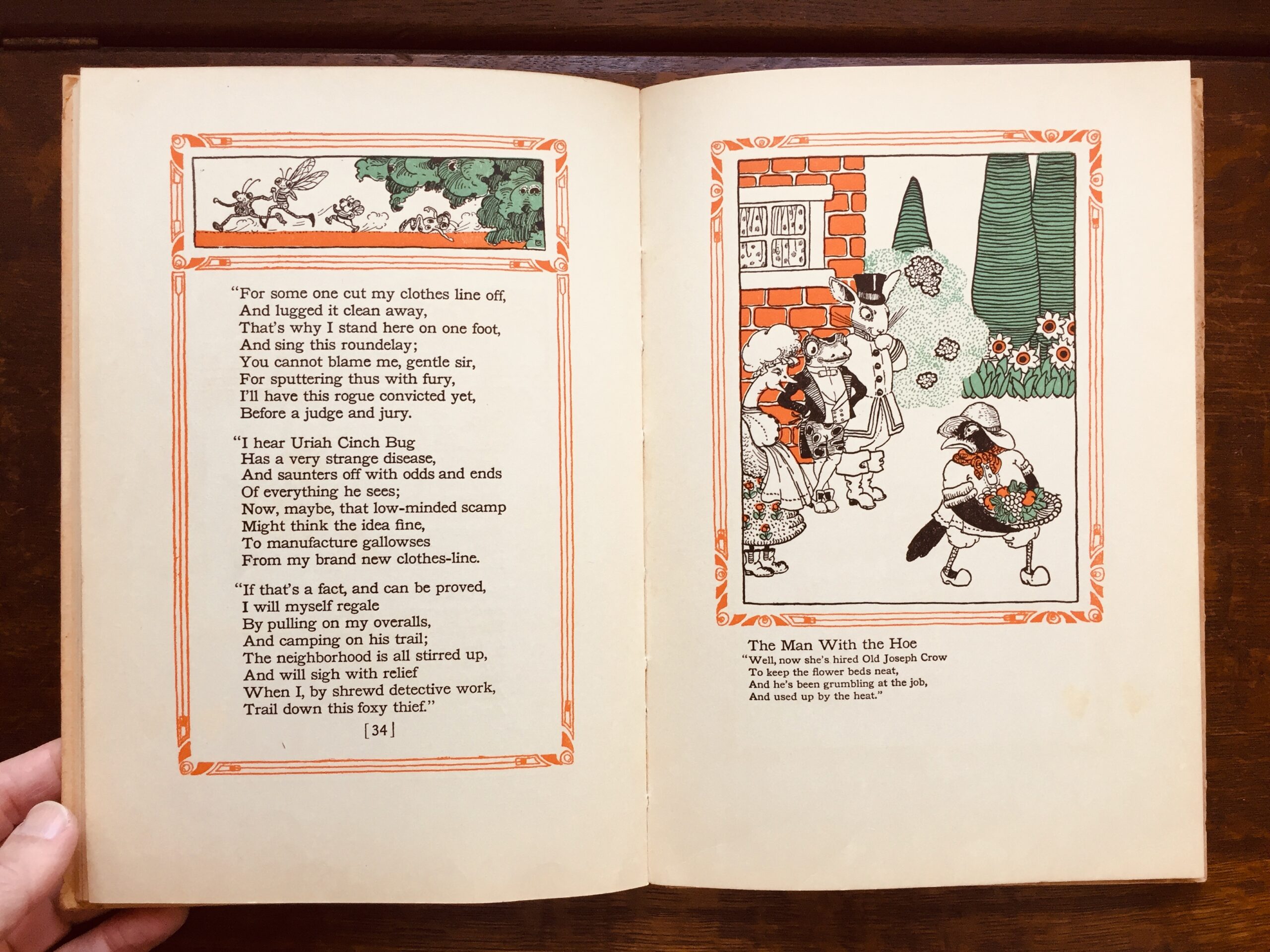
Pages 34-35 of Behind the Garden Wall

It’s unknown why Paul Elder ended up publishing Behind the Garden Wall, but the most likely scenario is that Morgan Shepard referred Elsie to Elder, knowing that Elder had the means to properly publish and market the book. Once in California, Elsie and Robert wrote another children’s book, Within the Deep Dark Woods, published later in 1913, but by Blair-Murdock, not Paul Elder. Perhaps Morgan Shepard referred Elsie to both publishers and they agreed to do one book with each?
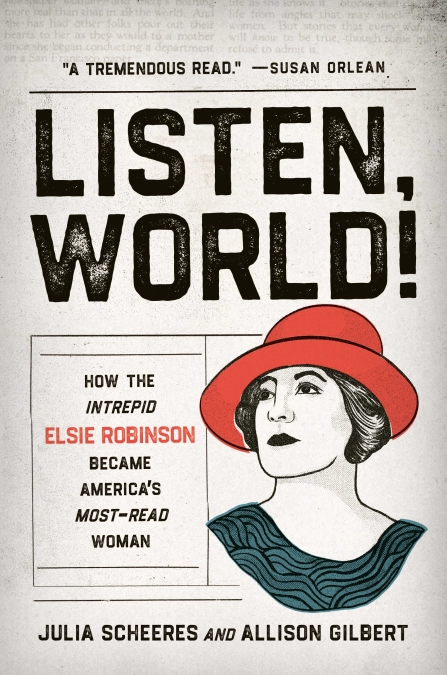


Cover of “Listen, World!” the new biography of Elsie Robinson by Julia Scheeres and Allison Gilbert


  • 1
    This and other biographical details are from Listen World!, by Julia Scheeres and Allison Gilbert, Seal Press, 2022

Paul Elder’s Book Forum

The debut column, 5 January 1970

In October 1968, Paul Elder Jr. sold the 70-year-old family business to Brentano’s. The bookstore, however, remained open under the Paul Elder name for another 14 months, closing for good on 29 December 1969. Be it by chance or design, just two days later—New Year’s Day 1970—the San Francisco Examiner announced a new column:

More than 30,000 new books are published each year. No one can read them all, or would want to. then how can you find out about the new books you do want to read and own? Use the Reading Man’s Filter: Paul Elder’s Book Forum. …

“The Forum” will be guided by a man whose name has long been a synonym for books in San Francisco. Until recently, Paul Elder owned and operated one of the country’s leading bookstores. He has bought and sold millions of books. No one in the country has a better idea of what Northern Californians look for in books, because for 40 years that was his business. Now this distinguished bookman will share with you his instinctive awareness of the books which has appeal to the varied tastes and interests of Examiner readers.1San Francisco Examiner, 1 January 1970, p57

Paul Elder’s Book Forum of 14 January 1970, opposite a Sydney J. Harris column on women journalists

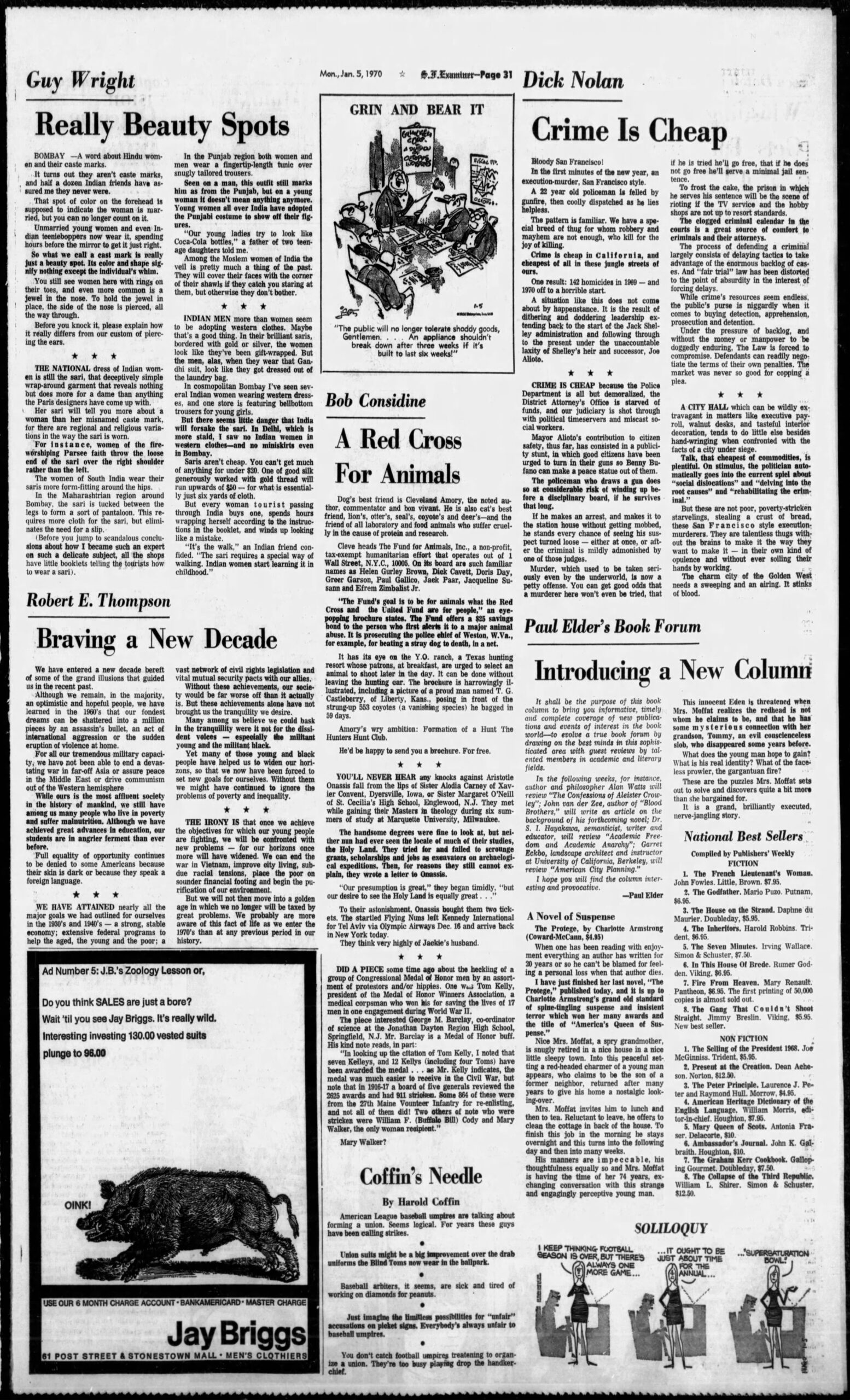
“Paul Elder’s Book Forum” debuted on 5 January 1970 opposite the newspaper editorials, and alongside the regular Examiner columnists such as Guy Wright, Sydney J. Harris, Bob Considine, and Dick Nolan. The debut column began with this introduction:

It shall be the purpose of this book column to bring you informative, timely and complete coverage of new publications and events of interest in the book world—to evolve a true book forum by drawing on the best minds in this sophisticated area with guest reviews by talented members in academic and literary fields.

Elder then warmly reviewed Charlotte Armstrong’s suspense novel The Protege, saying “when one has been reading with enjoyment everything an author has written for 20 years or so, he can’t be blamed for feeling a personal loss when that author dies.” Armstrong had passed away six months earlier at the age of 64. Over the following weeks and months, the column’s book reviews covered a wide range of topics, including art, politics, public school integration, ancient Rome, celebrities, dictionaries, civic planning, and famous criminal cases.

Equally illuminating, in your editor’s opinion, are the other columns on the page. To give just one example: on 14 January 1970, running opposite Elder’s column reviewing an account of the ordeal of the crew of the captured spy ship USS Pueblo, is a piece by Sydney J. Harris applauding Sigma Delta Chi’s (the national journalism society) long-overdue decision to admit women as members. Harris notes in particular that women “understand men far better than other men do; the best interviews I have read have been conducted by women, with devastating accuracy.” He calls out Gloria Steinem as one of several women who “have proved that politics, city planning, transportation, and the other ‘heavy’ subjects of urban life can be dealt with as dexterously and insightfully (if not more so) by women as by men.”

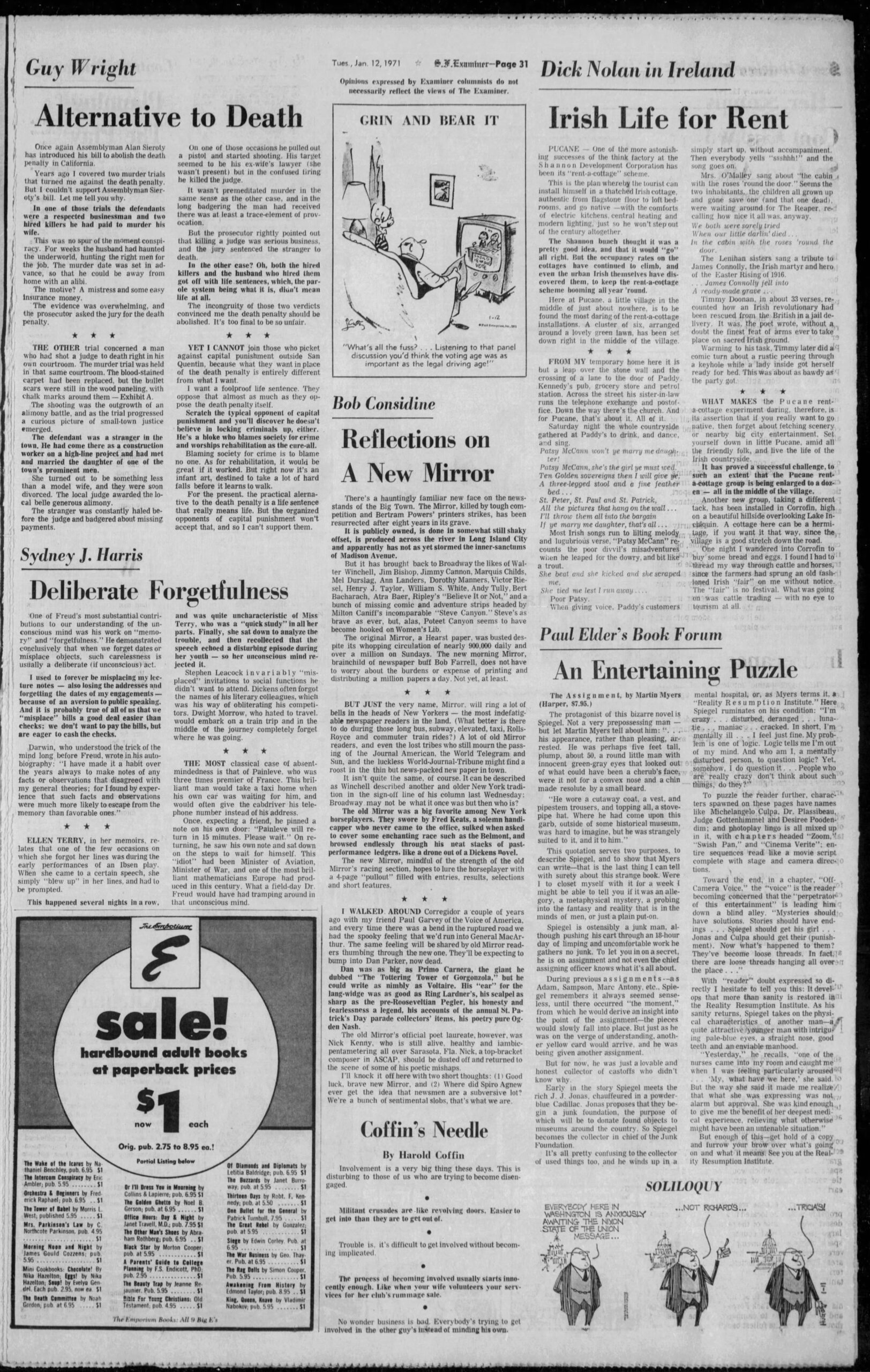
The final installment, 12 January 1971

Presumably, Paul Elder’s column was a popular one. The Examiner published several letters to the editor in praise of the Forum:

The new column “Paul Elder’s Book Forum” is most interesting. I am grateful for the objective and unbiased articles prepared by Paul Elder who is obviously well informed regarding books… It is refreshing to read a real expert. (Holly Talley, San Francisco) 2San Francisco Examiner, 5 February 1970, p30

Even though I am blind, I am enjoying Paul Elder’s Book Forum very much. My husband reads it to me every evening as he reads the paper to me. It is so good to have someone with whom to discuss books and I have truly missed this since I lost my sight seven years ago. Thanks again. (Mrs. M. Orr, San Francisco) 3San Francisco Examiner, 9 February 1970, p28

I miss Paul Elder’s as I miss Newbegin’s, but I am happy to see the Elder column in the Examiner. (Marshall Dill, Jr., San Francisco) 4San Francisco Examiner, 7 June 1970, p32

Paul Elder’s Book Forum ran for just over one year, totaling 321 installments. His final column appeared on 12 January 1971, though there was no indication that it would be Elder’s final review. Beginning the next day, the book review department continued on as the “Examiner Book Forum,” featuring a review from a syndicated service called “Book World.”

We can only speculate why Elder’s participation in the Book Forum ended so abruptly, without a published explanation. The simplest explanation is that, after 321 columns, Elder just wanted to move on to his next project. Less likely, there could have been an unpleasant disagreement with the newspaper, forcing the Examiner to scramble for a syndicated column rather than a local reviewer. However, until the end of its run in late 1973, the Examiner Book Forum continued to publish only syndicated reviews from Book World, so perhaps syndication was always the plan once Elder decided to end his participation.


Updated 2026-06-29

  • 1
    San Francisco Examiner, 1 January 1970, p57
  • 2
    San Francisco Examiner, 5 February 1970, p30
  • 3
    San Francisco Examiner, 9 February 1970, p28
  • 4
    San Francisco Examiner, 7 June 1970, p32