Question: of the 400+ books that Paul Elder published, which one sold the most copies?
The surprising answer is Wallace Irwin’s Love Sonnets of a Hoodlum. First published in 1901, this slim volume of jaunty verse remained in print at least through 1907. Fellow San Francisco humorist Gelett Burgess (of “Purple Cow” fame) added a mock scholarly introduction. The reviews were lukewarm, particularly of Burgess’s introduction, but sales were like nothing Elder had ever seen. Between November 1901 and March 1902 alone, The Love Sonnets of a Hoodlum sold 12,000 copies.1San Francisco Chronicle, February 23, 1902, p4
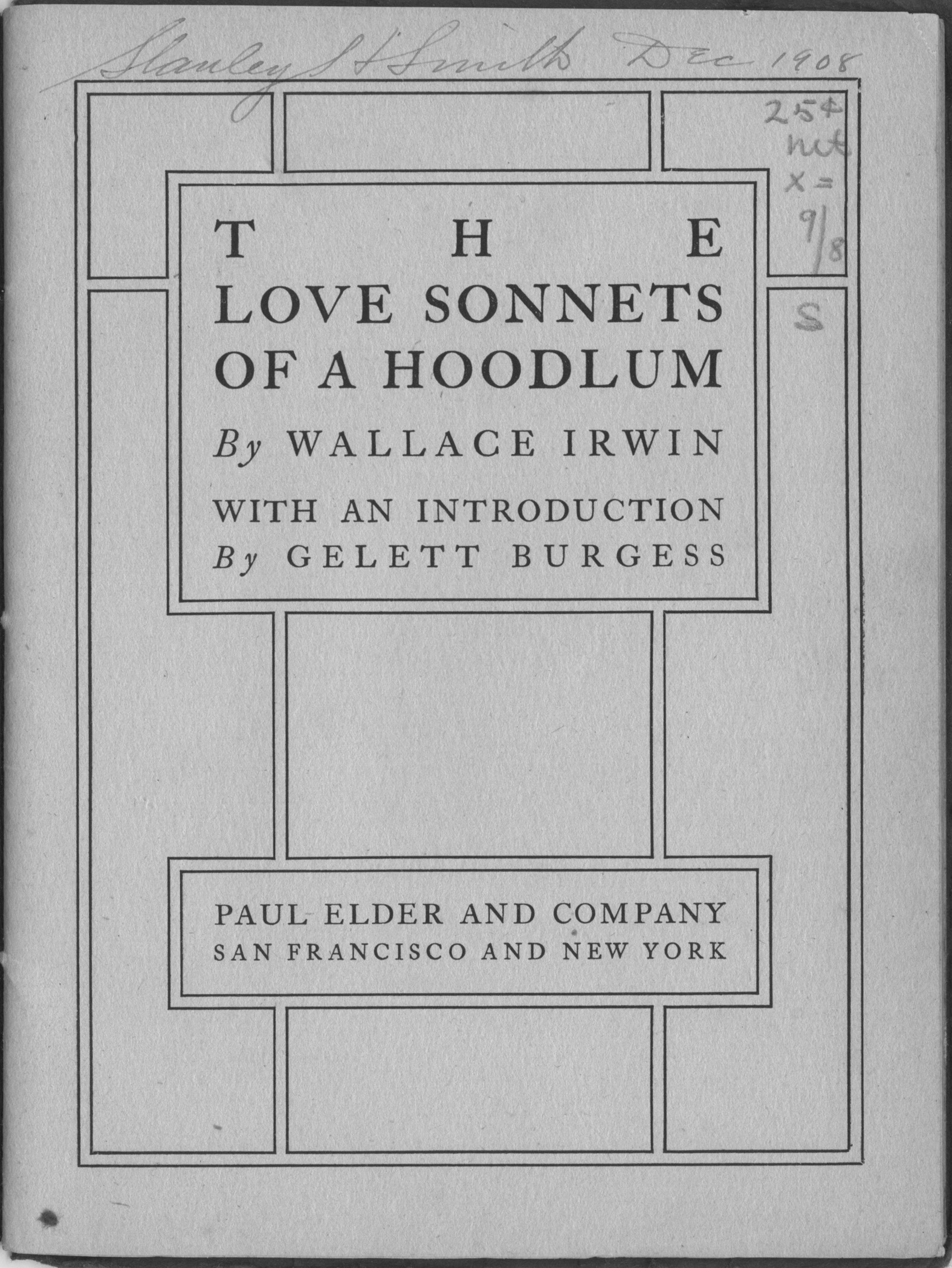
Wallace Irwin (1875-1959) was a well-known humorist in the early 1900s. Born in Oneida, New York and raised in Colorado, Irwin attended Stanford University where he edited two humor magazines, but was expelled for writing satirical poetry about the faculty. Afterwards, Irwin wrote for the Overland Monthly and San Francisco Examiner, and hung out with the local bohemian crowd. (Getting kicked out of a university seems to have been a requirement for local humorists: in 1894, Gelett Burgess was fired by UC Berkeley after pulling down a statue of pro-temperance campaigner Henry Cogswell. Burgess clearly saw a kindred soul in Irwin.)
For a book that sold so well, its creation was almost an accident. In his memoir, Irwin wrote that Burgess was looking through Irwin’s papers one day and noticed a slang sonnet written some years before. Burgess said, “It would be fun to make that part of a classic sonnet cycle, such as Petrarch wrote.”2Wallace Irwin, “I Look at Me,” typed manuscript, 132–33. Wallace Irwin papers, Bancroft Library, University of California, Berkeley. Irwin continued:
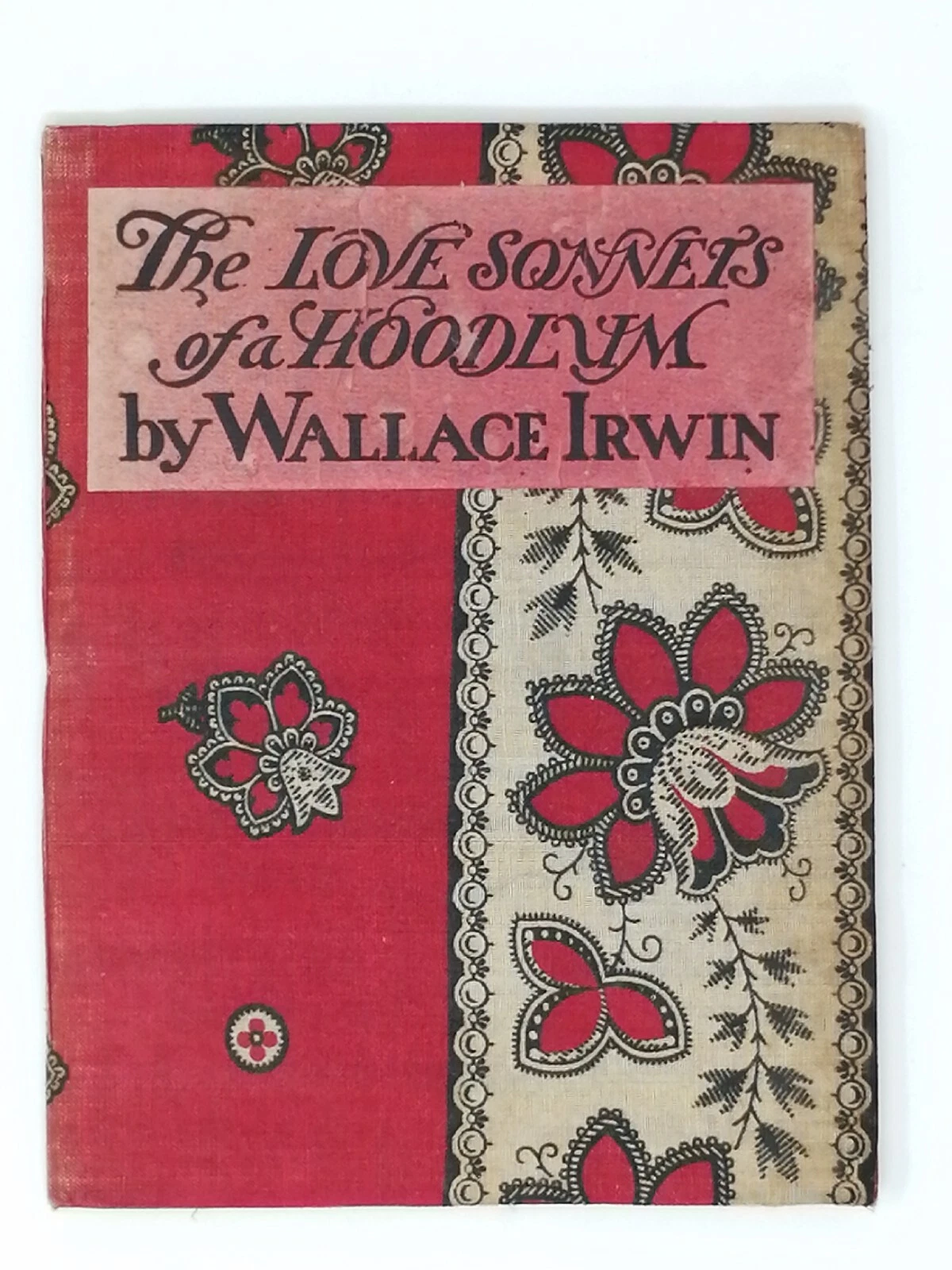
[The sonnets] rippled off the typewriter with no intention of being more than a literary prank. Burgess was generous enough to write the introduction, a mockpedantic essay in highly styled English. My neighbor Morgan Shepard and his partner Paul Elder recklessly offered to publish it as a sort of a gay pamphlet with a sale price of 25 cents. Its lacquer red paper cover featured the gentle cynicism “Showing how Vanity is still on deck / And humble Virtue gets it in the neck.” The bargain price contributed to its popularity, no doubt. A stingy first edition leaped toward more and larger editions so that the callow author was struck dumb by the prodigy. Reviewers were praising it all over the country. . . . And the sales went up to 130,000.
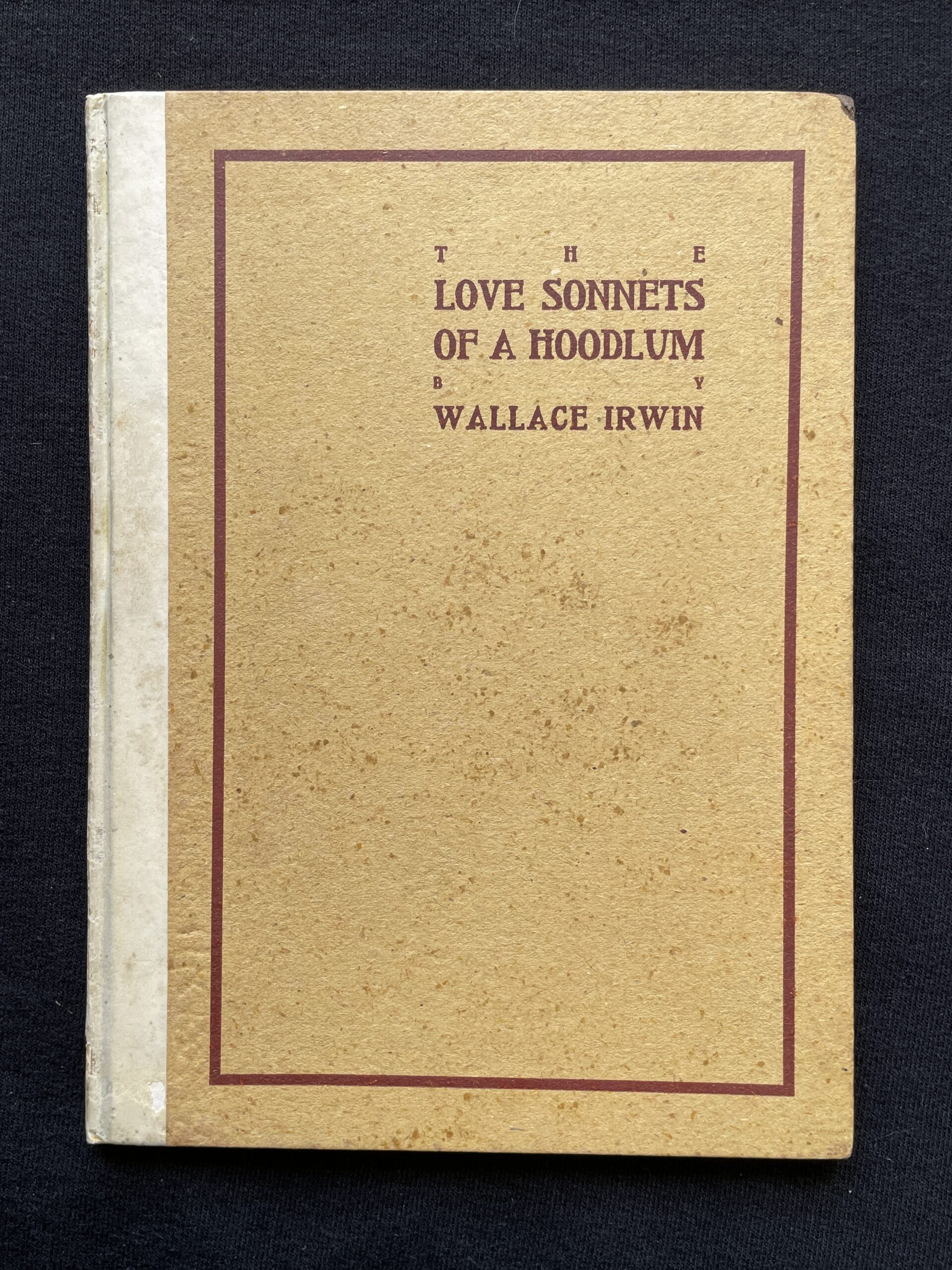
The Love Sonnets of a Hoodlum appeared in both red paper wraps and colorful fabric wraps. Ten fabric-covered examples have been seen so far, all different, and all (with one exception) made with bright white-and-red fabrics similar to the one shown on this page. There was also an autograph edition of 100 copies, in paper over boards.
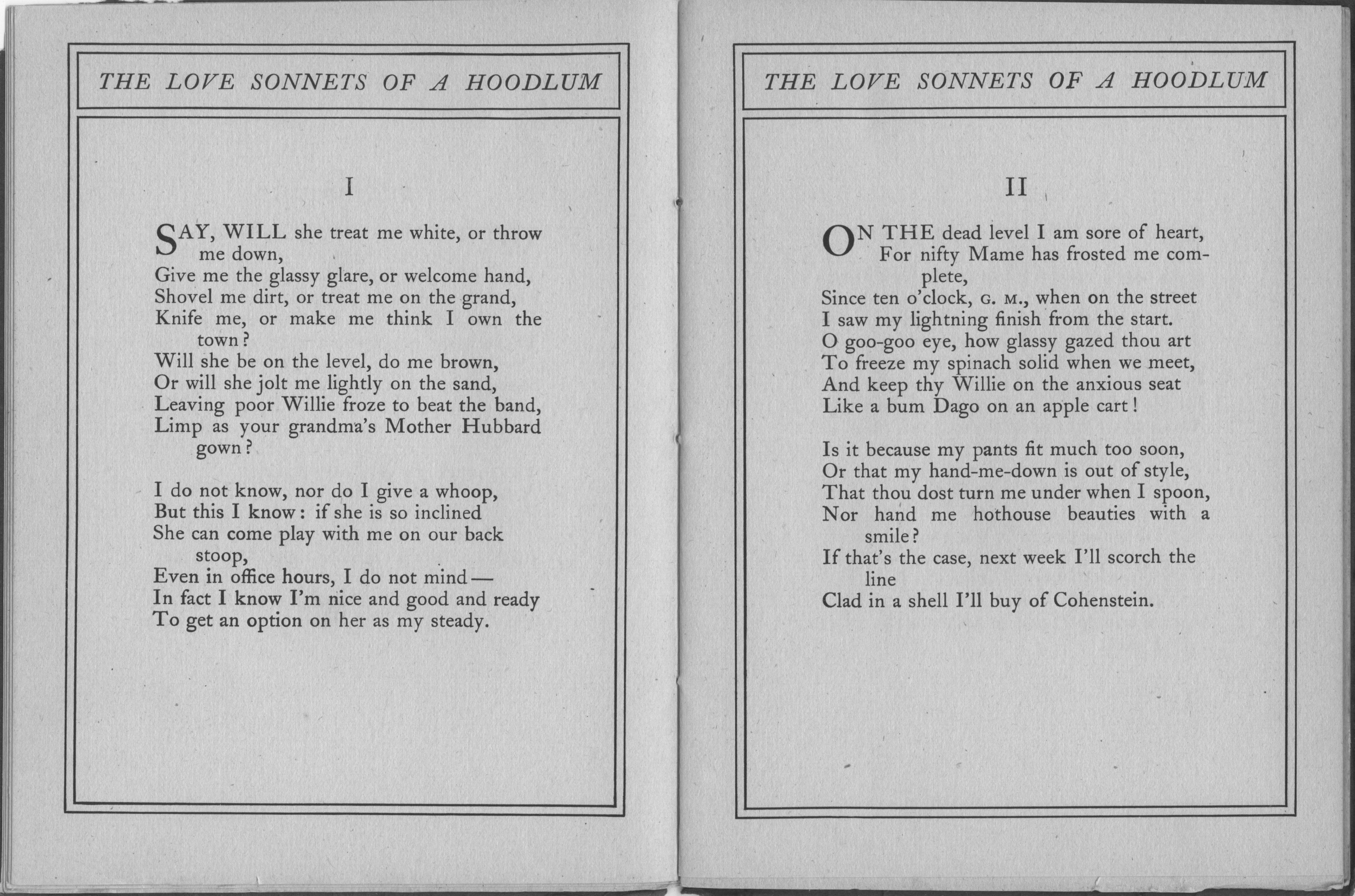
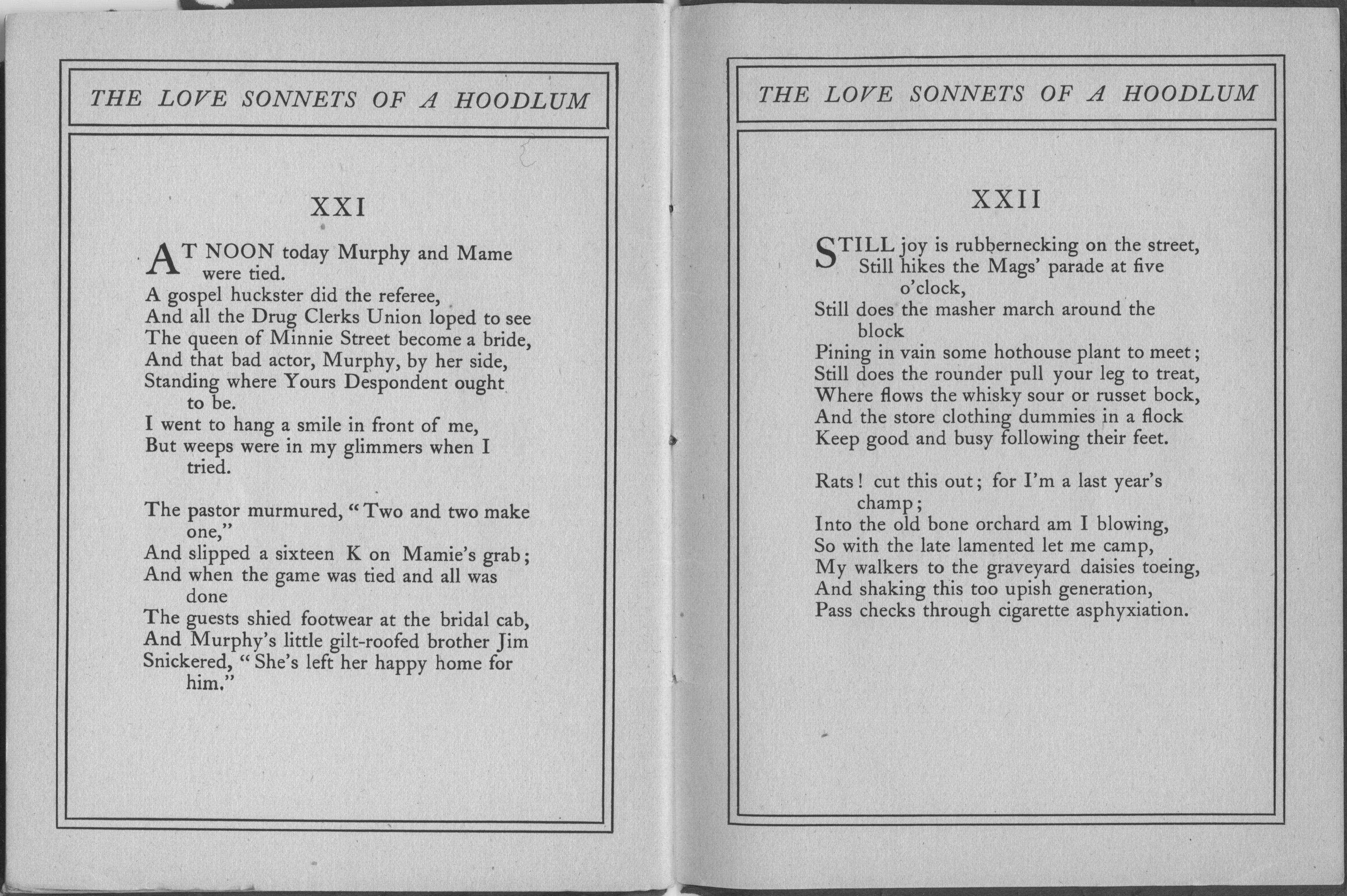
Irwin’s humor has not aged well. In Love Sonnets of a Hoodlum, our hoodlum hero fancies a lady and attempts to win her favor, but neither Irwin’s slang nor his references will be familiar to today’s readers.
Most disturbing to modern sensibilities, however, is Irwin’s racial humor. In Sonnet II below, he caricatures both Italians (“Dago”) and Jews (“Cohenstein”). More was to come: in 1907 Irwin began a long serial for Colliers magazine purporting to be the letters of a 35-year-old Japanese “boy,” going so far as to call the fourth volume Yellow Peril, and posing for the cover photograph himself in yellow makeup.
Irwin wrote many other works, including the 1935 novel The Julius Caesar Murder Case, which is generally credited as the first mystery novel set in antiquity.
Updated 2026-01-19