In Japanese mythology and folklore, Ebisu (恵比須) is the Japanese god of fishermen, workingmen and good luck, and is one of the Seven Gods of Fortune. Although slightly lame and deaf, he is happy and auspicious. He is often displayed with Daikokuten and Fukurokuju, two more of the Seven Gods of Fortune, in shopkeeper windows.
Paul Elder published this doggerel about Ebisu exactly 100 years ago, as a greeting for the Christmas season of 1910. It is a large format piece—25″ wide—that folds in thirds to a 8.5 x 10″ finished size. Cutouts reveal photographs of the front and back of a pottery Ebisu figure. It’s unclear whether Elder also sold the figurines along with the greeting.
The poet was William O’Connell McGeehan (1879-1933) a sportswriter and editor of the New York Herald Tribune. He wrote primarily about boxing (which he euphemistically called “the manly art of modified murder” or “The Cauliflower Industry”). The Herald Tribune sent McGeehan to Dayton, Tennessee in 1925 to cover the famous John Scopes trial, no doubt sensing a metaphorical boxing match between the attorneys Clarence Darrow and William Jennings Bryan. McGeehan had written Ebisu long before, while he and his wife, journalist and playwright Sophie Treadwell, were still reporters for newspapers in San Francisco.
Update 18 August 2025: In March of this year, I announced here that I had decided to upgrade Ebisu from ‘ephemera’ to ‘checklist’ status, but I have changed my mind. It’s clearly listed in Elder’s 1910 Pleasant Pages catalog in the “Greetings and Decorations” section under “Miscellaneous” (page 56). There are one or two other ephemeral items that I listed in the checklist back in 1999 when I knew much less about the items, and while it’s too late to remove those now, I shouldn’t compound the problem by adding more ephemera to the checklist.
Title page of “Ebisu”Page 2 of EbisuW. O. McGeehan’s poem “Ebisu”Ebisu sculpture, with more poetryBack of Ebisu sculpture, with more poetry
Paul Elder frequently called upon artist Harold Sichel to illustrate ephemera. Elder was quite fond of the genre where an inspirational quote from English literature was centered within a floral or nautical scene. These small Miniature Leaflets, all illustrated by Sichel, were about 4″ x 2-1/2″, and were issued beginning in 1905 until at least 1909. They were probably only sold in sets, complete with their own box. Too small to be proper greeting cards, I imagine they were intended as a card you would attach to a gift-wrapped present.
Miniature Leaflets #4, #3 and #1 (1905)Miniature Leaflets #10 (1908) and #18 (1909)Miniature Leaflets box
Paul Elder published this beautiful booklet during the 1915 Panama-Pacific International Exposition. It’s a real gem, with striking full-color drawings by Audley B. Wells, sold with a matching envelope.
Perhaps only after admiring the booklet do we notice the poem it contains, California, by Fred Emerson Brooks (1850-1923). Though Brooks and his poetry have been forgotten, he was very popular a century ago as a writer and speaker. Modesty, it would seem, was not one of Brooks’s character flaws. Billed in a promotional flyer as “The Man Who Never Disappoints, Always Smiling, Always There,” his Chicago publisher gushes:
Fred Emerson Brooks is one of the great men in the lyceum world … Phenomenal health, a clean life and a sunny nature give him a remarkable record. Brooks has a marvelous breadth of thought and expression—there is no passion or feeling he does not portray. He is a gifted orator with a voice ranging from that of thunder to the softness of a summer zephyr.
The flyer also includes endorsements from Presidents McKinley, Roosevelt (“I’ve heard Brooks, and he’s bully!”) and Taft.
Fred Emerson Brooks was born in Waverly, New York on 5 December 1848, the son of William Brooks and Matilda C. Stone. His great-grandfather John Broad Brooks was He was educated at the Waverly Academy before going on to Colgate University, where earned his bachelor’s degree in 1873. He married Mary Emma Tregidgo, a native of Cornwall, England, on 1 December 1884 in the remote mining boomtown of Tombstone, Arizona, just three years after the famous gunfight at the O.K. Corral. Fred and Mary had three daughters before her death in 1907. He married Emma Frederika Jahn in 1913 in San Francisco. Fred Brooks died suddenly at his home in Berkeley, California on 31 May 1923.
Updated 2026-01-27
California, page 3California, page 5California, page 7California, page 9California, page 11California, page 13California, page 15matching envelope for California, A Poem
Cover of New Footprints in Old Places, with artwork by Rudolph F. Schaeffer
One of the most satisfying things about writing these weekly spotlights is discovering unusual books that are worth reading. Ruth Gordon, who wrote her 1977 Ph.D. thesis on Paul Elder, entitled one chapter “Books Beautiful, Literature Mediocre.” Indeed, many of Elder’s publications are forgotten for good reason. As a group, however, I find Elder’s travel books well worth a look.
Pauline Stiles’s New Footprints in Old Places (1917) chronicles her nine-month holiday in Italy. Nine months! How many of us have the wherewithal to take a nine-month vacation? Stiles was clearly from a well-to-do family. She and her two female companions left New York on 4 October 1913 and arrived in Naples on Friday the 17th. [The Naples-New York steamer route was heavily traveled by Italian immigrants. My grandparents came to America on the Naples steamer in 1910 and 1911. —ed.]
Stiles and her friends spent the next six months based in Rome, with excursions to Florence, Assisi, Pompeii, Capri, and most of the other sites that had become well-established tourist destinations. They left Rome on the first of May, 1914, on a leisurely journey north, arriving in Paris on June 6th where they stayed for three weeks. Then two weeks in Belgium, spending their last night in Bruges on July 17th:
Frontispiece / title page of New Footprints in Old Places
Bruges is like an old, old etching, with the same dim lights and shadows, and the same uneven lines. It is an enchanting medieval town that has let the years slip over it without ever growing modern. It seems asleep, the houses, the towers, the bridges, the canals flowing by flowering walls, and even the swans that drift upon the water.
Pauline Stiles (1885-1957)
The next day they arrived in London, which had been stirred like a hive of bees. On June 28th, Serbian nationalist Gavrilo Princip had assassinated Archduke Franz Ferdinand of Austria in Sarajevo. On July 28, Austria-Hungary would declare war on Serbia, and the first hostilities of World War I quickly followed. On Sunday 2 August, Stiles writes:
We can talk and think of nothing but war. The whirlwind has swept on at incredible speed. Germany has broken the neutrality of Belgium, and France has gone to the aid of her ally, Russia. Everyone wonders what England, as the third of the Entente, will do.
Meanwhile the city is absolutely stunned. Great crowds swarm the streets, buying the latest extras. The air is rasped with the cries of the hawkers, and is electric with excitement.
Towards evening we rode down to Charing Cross. All the French in London were going home to join the army. The men were marching to the trains, waving good-bye to their women; eyes were dry but lips were trembling. A band was playing the Marseillaise. Every hurdy-gurdy in the city is grinding out that stirring tune.
New Footprints in Old Places, page 134-5
Determined not to change her travel plans, Stiles journeys to Stratford-on-Avon:
The country is swarming with troops. Many horses in all the towns have been taken, and in Warwick every house is filled with soldiers, waiting their orders. Our landlady, Mrs London, entertained us with all the news as she served us our meals of boiled beef, boiled potatoes, boiled beans, boiled everything in her stuffy little parlor. The men are “Reservists” and “Territorials”; she has to take some in and “board and bed them for two shillings per head.” No one knows were the troops are bound for. I wonder if you realize how horrible this war is going to be.
In Liverpool on 26 August 1914, Stiles and her companions board a steamer for New York. Eleven hundred people are crowded onto a ship designed to hold nine hundred. “The ship is packed from top to hold; every place in the steerage taken, and conditions are ghastly down there.” Stiles, however, has the best stateroom on the ship. “Farewell, Old World,” she closes. “I have seen you in all your proud prosperity, at the summit of your civilization. You will never be the same again.”
Stiles’s book presents as a travel diary, and her predictions about the sickening casualties of the front lines and the impending fall of the European Old Order seem prescient, but New Footprints in Old Places wasn’t published until August 1917, three years after Stiles’s European holiday. It’s most likely that Stiles added those lines as publication loomed. Depressingly, the Great War was still raging. Many of the Flanders fields that Stiles visited on her way to London had been obliterated. Armistice would not be until 11 November 1918, still over a year in the future.
Pauline Stiles was born in Illinois on 14 March 1885, and moved with her family moved to San Bernardino, California, in 1889. Her father, William H. Stiles, was an obstetrician and was said to have “delivered about 90% of the pioneer valley babies.” After New Footprints in Old Places, she worked in the silent-picture-era Hollywood as a “critic of scenarios.” In 1927, she published her first novel, The Crooked Stick. More novels followed, including Red Pavilion, Lovers Must Live, and Cloud by Day. In 1949, she published Dr. Will, a biography of her father. Pauline Stiles never married and had no children. She died on 28 June 1957 at her home in San Bernardino. She was 71 years old.
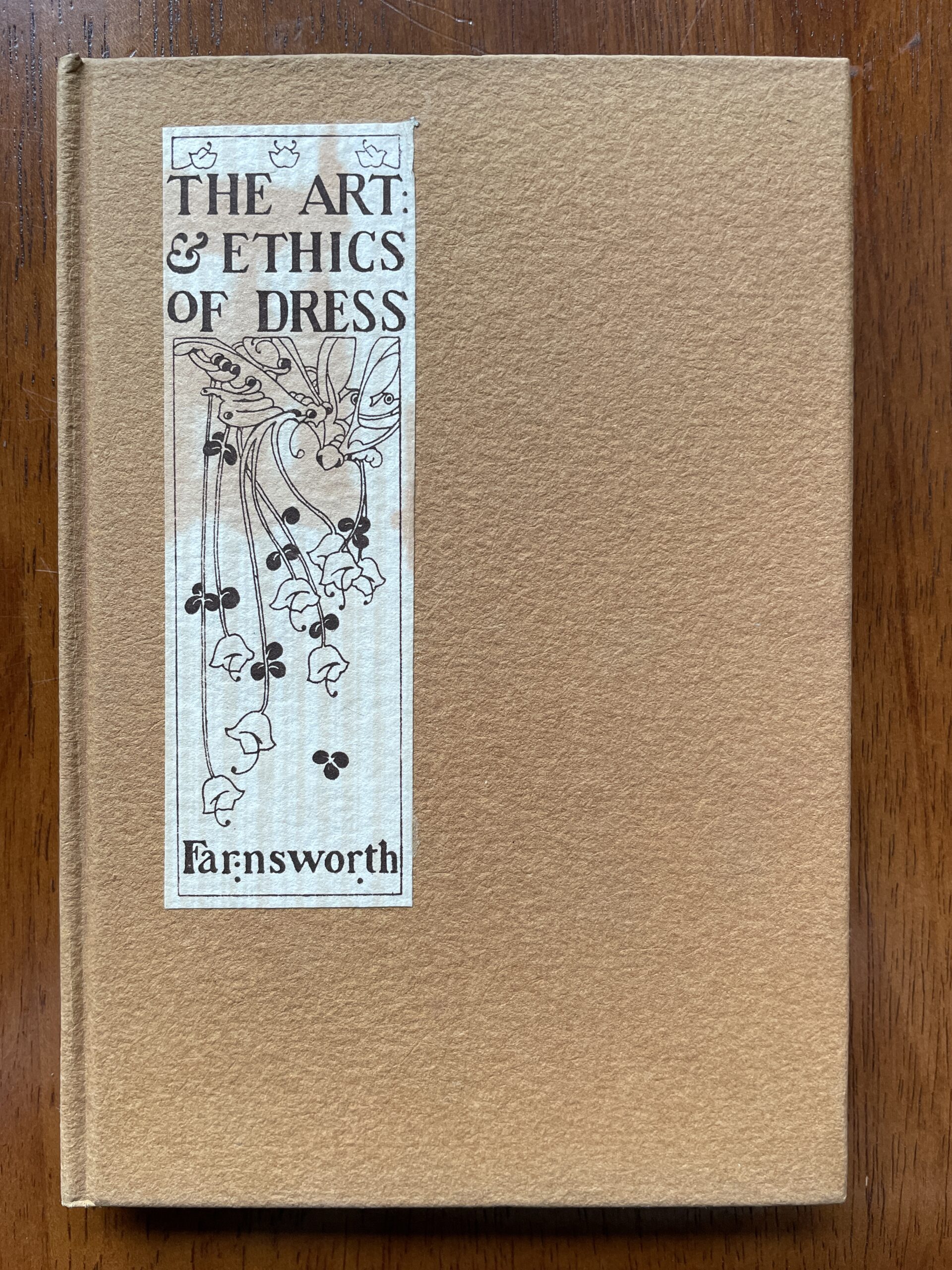
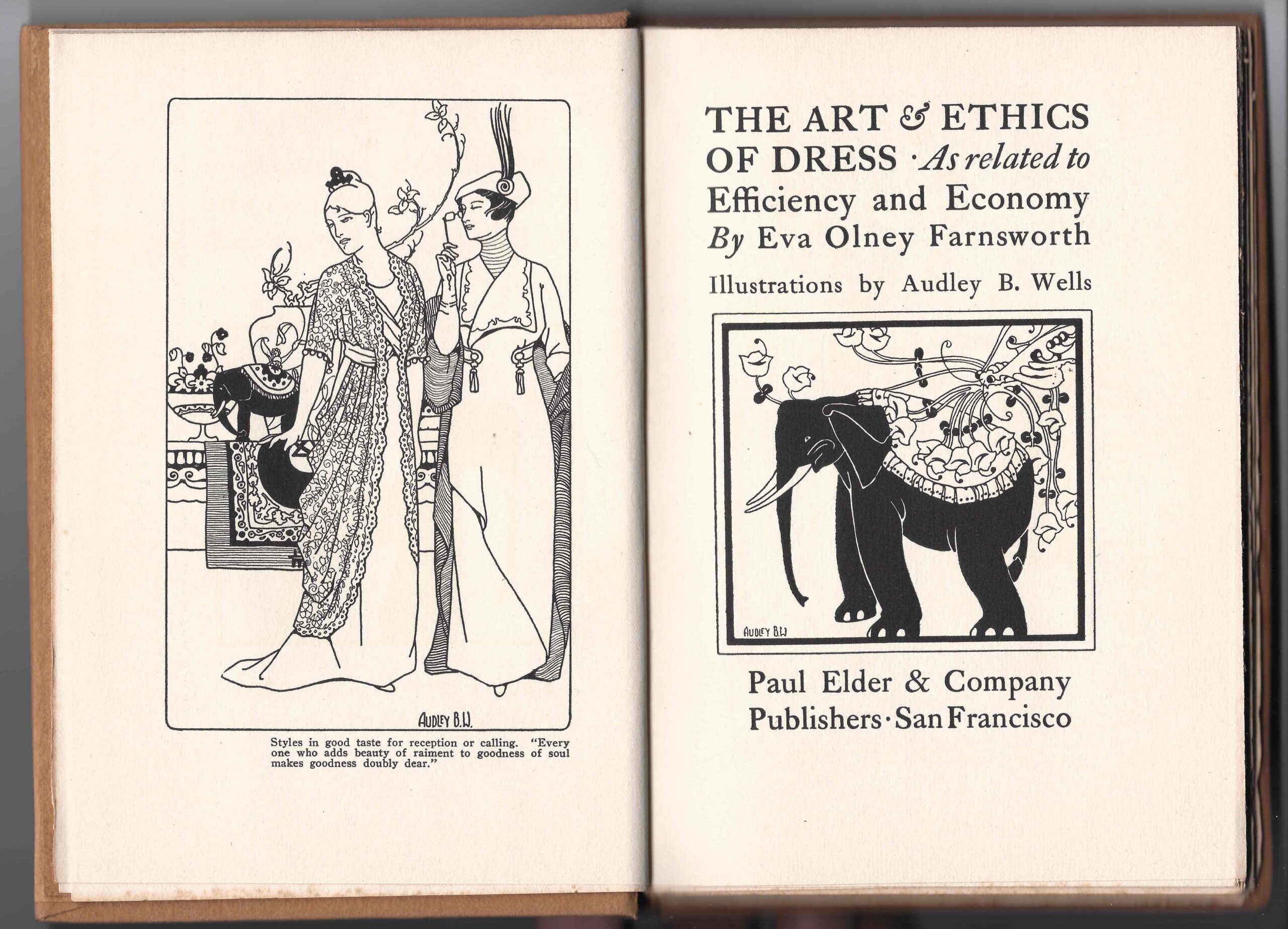
When you open Eva Olney Farnsworth’s Art & Ethics of Dress (1915), you are immediately struck by the pen-and-ink drawings of Audley B. Wells. But just as memorable are Olney’s exhortations that women can dress well and healthily, no matter what their shape or size. In many ways, this book was ahead of its time: Olney rails against corsets and other restrictive underclothes, the fashion industry which is only in search of novelty, and high-heeled shoes and their ravages upon women’s feet (ninety-five years later and we are still fighting that battle).
In other chapters, Olney tries to have it both ways. If a woman has “a waist circumference that is altogether clumsy and awkward,” Olney describes how she can dress to accentuate her other features. However, the author also admonishes that “she must consistently endeavor to induce all the symmetry of figure she can achieve through every means open to her in the gymnasium.” In a telling comment about the economy of the times, Olney writes:
Frontispiece and title page of The Art & Ethics of Dress
Even an employee who is earning the most modest income may have in her wardrobe all that her business or social duties call form, and its items will be once individual and fitting the occasion. One year she may add to her store a simple evening gown and a tailor-made dress; the next she will find occasion to buy one afternoon gown and perhaps a big cloak suitable for steamer or railroad traveling, and the third she may make additions to her lingerie.
The Art & Ethics of Dress, page 30. “Nothing is so glaring as the latest novelty.”
How fortunate we are to be living in an age where we need not restrict the purchase of undergarments to once every three years!
In the appendix, Olney introduces an undergarment of her own design, the “Patricia Garment,” patented on 15 December 1914. Corsets were going out of fashion, a trend that would accelerate a few years later, when metal supplies, such as that used for corset stays, were diverted towards America’s entry into World War I. Designed for adolescent women, the Patricia Garment was “a corset substitute, and will meet the needs of all who enjoy physical freedom. It is a four-in-one garment which combines the necessary support for the bust and clothing with room for growth and development of the torso.”
Updated 2026-01-24
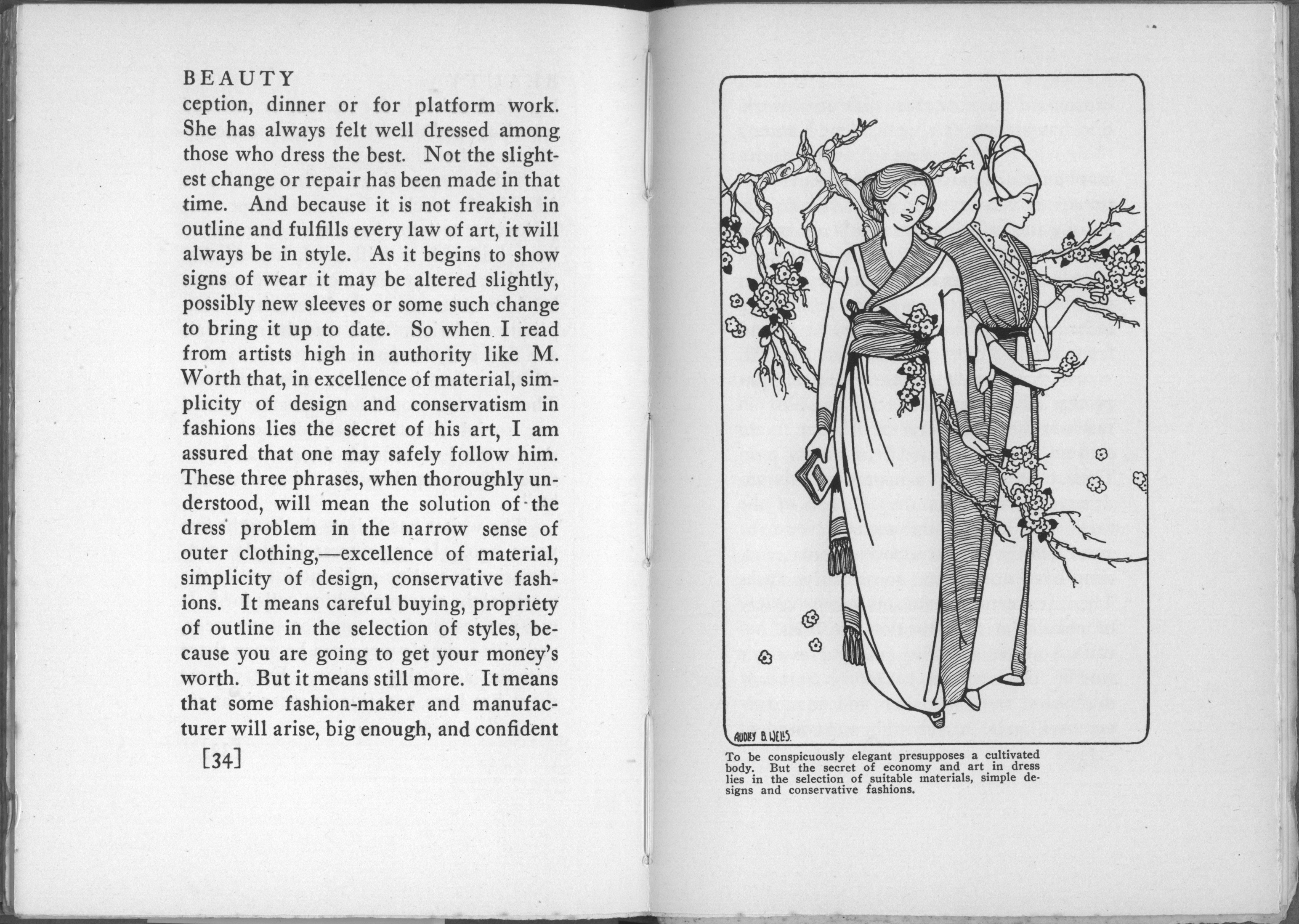
The Art & Ethics of Dress, page 34-35. Beautiful Japanesque dresses.The Art & Ethics of Dress, page 55. “The Patricia Garment”