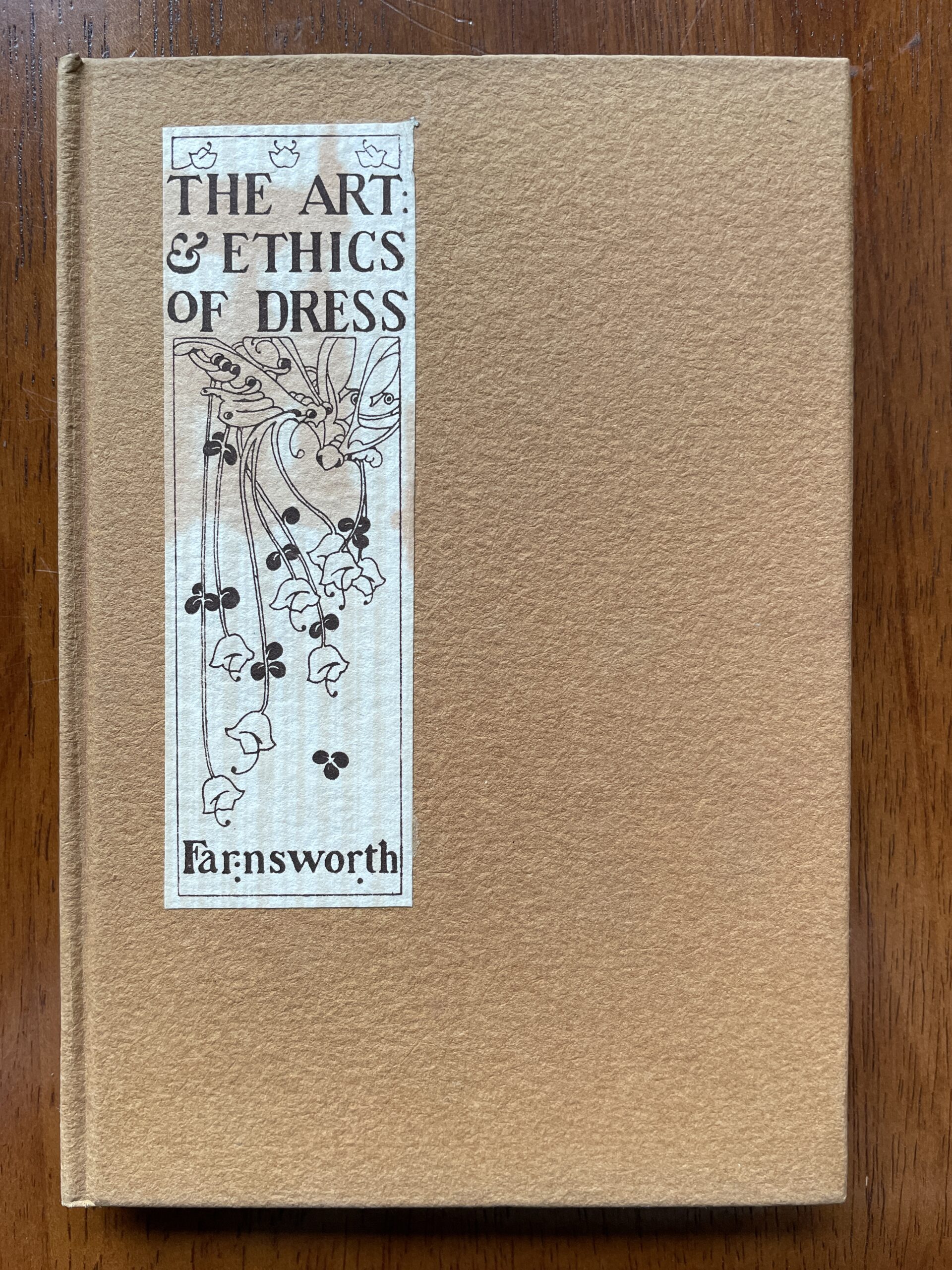
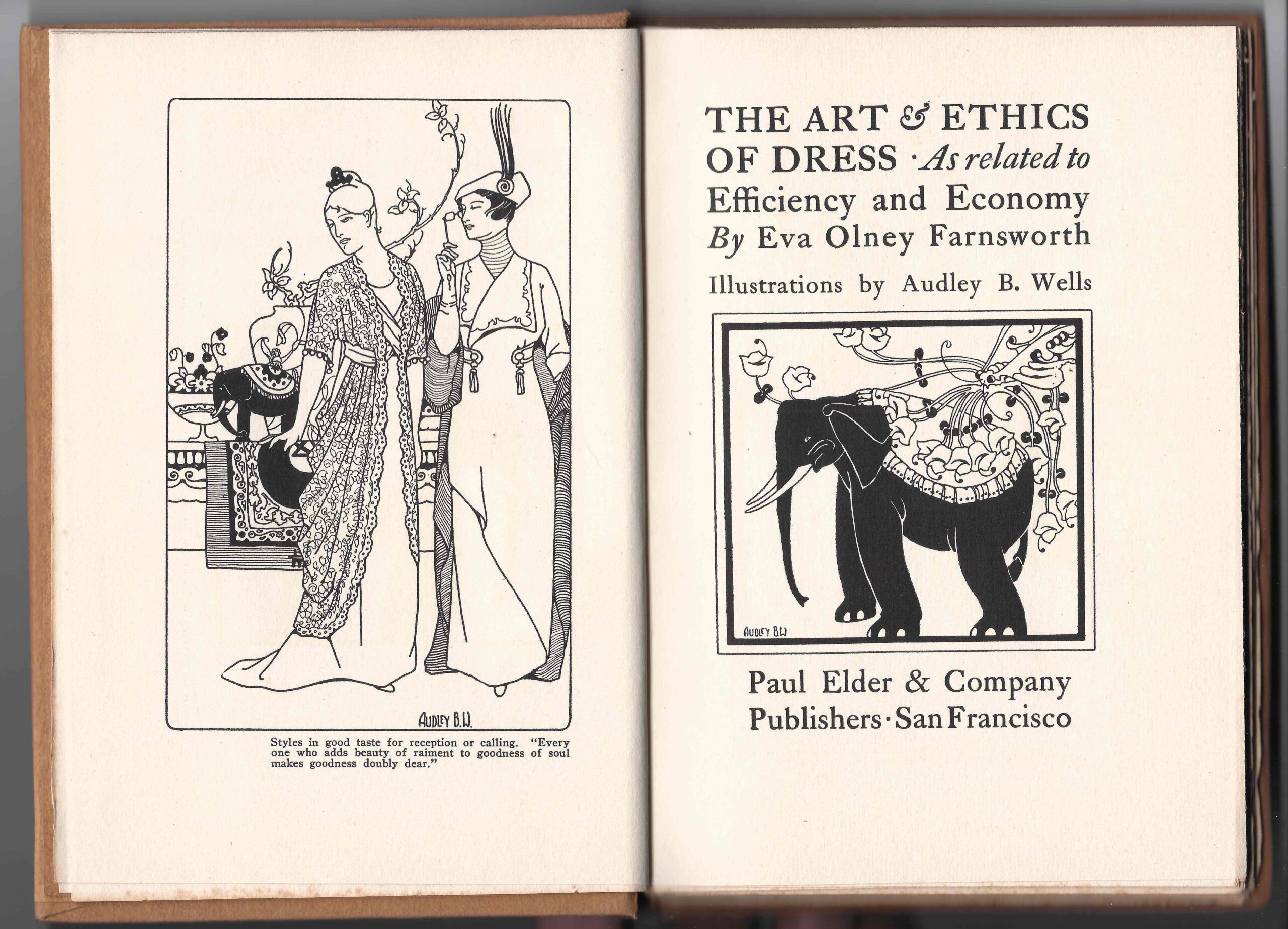
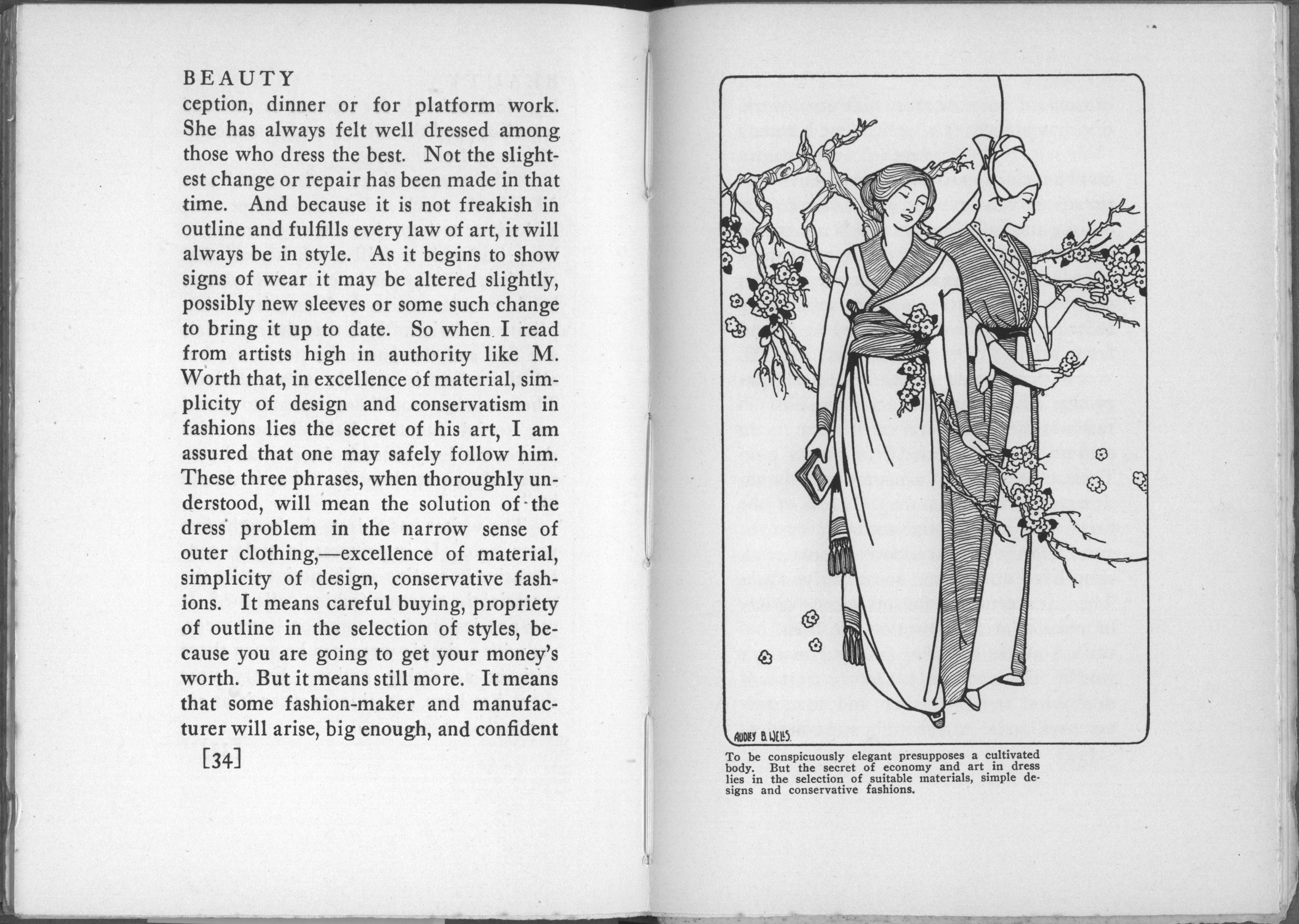
When you open Eva Olney Farnsworth’s Art & Ethics of Dress (1915), you are immediately struck by the pen-and-ink drawings of Audley B. Wells. But just as memorable are Olney’s exhortations that women can dress well and healthily, no matter what their shape or size. In many ways, this book was ahead of its time: Olney rails against corsets and other restrictive underclothes, the fashion industry which is only in search of novelty, and high-heeled shoes and their ravages upon women’s feet (ninety-five years later and we are still fighting that battle).
In other chapters, Olney tries to have it both ways. If a woman has “a waist circumference that is altogether clumsy and awkward,” Olney describes how she can dress to accentuate her other features. However, the author also admonishes that “she must consistently endeavor to induce all the symmetry of figure she can achieve through every means open to her in the gymnasium.” In a telling comment about the economy of the times, Olney writes:
Frontispiece and title page of The Art & Ethics of Dress
Even an employee who is earning the most modest income may have in her wardrobe all that her business or social duties call form, and its items will be once individual and fitting the occasion. One year she may add to her store a simple evening gown and a tailor-made dress; the next she will find occasion to buy one afternoon gown and perhaps a big cloak suitable for steamer or railroad traveling, and the third she may make additions to her lingerie.
The Art & Ethics of Dress, page 30. “Nothing is so glaring as the latest novelty.”
How fortunate we are to be living in an age where we need not restrict the purchase of undergarments to once every three years!
In the appendix, Olney introduces an undergarment of her own design, the “Patricia Garment,” patented on 15 December 1914. Corsets were going out of fashion, a trend that would accelerate a few years later, when metal supplies, such as that used for corset stays, were diverted towards America’s entry into World War I. Designed for adolescent women, the Patricia Garment was “a corset substitute, and will meet the needs of all who enjoy physical freedom. It is a four-in-one garment which combines the necessary support for the bust and clothing with room for growth and development of the torso.”
Updated 2026-01-24
The Art & Ethics of Dress, page 34-35. Beautiful Japanesque dresses.The Art & Ethics of Dress, page 55. “The Patricia Garment”
When a Californian calls something “old,” it’s usually not as old as something a Bostonian would call “old.” As a native Californian, I have often been reminded of this. “Well,” says my Easterner friend, “we wouldn’t call this ‘old’ back home.”
It turns out that this scenario is at least a century old, for it occurs on the very first page of The Lure of San Francisco:
“I believe you Californians have but two dates on your calendar,” he exclaimed, “for everything I mentioned seems to have happened either ‘before the fire’ or ‘in the good old days of forty-nine!’ ‘Good old days of forty-nine,’” he repeated, amused. “In Boston we date back to the Revolution, and ‘in Colonial times’ is a common expression. We have buildings a hundred years old, but if you have a structure that has lasted a decade, it is a paragon and pointed out as built ‘before the fire.’”
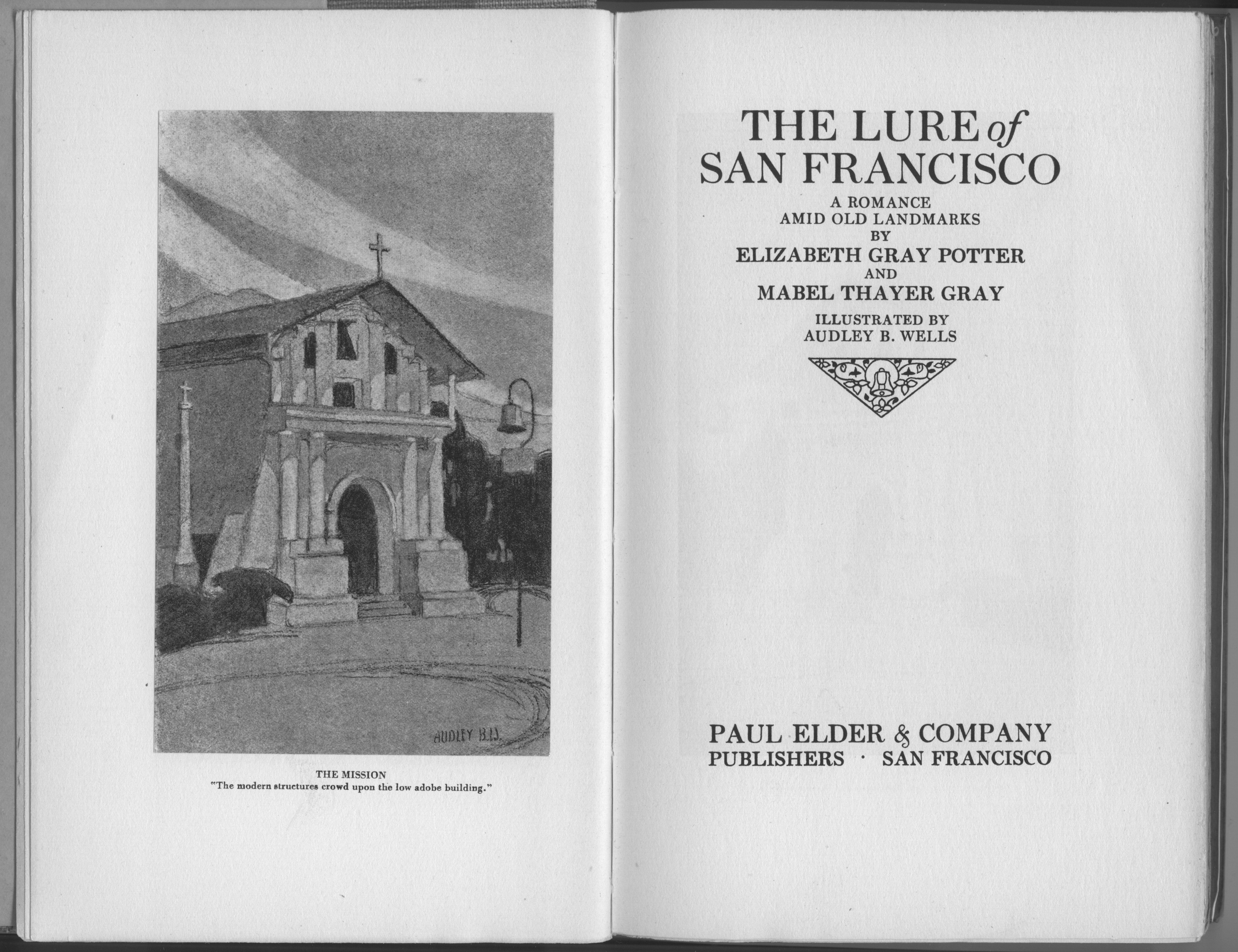
Frontispiece and title page of The Lure of San Francisco
The Lure of San Francisco is written as a long conversation between the narrator, a native San Franciscan woman, and her Bostonian guest. They visit the four principal sights of pre-1906 San Francisco: Mission Dolores, the Presidio, Portsmouth Plaza, and Telegraph Hill.
Unfortunately, the casual racism common during the late 19th- and early 20th-century intrudes into Potter and Gray’s book. In the chapter “The Mission and its Romance,” Potter and Gray trot out the tired reframing of the “lazy, roving” life of the California Indians, and how the Spanish “padres were not hard taskmasters.” Elsewhere, the inhabitants of Chinatown are called “slant-eyed” and “sallow-faced.”
The Lure of San Francisco, pages 8-9
The book has a beautiful cover with a nautical motif, and is elegantly illustrated inside with eight tonalist drawings by Audley B. Wells. It was one of more than a dozen books Elder published during the Panama-Pacific International Exposition.
Elizabeth Florence Gray Potter (1874-1959) and Mabel Thayer Gray (1870-1946) were born in Oakland, California, the daughters of George Dickman Gray, a lumber dealer, and Susan Hitchborn Thayer. In both 1880 and 1900, the family lived at 754 Tenth St. in San Francisco (a spot now underneath a modern freeway interchange); they may have gotten burned out in the 1906 earthquake and fire. Elizabeth married Frederick W. Potter in February 1906; Mabel never married, and neither woman had any children. They are buried in the Gray family plot at Cypress Lawn Memorial Park in Colma.
Frontispiece and title page of Comfort Found in Good Old Books (1911)
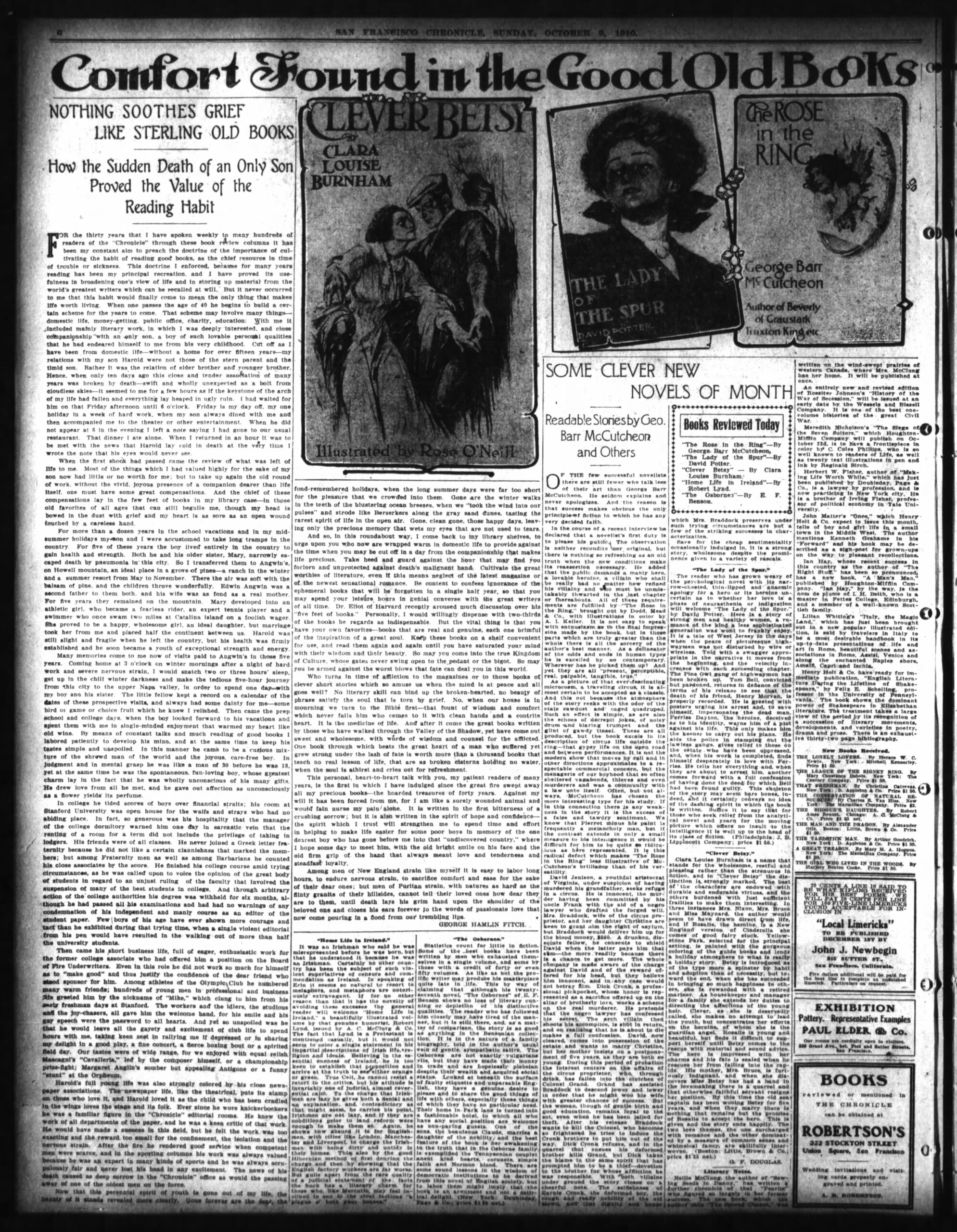
George Hamlin Fitch (1852-1925) was the San Francisco Chronicle’s literary critic and book reviewer from 1880 until his retirement in 1915. On 9 October 1910, his weekly Sunday column took on a far more serious subject than usual:
For the thirty years that I have spoken weekly to many hundreds of readers of The San Francisco Chronicle through its book review columns, it has been my constant aim to preach the doctrine of the importance of cultivating the habit of reading good books, as the chief resource in time of trouble or sickness … But it never occurred to me that this habit would finally come to mean the only thing that makes life worth living.
Fitch writes of his son’s death. San Francisco Chronicle, 9 October 1910, page 6
Fitch goes on to describe the death of his only son, Harold:
Cut off as I have been from domestic life, without a home for over fifteen years, my relations with my son Harold were not those of the stern parent and the timid son. Rather it was the relation of elder brother and younger brother.
Hence, when only ten days ago this close and tender association of many years was broken by death—swift and wholly unexpected, as a bolt from cloudless skies—it seemed to me for a few hours as if the keystone of the arch of my life had fallen and everything lay heaped in ugly ruin. I had waited for him on that Friday afternoon [30 September 1910] until six o’clock. Friday is my day off, my one holiday in a week of hard work, when my son always dined with me and then accompanied me to the theater or other entertainment. When he did not appear at six I left a note saying I had gone to our usual restaurant. That dinner I ate alone. When I returned in an hour it was to be met with the news that Harold lay cold in death at the very time I wrote the note that his eyes would never see.
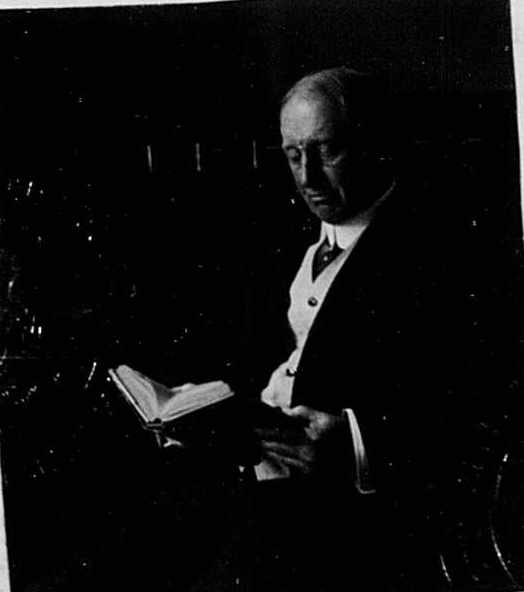
George Hamlin Fitch (1852-1925)
You know not how much time you have, says Fitch. Use it well! Read the best books history has to offer.
And so, in this roundabout way, I come back to my library shelves, to urge upon you who now are wrapped warm in domestic life and love to provide against the time when you may be cut off in a day from the companionship that makes life precious. Take heed and guard against the hour that may find you forlorn and unprotected against death’s malignant hand. Cultivate the great worthies of literature, even if this means neglect of the latest magazine or of the newest sensational romance. Be content to confess ignorance of the ephemeral books that will be forgotten in a single half year, so that you may spend your leisure hours in genial converse with the great writers of all time.
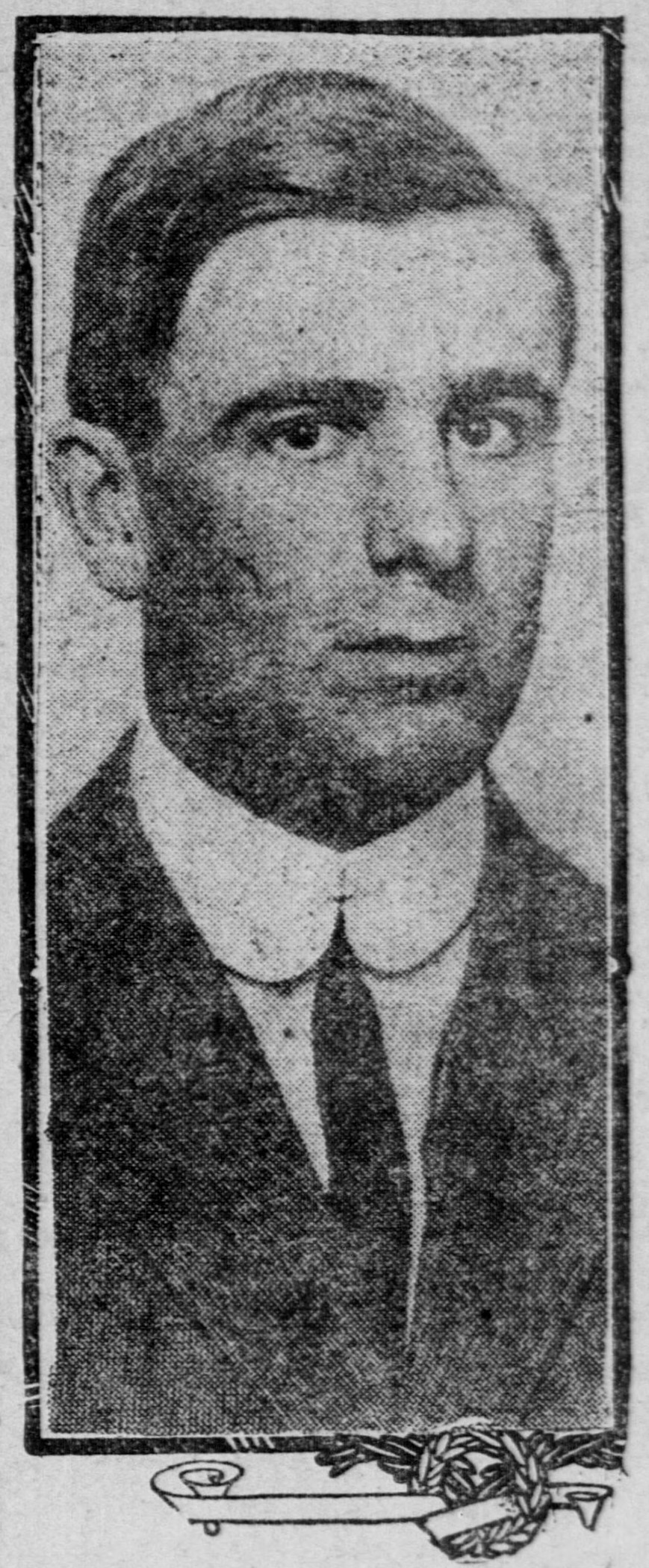
Harold Fitch (1885-1910). San Francisco Call, 3 October 1910, page 3
In his article, Fitch does not mention how Harold died, but death and burial records make it clear that Harold Fitch died of a self-inflicted gunshot wound to the head. The shock of his son’s death was bad enough, but having also to process his suicide, presumably without being willing to confide in anyone about it, must have been a struggle for the rest of George Fitch’s life.
In the weeks following Fitch’s article in the Chronicle, many readers asked him to list the great books that had proved so comforting to him in his sorrow. Fitch did so in his Sunday columns over the following weeks. In 1911, he gathered them together and published them under the headline of his original article, Comfort Found in Good Old Books. It proved a good seller for Paul Elder and was reprinted several times.
There is another aspect of the book worth highlighting. The New York Times reviewer, while noting that Fitch “is the best known and most highly esteemed [western] critic of current literature” and that the book would also serve “as a signpost out of the surging mass of current ephemeral literature,” also pointed out that Westerners feel compelled to talk about personal emotions. Here in the East, he is saying, we don’t display such delicate emotions, we suck it up:
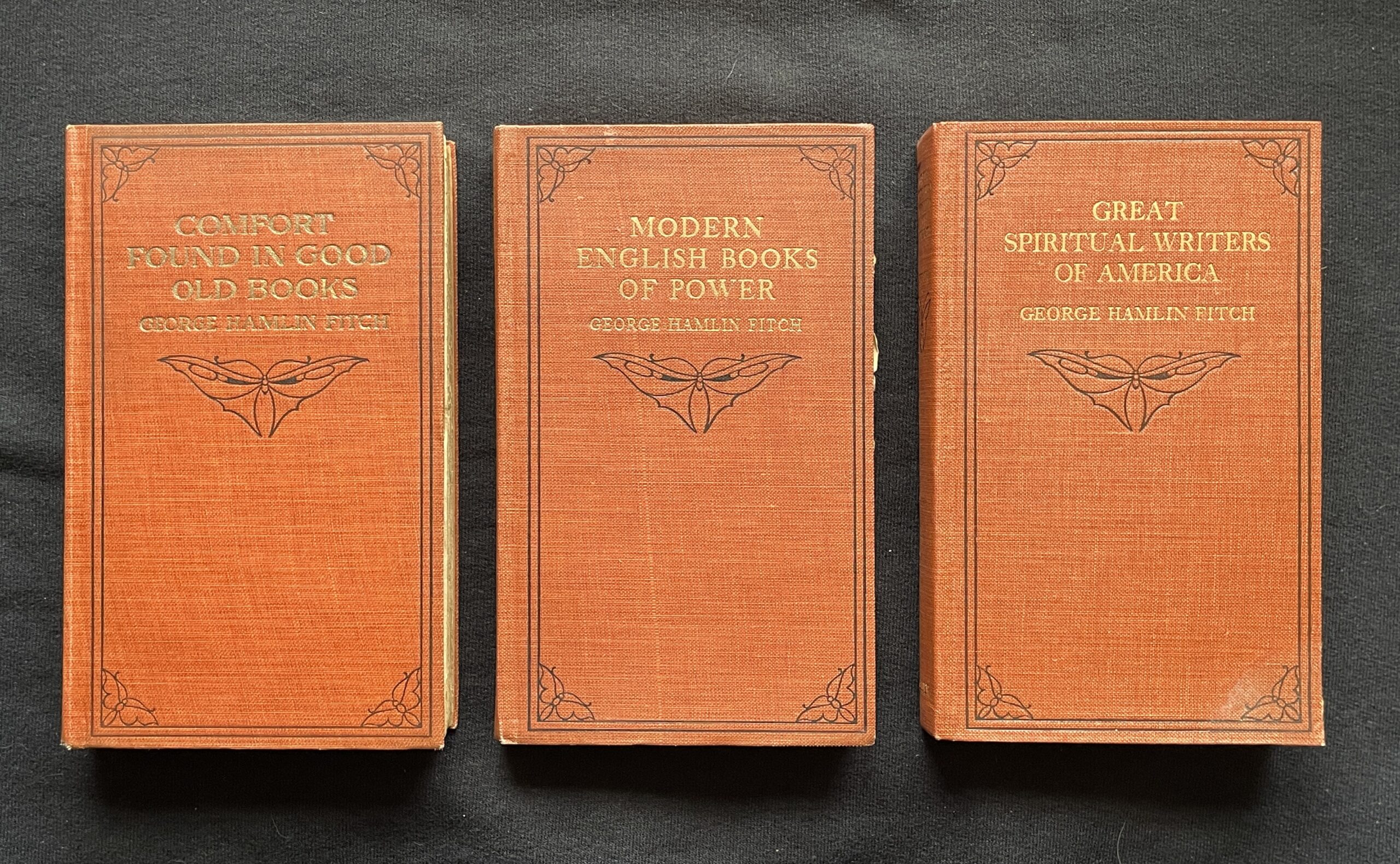
Comfort Found in Good Old Books, along with two later Fitch volumes, Modern English Books of Power and Great Spiritual Writers of America, in matching “butterfly” covers
The detachment of the Pacific Coast from the rest of the country, and the way in which, to a rather marked degree, it is still thrown upon itself, strengthen very much this tendency toward a more intimate expression of thought and emotion. The Eastern reader of Mr. Fitch’s book needs to understand these peculiar conditions and influences under which it had its inspiration. Otherwise he may be surprised and perhaps repelled a little by the peculiar frankness and intimacy of the opening chapter, a tribute to the author’s only son, written a few days after the young man’s sudden death.1“A Book from a Man’s Heart,” New York Times, 3 September 1911, p532
Fitch wrote several other books for Elder, including The Critic in the Orient, The Critic in the Occident, Great Spiritual Writers of America, and Modern English Books of Power. Like Comfort Found, each of these books were compiled from Fitch’s newspaper columns in the Chronicle.
George Hamlin Fitch was born in Lancaster, New York, a suburb of Buffalo, on 25 November 1852. His family moved to San Francisco when he was a young boy, but the family returned to New York in 1865, where he was educated at preparatory schools and Cornell University. His first newspaper job was at the New York Tribune, where he worked for three years. He returned to San Francisco in 1879 to work for the Chronicle, and quickly rose to become its literary critic.2San Francisco Chronicle, 25 February 1925, p3 In June 1881, he married Theodosia Hudson, also a native New Yorker. Their daughter Mary was born in 1882, and son Harold in 1885. George and Theodosia divorced about 1895, and Fitch lived on his own for most of the rest of his life. In 1910, he married Amerique B. Deussing, but this union appears to have been very short. After his retirement in 1915, he lived for a while in England and New York before settling in Arcadia, in Southern California, in 1920. At the time of his sudden death in 1925, he was living with a Mrs. Amelia White, but it’s not clear whether they were married. It was originally thought that he would be buried in the Fitch family plot at Cypress Lawn Cemetery in Colma, but perhaps due to Mrs. White’s desires, he was laid to rest at Live Oak Memorial Park in Monrovia.
Updated 2026-01-27
1
“A Book from a Man’s Heart,” New York Times, 3 September 1911, p532
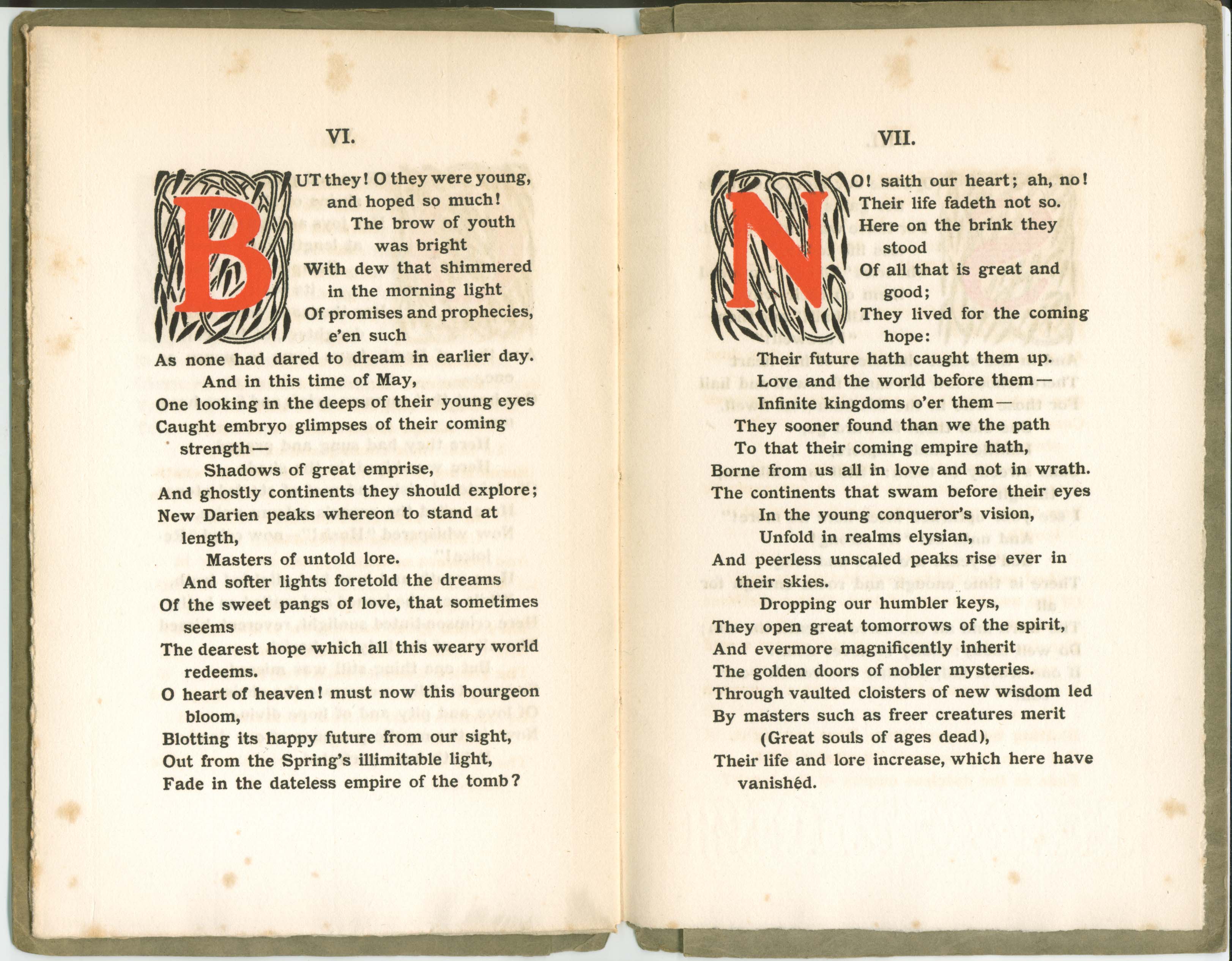
During Stanford University’s annual commencement on 25 May 1903, professor Raymond Macdonald Alden stood to read a poem. It was an ode dedicated to the members of the class of 1903 who had died that month. Consolatio is a sobering reminder of how, not so long ago, the sudden death of young men and women was an all too common event. It is easy to forget the roll of deadly diseases—measles, mumps, diphtheria, polio, typhoid, whooping cough, scarlet fever—that we have since largely eradicated.
Alden (1873-1924) was born in New York and educated at the University of Pennsylvania. He held junior positions at Harvard and George Washington University before accepting the post of assistant professor of literature at Stanford in 1899. He later became chair of the English department at the University of Illinois. Alden also wrote a Christmas story Why the Chimes Rang (1909). Forgotten today, it was once quite popular. It tells the story of church bells which ring every Christmas Eve whenever someone places a special gift on the altar.
If you are looking for an exemplar of the Tomoye Press during its best years, the lovely booklet Patience And Her Garden (1910) will serve you well. It was printed in two colors on Spanish handmade paper, beautifully illustrated, pleasant if unmemorable content, readable in one sitting, reasonably priced at 35¢, and came with a matching envelope—in short, the perfect gift. How many copies of Patience were given from mother to daughter, from one society matron to another, or from a gentleman caller to a young lady he fancied?
The cover and title page show the unmistakable calling card of printer John Henry Nash: the mitred rule. Boxes such as these were difficult to set, but Nash was well-known as a technician. The frontispiece, by one of Elder’s favorite artists, Spencer Wright, was sold separately as Impression Leaflet #27, and also appeared annually in the Impressions Calendar series. The boxed quotation in the frontispiece, by Manx poet Thomas Edward Brown, neatly mirrors Nash’s title page with its own quote in a box.
Title page and frontispiece of Patience And Her Garden
Ida Alberta Smith was born on 5 September 1863 in New York City, as a young girl moved with her family to Austin, Minnesota, a town founded by fur trappers only a dozen years before. Her father Hiram Smith worked as a blacksmith. In 1896, Ida married Levi William Decker; they had one daughter, Evaline, named after Ida’s mother. Ida Smith died on 7 July 1914, at just fifty years of age; she had been ill for some months. Her obituary reads in part: “She was one of Austin’s best women. She loved the home and her literary work, and few were as talented as she. She was very reticent, but gave freely of her literary work to social gatherings, being a member of the Stoddard Club, also the Birthday Club.”
I have no information about the connections enabling a “reticent” yet literary woman in a small Minnesota mill town to be published by Paul Elder in San Francisco.