A Yosemite Flora

Cover of "Yosemite Flora"
Cover of “A Yosemite Flora”

In 1912, the field guide was still a fairly new kind of book. The first modern field guide was Birds Through an Opera-Glass, written in 1890 by Florence August Merriam (1863-1948). The first botanical field guide in the United States was the 1893 How to Know the Wildflowers, by Mrs. William Starr Dana (Frances Theodora Parsons, 1861-1952). The public was clearly eager for these new field guides, as Parsons’s first printing sold out in five days, and she published several subsequent editions.

Harvey and Carlotta Hall’s 1912 field guide A Yosemite Flora is a work of the highest academic quality. Paul Elder published several “armchair nature” books, notably Bird Notes Afield by Charles Keeler, but this is the botany book that Keeler might well have carried in his back pocket while traipsing through the Sierras. It is profusely illustrated with 170 drawings and eleven plates (though due to a production error many copies were issued without plates 2-11, and contain an errata slip to that effect).
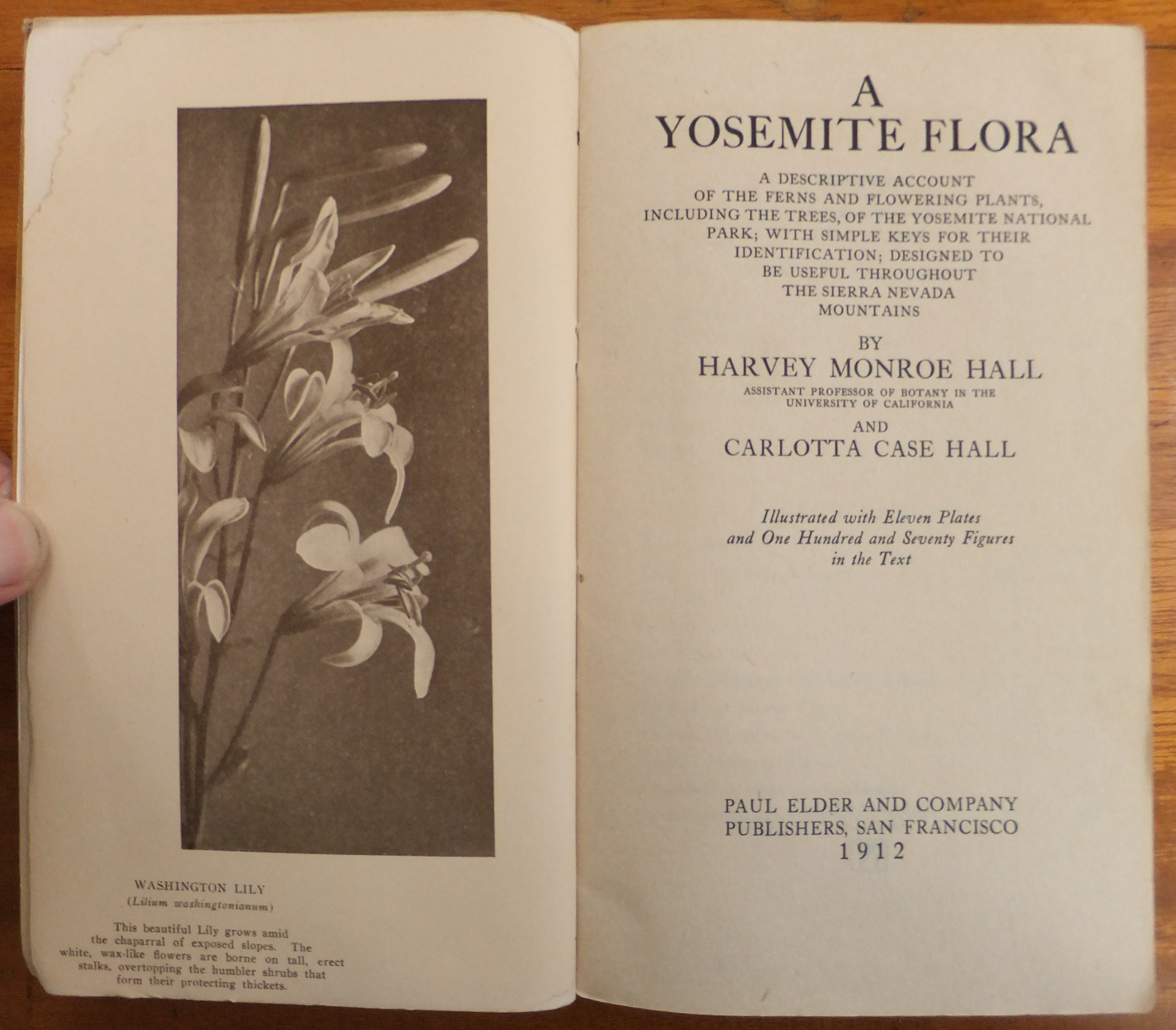
Frontispiece and title page to "A Yosemite Flora"
Frontispiece and title page to “A Yosemite Flora”

Harvey Monroe Hall (1874-1932) was born in Illinois but grew up in Riverside, California. He received his Ph.D. in botany in 1906 from the University of California, Berkeley, writing a thesis entitled The Compositae of Southern California. He remained on the UC faculty until 1919, when he joined the Carnegie Institute. There he began an exploration of experimental methods of plant taxonomy. In 1929 he came Acting Professor of Botany at Stanford University.

Hall was a painstaking investigator, and his work became the basis for a fresh approach to organic evolution. He had spent 1928 in Europe studying the national parks there, and his returned an enthusiastic proponent of a new model of ecological management, the wildlife preserve.
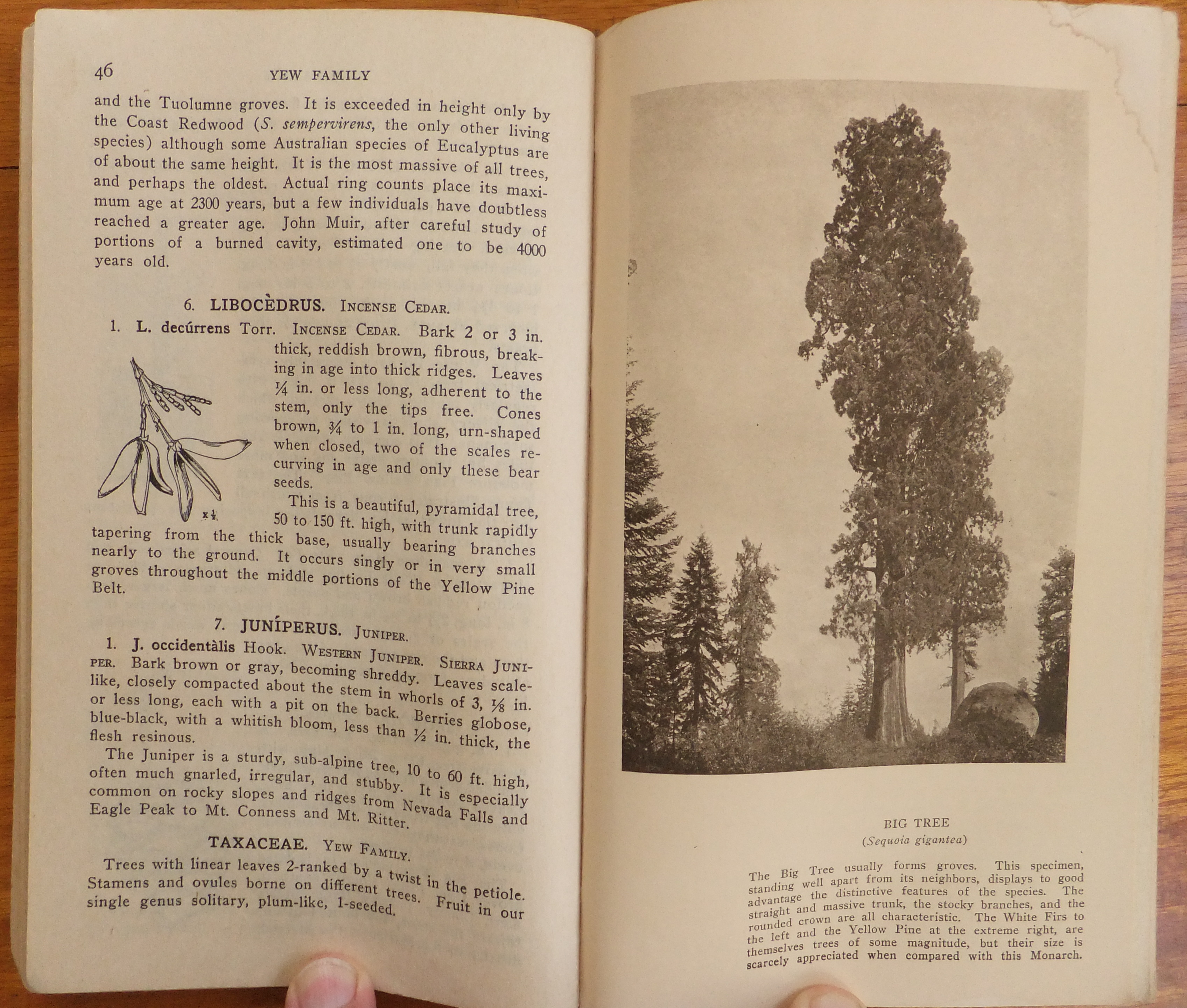
Page 46-47 of "A Yosemite Flora"
Page 46-47 of “A Yosemite Flora”

In 1910 Hall married Carlotta Case (1880-1949),  a 1905 graduate of the University of California and a collector of western ferns. They had one daughter, Martha Hall Niccolls (1913-1991).

Shortly after Hall’s death, the Harvey Monroe Hall Research Natural Area was established within Inyo National Forest, just north of Tioga Pass in Yosemite National Park. It was one of the first RNAs to be created.

Poem Delivered at the Dedication of the Pan-American Exposition

Cover of "Poem Delivered..."
Cover of Poem Delivered

The Pan-American Exposition was originally scheduled for 1897 on Cayuga Island, New York, a few miles upstream from the huge tourist attraction of Niagara Falls. But when the Spanish-American War broke out in 1898, the fair was delayed. The City of Buffalo then took the opportunity to compete for the privilege of hosting the fair, which it won by virtue of its larger population (350,000 people, then the eighth-largest city in the United States) and better railroad service. The fair was held in May-November 1901 in the neighborhood known as Delaware Park.

The Exposition was a big success, and more than eight million visitors attended. Today, the Fair is remembered chiefly as the site of President William McKinley’s assassination on 6 September 1901. But before that momentous event, the biggest novelty was electricity: the fair was lit at night by Nicola Tesla’s new three-phase alternating current, powered by Niagara Falls, twenty-five miles away.

Robert Cameron Rogers (1852-1912)
Robert Cameron Rogers (1862-1912)

Robert Cameron Rogers (7 January 1862–20 April 1912) was born in Buffalo, and graduated from Yale in 1883. His father, Sherman Skinner Rogers, was one of the most prominent lawyers in Buffalo, and Robert spent a year in his father’s firm before deciding that law was not for him. Instead, he turned to writing, and published books, poems and magazine articles. His 1898 poem “The Rosary” was set to music several times, most notably by Ethelbert Nevin, and sold very well as sheet music.

Also in 1898, Rogers moved to Santa Barbara, where he married Beatrice Fernald, the daughter of former Santa Barbara mayor Charles Heard Fernald. In 1901, he purchased The Morning Press newspaper, which he molded into one of the most influential and best-edited papers in California. Back in Buffalo, when it came time to select a poet to write a dedicatory poem for the Exposition, no doubt it was the well-connected Sherman Rogers who secured the honor for his son Robert.

Aerial view of the Pan-American Exposition in Buffalo NY

At first glance, it is perhaps surprising the small San Francisco firm of Elder & Shepard should publish this volume, especially since New York City, the undisputed center of American publishing, was so close to the Exposition. This was very likely due to Morgan Shepard’s Santa Barbara connections, perhaps his sister-in-law Katherine Putnam, author of Wayfarers in Italy.

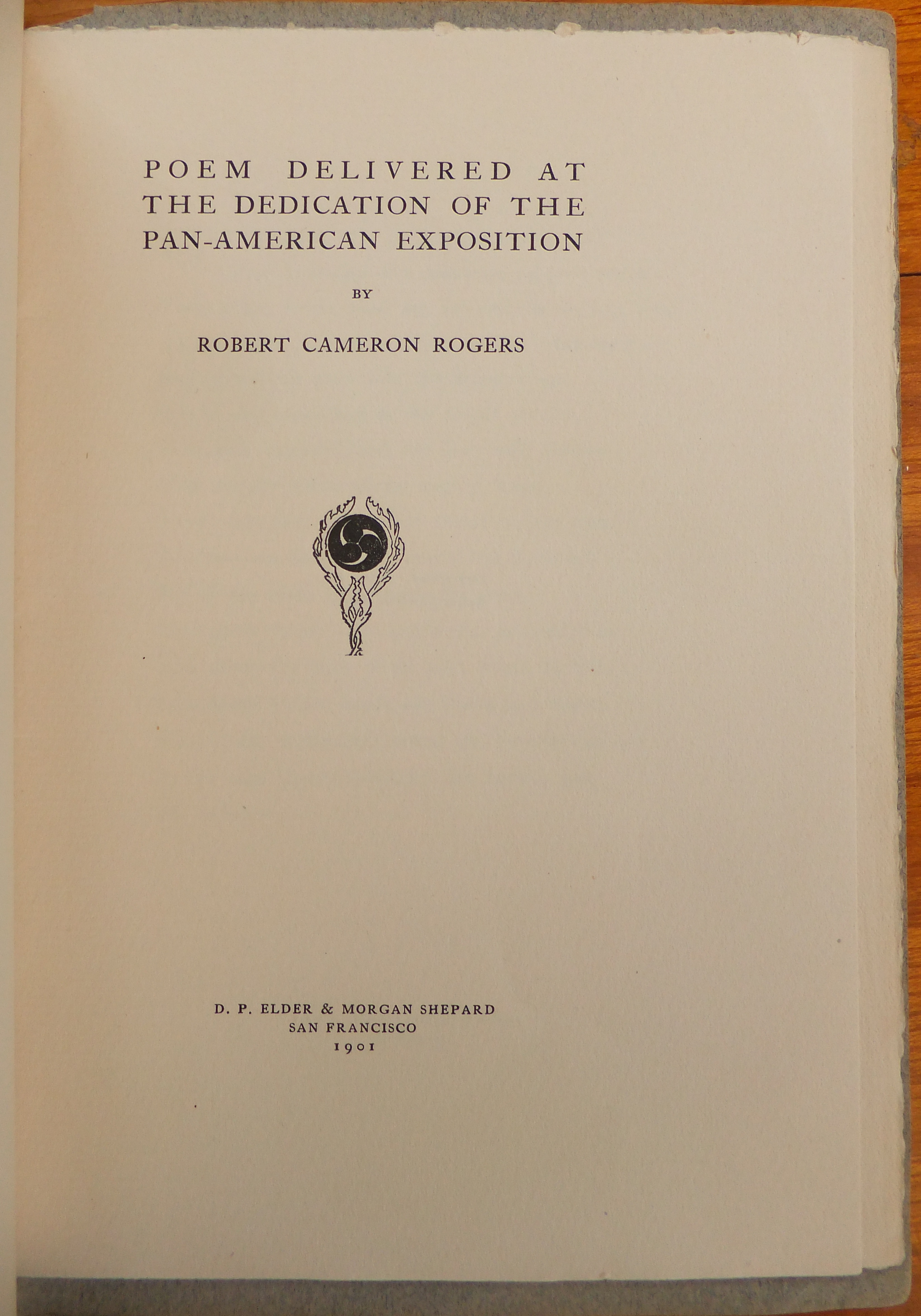
Poem Delivered at the Dedication of the Pan-American Exposition is a slim booklet, 16 pages and 8 x 5.5″ in size, printed on deckle-edge paper. The cover and title page feature a tomoye design, though the tomoye has no connection with the poem or the Exposition. The tomoye had only recently been chosen as a logo by Elder & Shepard, and they were clearly trying to establish their brand.

Rogers died in Santa Barbara in 1912 from complications of an appendicitis operation, just 50 years old.

Updated 2025-01-10

Title page of "Poem Delivered..."
Title page of Poem Delivered
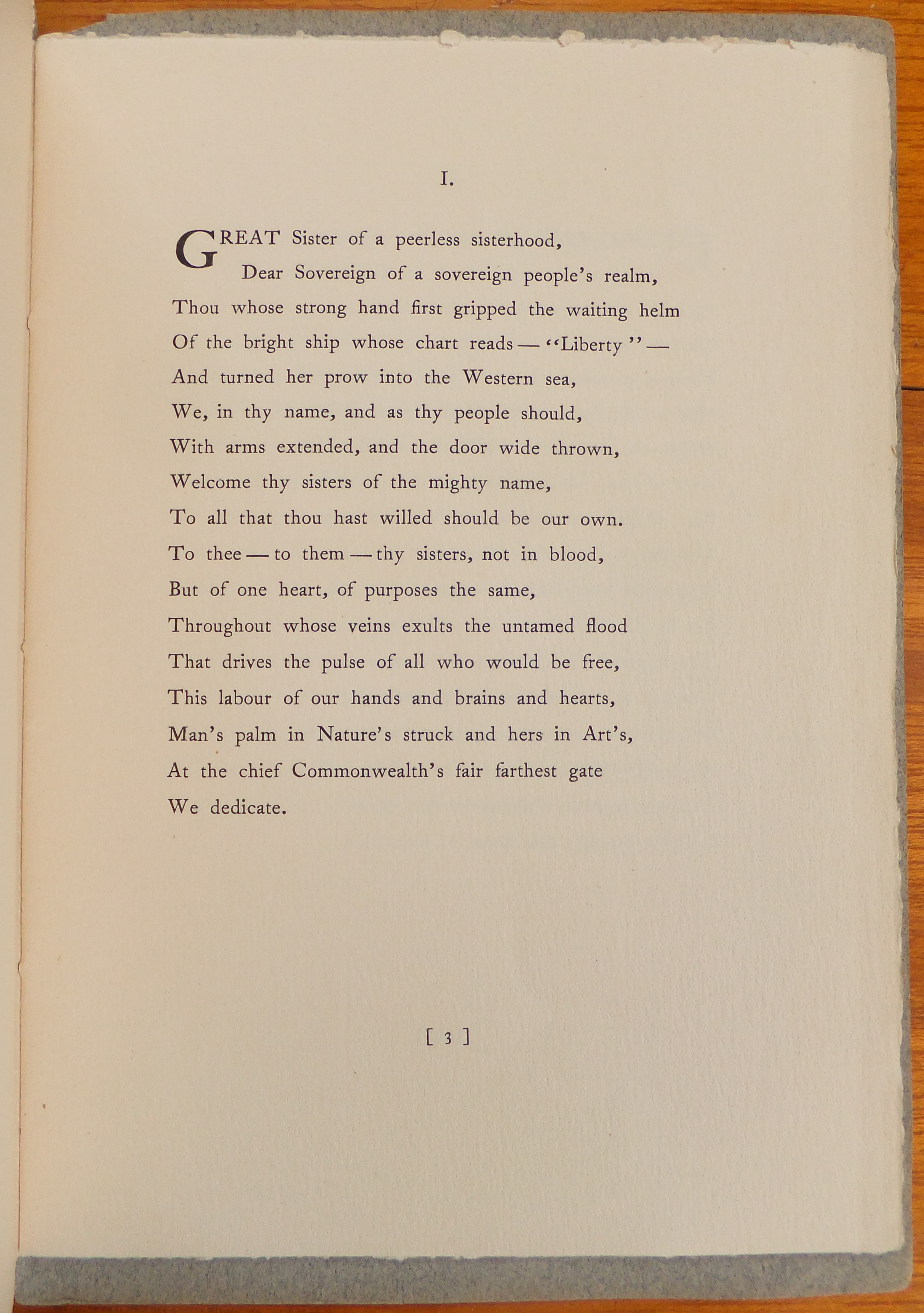
Page 1 of "Poem Delivered..."
Page 1 of Poem Delivered