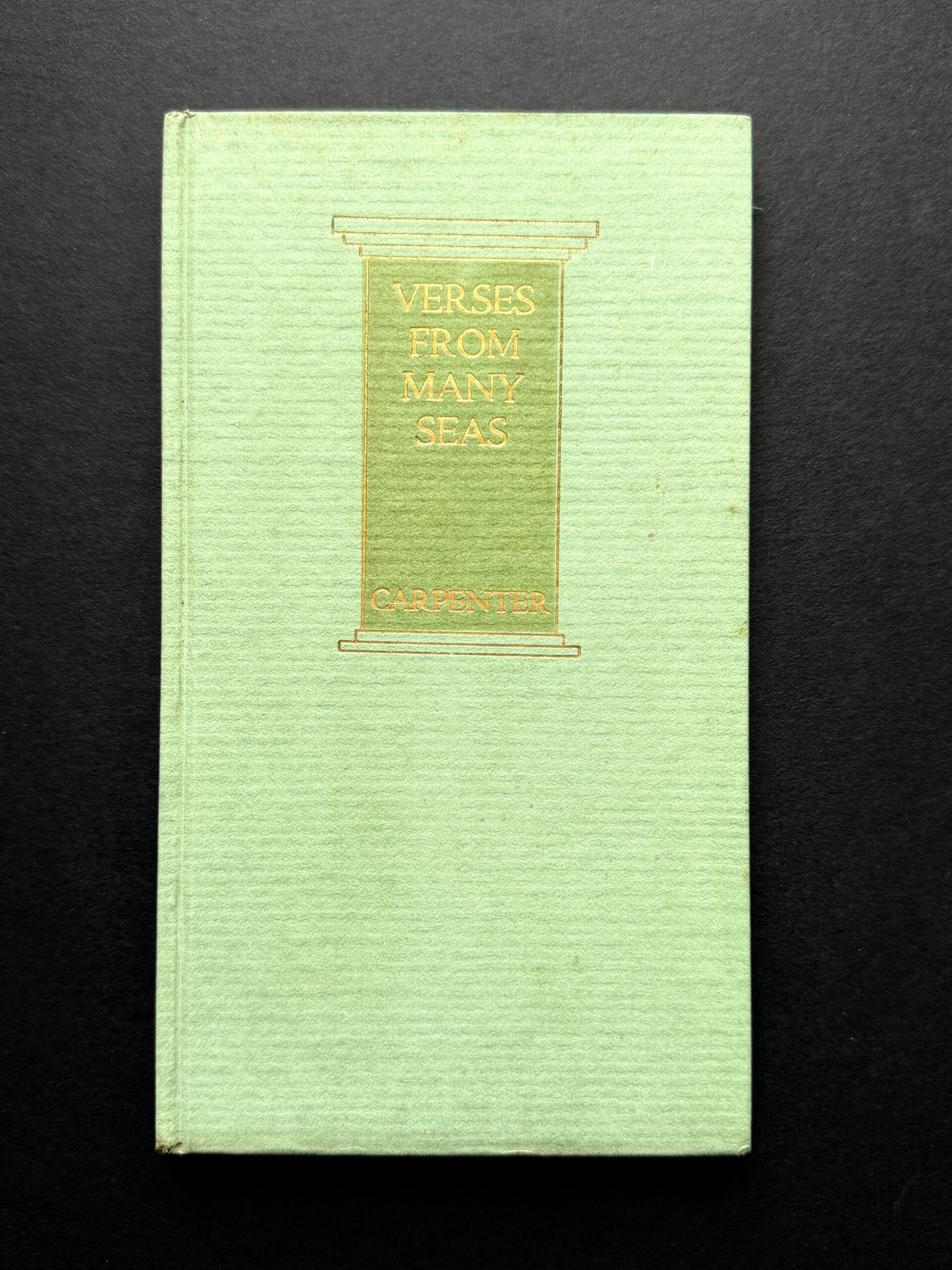
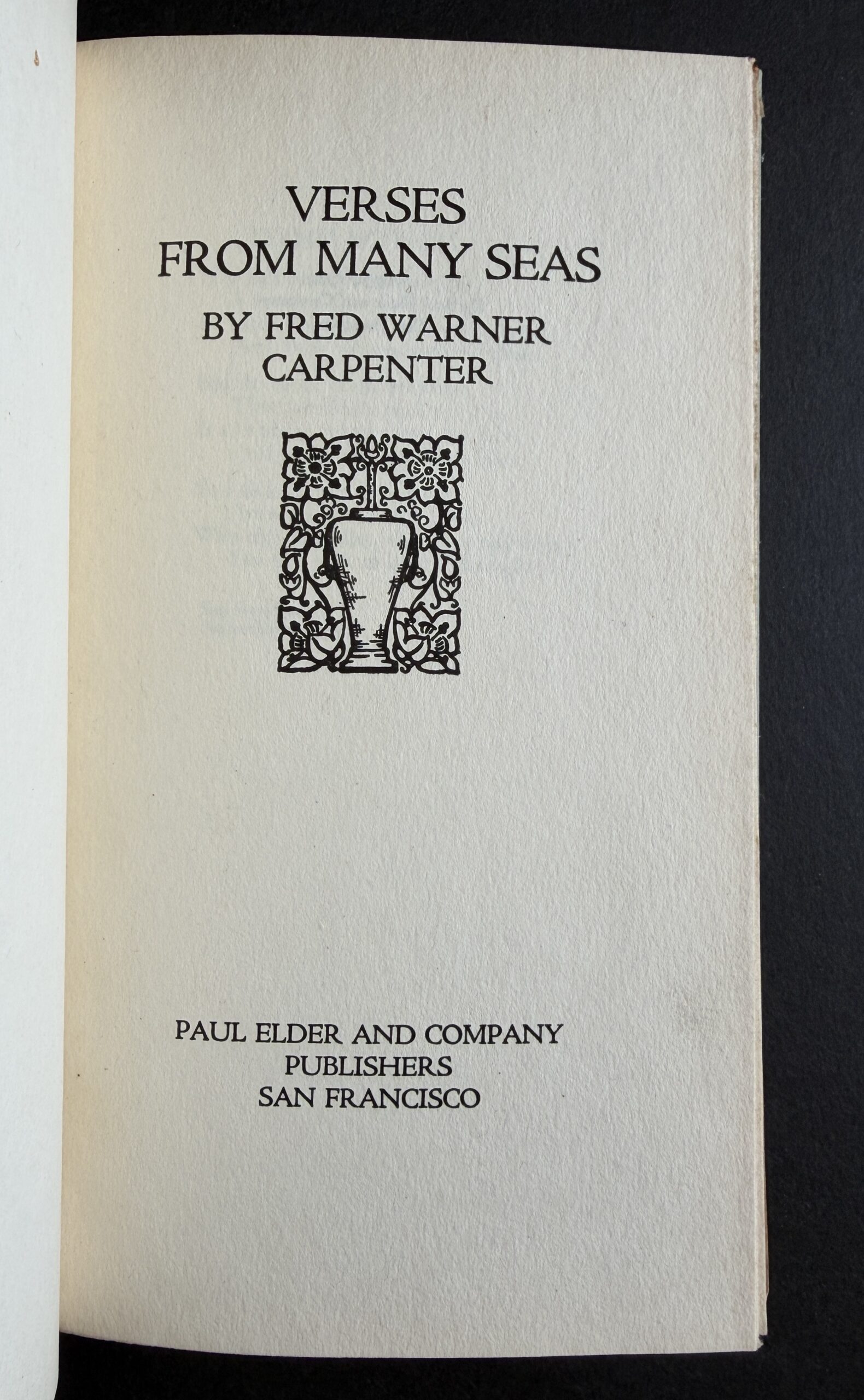
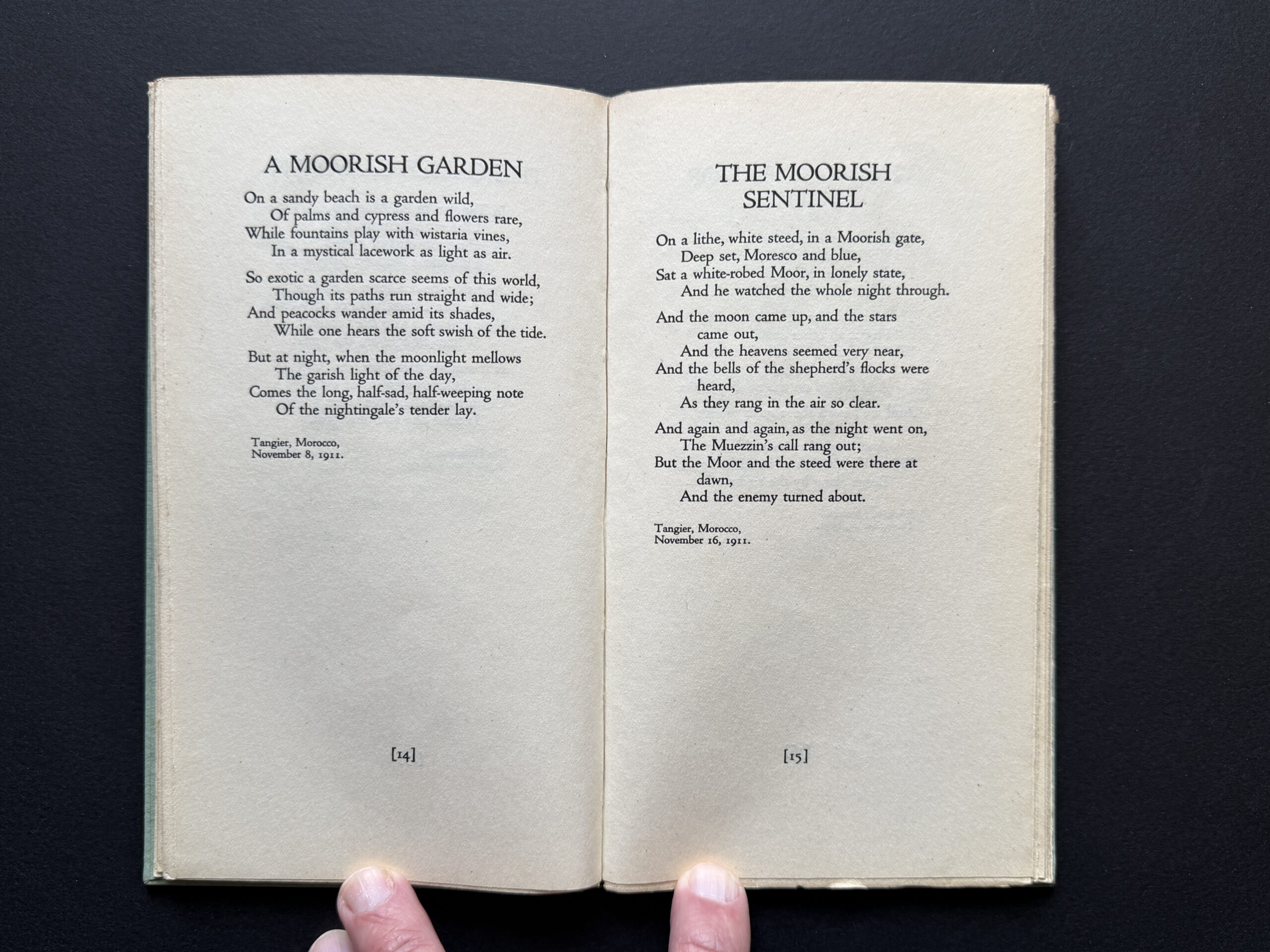
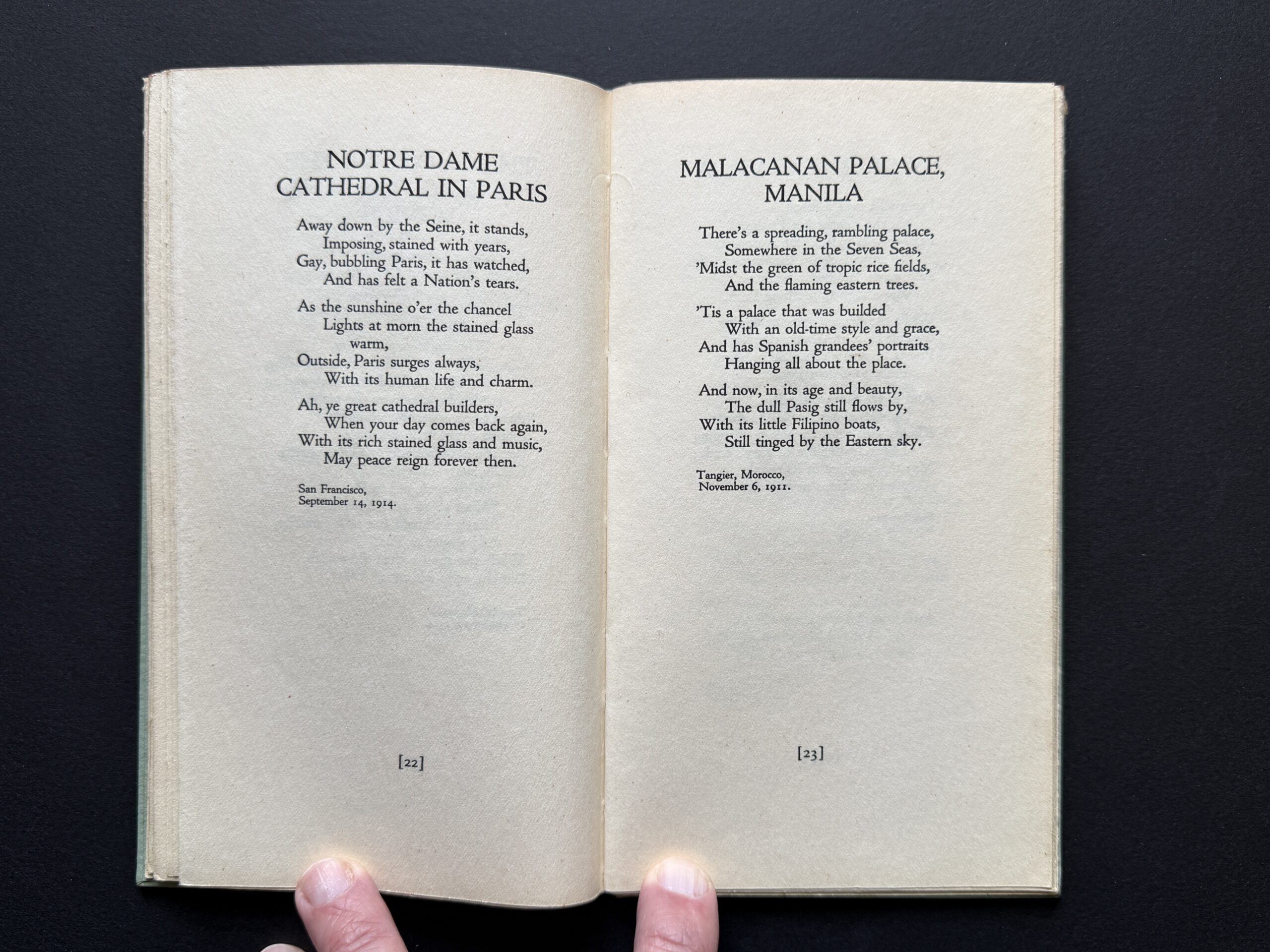
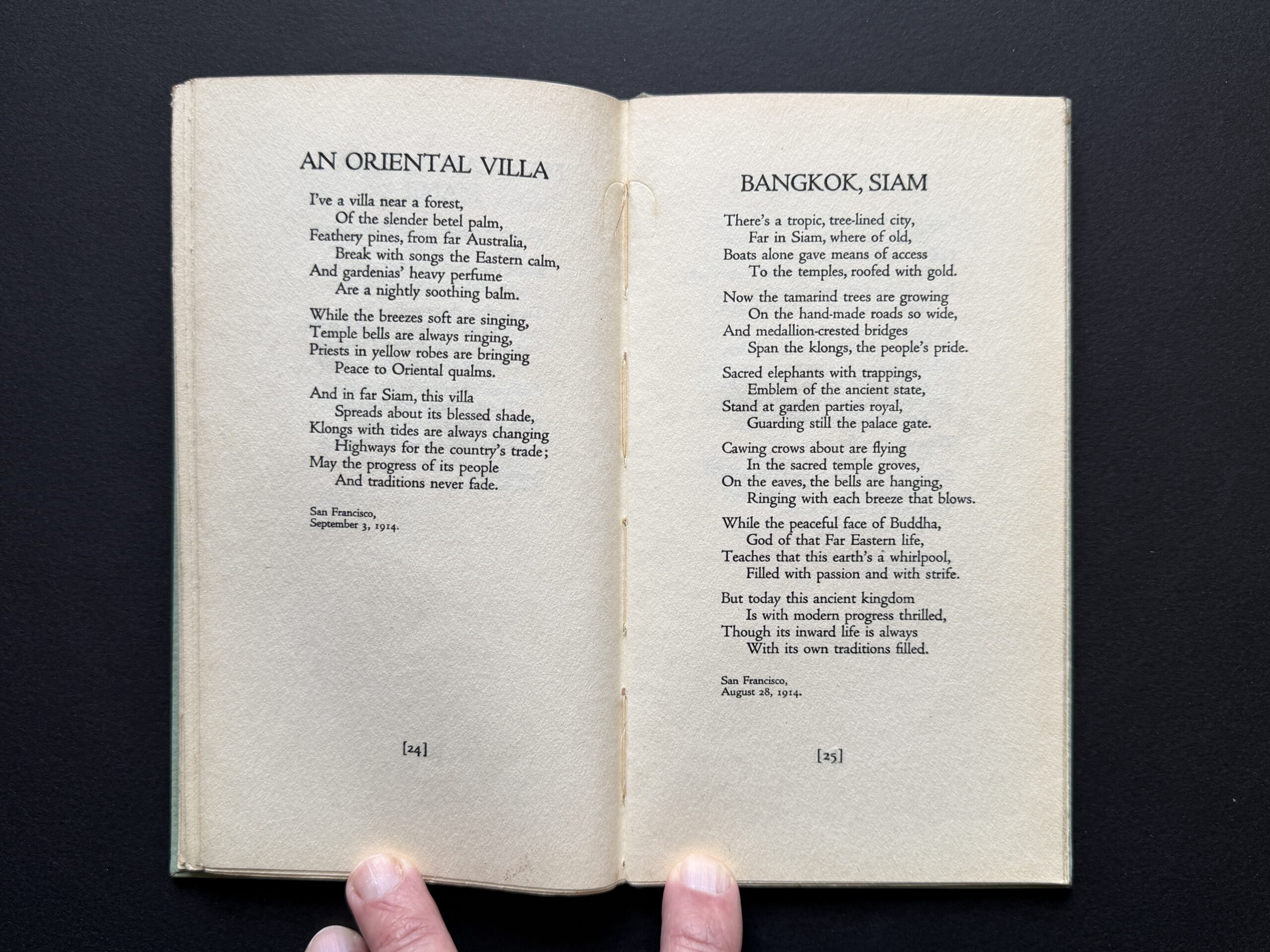
Fred Warner Carpenter had an eventful life: secretary to a President, diplomat to Morocco and Siam (now Thailand). Between 1911 and 1914, he composed a number of poems about those places and his experiences there. In November 1914, Paul Elder published Carpenter’s collected poems as Verses from Many Seas. The poems are pleasant if simplistic, with few risks taken, and return often to the same poetic meters.
Frederick Warner Carpenter was born on 12 December 1873 in Sauk Centre, Minnesota, the son of Ira M. Carpenter, a farmer, and Eva Augusta Wright. The family moved to California when Fred was twelve, and he spent his teenage years on a ranch near San Luis Obispo. After attending public schools and a local academy, returned to the University of Minnesota to study law, and was admitted to the bar in Minnesota and California in 1898.1New York Times, 6 March 1909, p1 He worked as a stenographer to Charles S. Wheeler at Bishop & Wheeler in San Francisco, before resigning to take the job that would launch his career: stenographer to federal judge William Howard Taft as he headed to the Philippine Islands as chairman of a commission to organize a civilian government. When Taft was installed as Philippines governor in 1901, Carpenter became his private secretary. Carpenter remained Taft’s secretary as he was appointed Secretary of War in 1904, then elected President of the United States in 1908.2Marquis’s Who Was Who in America, Volume V, 1969-1973, p117
On Taft’s first day as President, 6 March 1909, the New York Times described Carpenter as Taft’s “veritable shadow.” His long association with Taft came to an abrupt end on 27 May 1910, when Carpenter resigned his post in order to become Envoy Extraordinary and Minister Plenipotentiary to Morocco. Officially, a White House statement said that “the appointment of Carpenter to Morocco was made on his own application to be relieved of the duties of secretary to the president, which had been so heavy upon him as to threaten his health. The president thought that as Morocco has a delightful climate the change of duty which this would afford was wise and consented to Carpenter’s resignation of this present position.” Behind the scenes, as reported by the Call, Taft was likely embarrassed by a statement Carpenter issued about embattled Interior Secretary Ballinger, as well as the transmission of a list of congressmen that had met with Taft during his trip to the South. Essentially, Carpenter was being “kicked upstairs.”3San Francisco Call, 28 May 1910, p1
Carpenter was officially received by a representative of the Sultan two months later, on 27 July. In September 1912, he left Morocco to become Envoy Extraordinary and Minister Plenipotentiary to Siam, which he held until November 1913.4https://history.state.gov/departmenthistory/people/carpenter-fred-warner, accessed 28 Jan 2026 By 1917, he is working at the Mission Savings Bank at 16th and Valencia in San Francisco, perhaps as their attorney. By 1930, he appears to have retired.
Carpenter never married and had no children. He died on 27 August 1957 at his home in San Anselmo in Marin County, and is buried at the Kelseyville Cemetery in Kelseyville, Lake County, California.
In the printed checklists and indexes, Carpenter’s name is mistakenly given as Fred Carpenter Warner.
- 1New York Times, 6 March 1909, p1
- 2Marquis’s Who Was Who in America, Volume V, 1969-1973, p117
- 3San Francisco Call, 28 May 1910, p1
- 4https://history.state.gov/departmenthistory/people/carpenter-fred-warner, accessed 28 Jan 2026