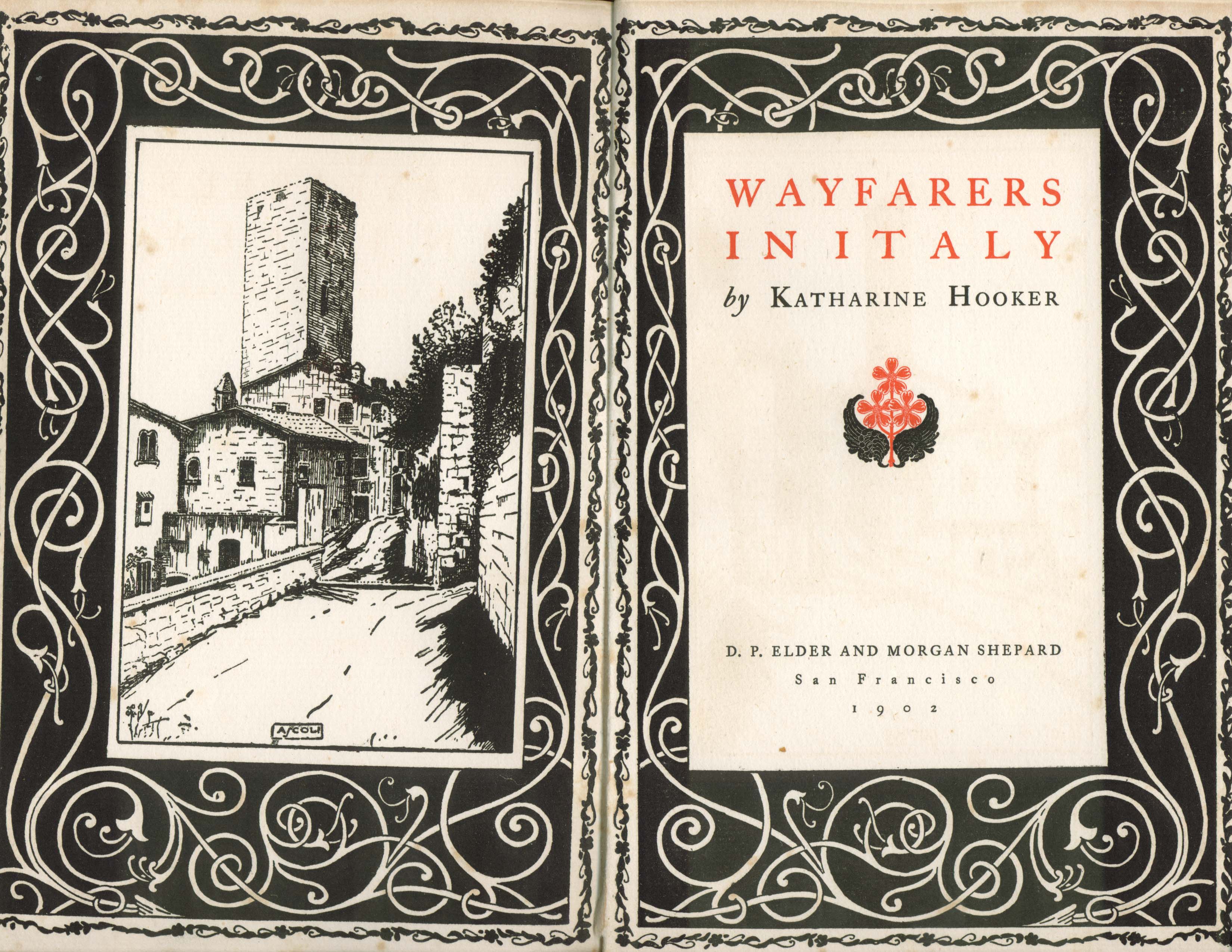
Katharine Hooker’s Wayfarers in Italy is perhaps the finest book issued by Elder & Shepard during their five-year partnership. It was printed in 1901 at the Stanley-Taylor Company on hand-made Ruisdael paper in two different limited editions of 100 and 300 copies. The The title page decorations and illuminated chapter headings were almost certainly designed by Morgan Shepard, and the book contains many photographs taken by Katharine’s daughter Marian. In 1902, Scribner’s bought publication rights the book from Elder; their edition of Wayfarers went through four printings by 1905.
It’s not clear how many copies of Wayfarers in Italy were offered for sale to the public. The colophons suggest that only the fancy 100-copy edition was offered for sale, but the 1902 Elder & Shepard holiday catalog reads “private edition of four hundred copies of which two hundred are for sale.” Even more confusing, my copy of the 300-copy edition has no binding, and appears never to have had one.
Hooker (1849-1935), born Katharine Mussey Putnam in Milwaukee, Wisconsin, grew up privileged and well-connected in turn-of-the-century California. She had an active, athletic youth, climbing Half Dome in Yosemite Valley and hiking the Grand Canyon: feats very rare for a woman in the 1860s. She learned French and German as a teenager, and had a lifelong interest in books.
In 1869, Katherine married John Daggett Hooker, who became wealthy in the ironworks industry. This allowed her to take an extended trip to Europe in 1896 with her daughter Marian and family friend Samuel Marshall Ilsley (author of By the Western Sea, Elder & Shepard’s first publication). She and Marian returned to Italy in 1899 (by which time Katherine had also become fluent in Italian), and it was this trip that became the basis for Wayfarers. The commission came to Elder & Shepard through Katharine’s sister Mary Putnam, who was married to Morgan Shepard. Katharine also wrote two other travel books about Italy, Byways in Southern Tuscany (Scribner’s, 1918) and Through the Heel of Italy (Rae D. Henkle Co., 1927).

Hooker’s prose is enjoyable, and if she uses the passive voice a bit too often, I forgive her. She is adept at painting a gauzy, romantic picture of warm Italian summer afternoons, while also recounting amusing and interesting conversations with the locals. In Milan’s Museo Poldi-Pezzoli, Hooker and her daughter fail to find a certain Madonna and Child listed in their catalog; they quiz the custodian without success, but later he escorts them into a private room to show them the painting. In Ancona, she delightfully describes a heaping plate of light, fluffy fritto misto. In Venice, they strike up a friendship with their gondolier, Giovanni, who teaches them about the hardships and politics of his profession. Hooker’s visit to Siena can be dated to August 1899 because she witnessed the Palio on August 16th, where the contrada of Lupa was victorious. And if you are an experienced visitor to modern Italy, you will shake your head on almost every page as you think about how much has changed in the last 110 years.
Marian Osgood Hooker (1875-1968) also had a notable life. She became a physician and published numerous medical and scientific books, in addition to being a prominent amateur photographer. In 1903, Marian became the first woman to climb Mt. Whitney (the tallest mountain in the contiguous 48 states, named in honor of her great-uncle Josiah Whitney), in a party that included family friend and famed naturalist John Muir.

Elder & Shepard’s edition of Wayfarers in Italy is rare because so few were printed, but the Scribner’s edition is easier to find. Here is one vintage book you will enjoy reading.