
Today Charles Keeler is known as a poet and author of The Simple Home, but in the 1890s he was best known as a naturalist. After graduating from the University of California, Berkeley, he rather remarkably landed a plum job at the California Academy of Sciences (then located on Market Street in San Francisco) as director of their Natural History Museum. In 1893, he wrote a long monograph for the Academy called “Evolution of the Colors of North American Land Birds,” a work admired at the time but whose science is today almost completely discredited.
By the end of the decade Keeler had decided that academia was not his cup of tea, and channeled his scientific work into writing for the armchair naturalist. Keeler’s slim 1899 volume A First Glance at the Birds was the first Elder & Shepard publication that garnered enthusiastic reviews. The San Francisco Chronicle wrote:
A beautiful little book is “A First Glance at the Birds.” . . . The publishers, Elder & Shepard, have given the book an artistic dress, printing it in large, clear type on fine opaque English deckle-edged paper. The title is in red and black, and the binding is ornamental brown paper. Mr. Keeler is an enthusiast about birds, and he writes of the various feathered dwellers in California fields and wood with the familiarity and appreciation of an old friend.1San Francisco Chronicle, 23 September 1899.
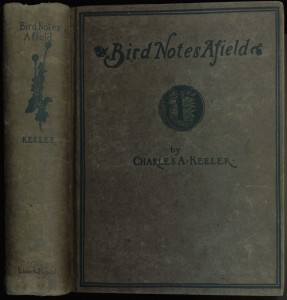
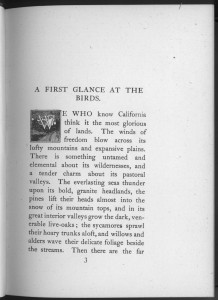
Heartened by the reviews, Elder & Shepard soon published an entire book by Keeler that same year, Bird Notes Afield, with the text of A First Glance at the Birds incorporated as the first chapter. Keeler describes the joys of birdwatching in his usual florid style:
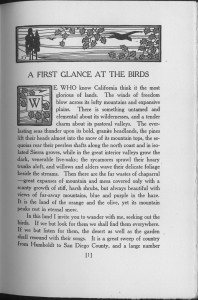
We who know California think it the most glorious of lands. The winds of freedom blow across its lofty mountains and expansive plains. There is something untamed and elemental about its wildernesses, and a tender charm about its pastoral valleys. The everlasting seas thunder upon its bold, granite headlands, the pines lift their heads almost into the snow of its mountain tops, the sequoias rear their peerless shafts along the north coast and in isolated Sierra groves, while in the great interior valleys grow the dark, venerable live-0aks; the sycamores sprawl their hoary trunks aloft, and willows and alders wave their delicate foliage beside the streams. … In this land I invite you to wander with me, seeking out the birds. If we but look for them we shall find them everywhere. If we but listen to them, the desert as well as the garden shall resound with their songs.

Keeler then proceeds to describe the native birds of California from loon to lark, from gull to grosbeak:
If the junco is merry, the kinglets are the incarnation of feathered light-heartedness. No larger than your thumb, these little midgets are full of restless animation and nervious enthusiasm.
and
In the late afternoon the russet-backed thrushes begin their ethereal caroling, and presently the western night-hawk hies him from the privacy of his woodland retreat where his mottled brown plumage blends with the tree trunks.
Keeler organized Bird Notes Afield as a sort of calendar, with chapters such as “January in Berkeley,” “A Trip to the Farallones,” “April in Berkeley,” “Summer Birds of the Redwoods,” and “Nesting Time.” He paid particular attention to his home town of Berkeley, as a naturalist writes about what he sees and what he knows.
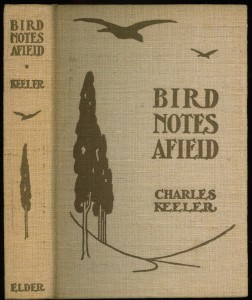
Bird Notes Afield proved a popular title for Elder and Shepard. Originally published in October 1899, there was a second printing in May 1900. Indeed, the book was so popular that Paul Elder & Company published an enlarged second edition in April 1907, with a new preface and index, and issued with a dust jacket. Two cover variants have been seen, one with buckram over boards, the other with smooth brownish-green cloth over boards.
Updated 2025-12-21



- 1San Francisco Chronicle, 23 September 1899.