Fairy Tales Up-to-Now

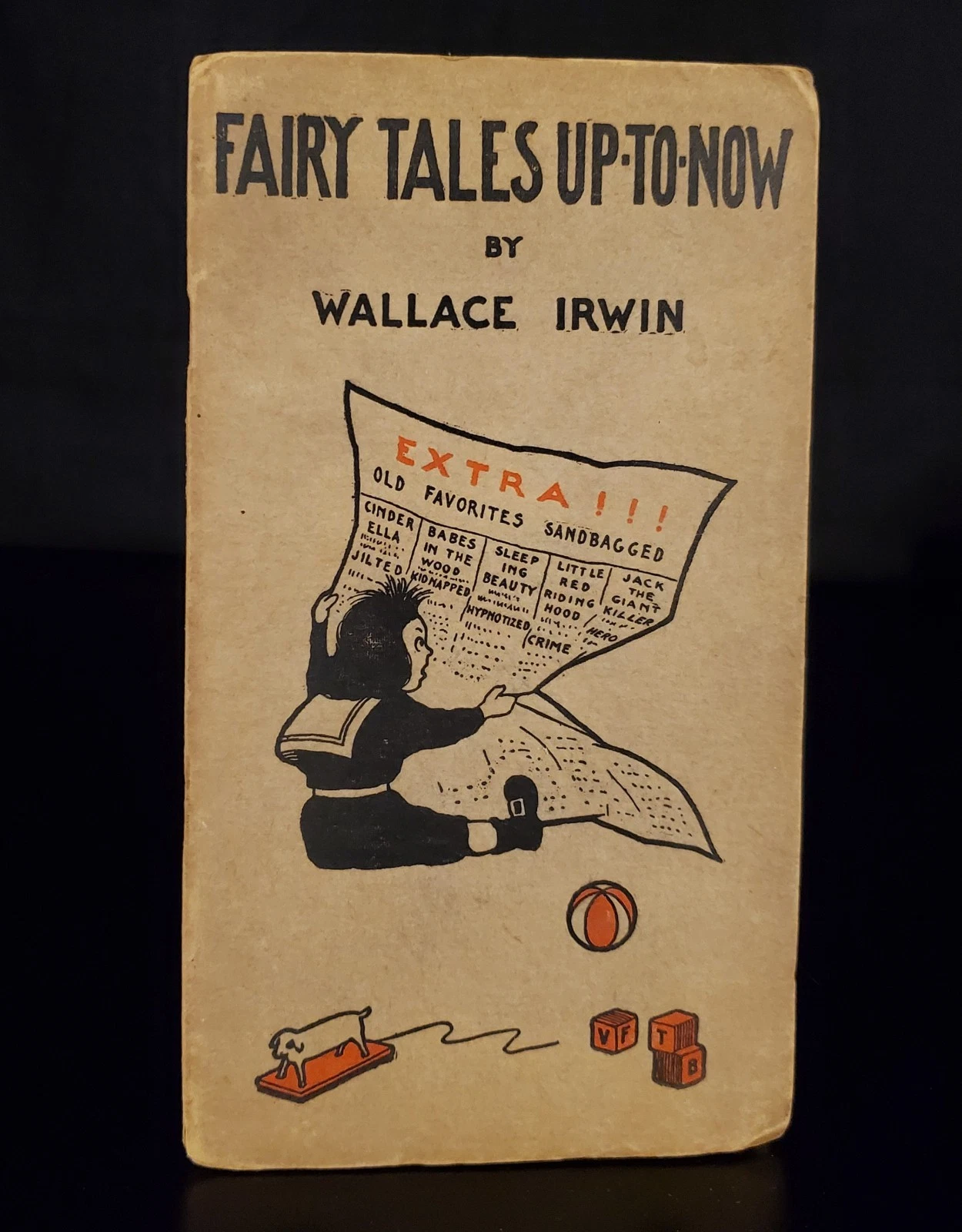
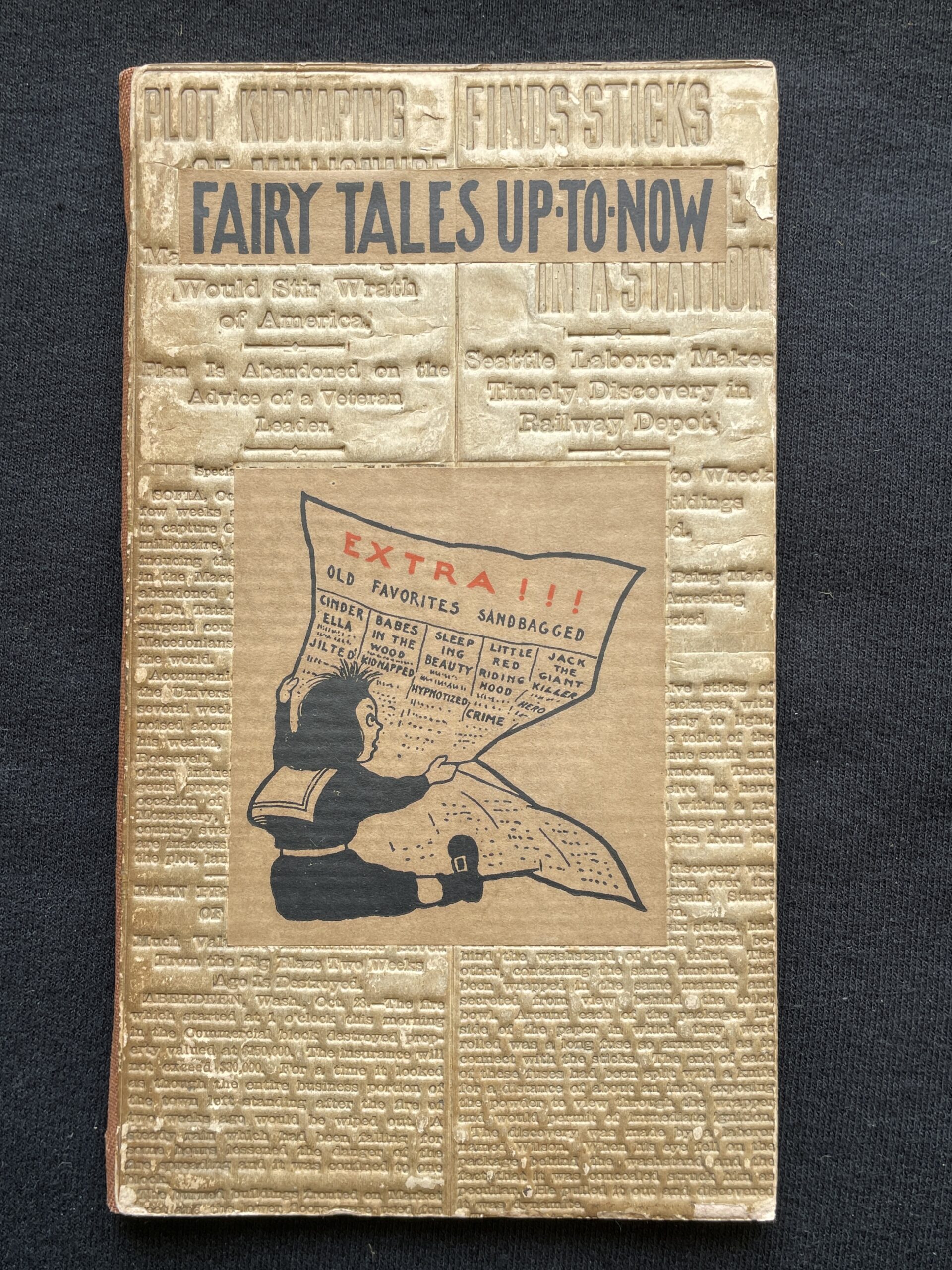
Cover of Fairy Tales Up-to-Now, a flong from the San Francisco Call of 29 October 1903, page 2.

Extra, extra, read all about it! Wallace Irwin rewrites old fairy tales!

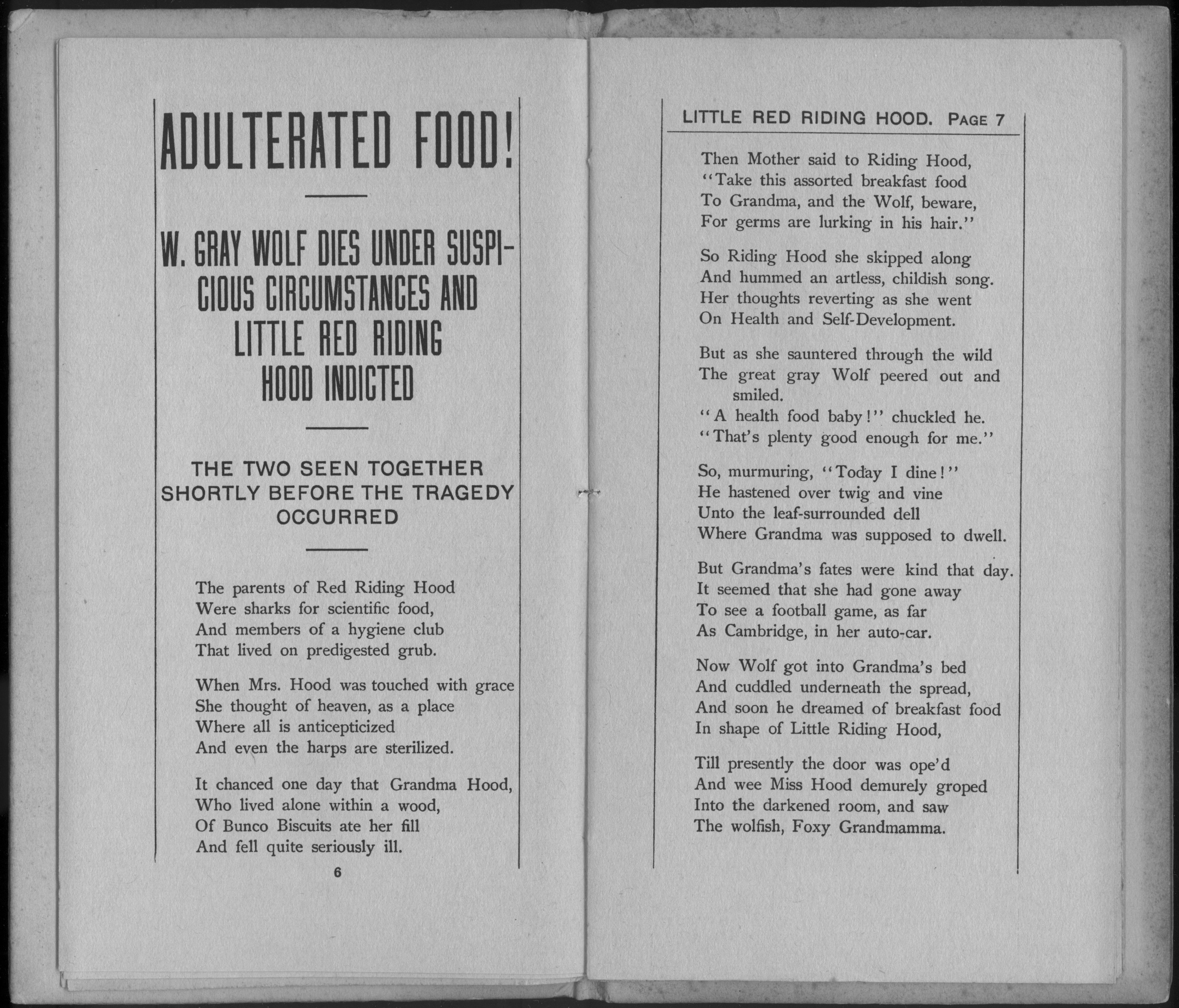
In contrast to Irwin’s Love Sonnets of a Hoodlum, whose humor is obscure to modern readers, his 1904 Fairy Tales Up-to-Now is fairly accessible. The book contains five poetical satires of five classic children’s stories titled with tabloid newspaper headlines. Cinderella, a stenographer working for 50¢ a day, goes to the ball in a rented gown, but when the Prince discovers that her diamond slippers are just paste, he rejects her because he’s broke and needs a bride who’s wealthy. Cinderella, though, becomes a millionaire by selling faux-diamond slippers. Jack, of Beanstalk fame, rides off to slay the Standard Oil Giant, but is given a job instead, rises to the rank of treasurer and becomes a Giant himself, but then returns home to endow a library, gas-works and church. 

A charming feature of the book are the front and back covers, which are flongs, temporary paper molds used for printing newspapers. Stereotype metal was poured over the flong, then the stereotype was wrapped around the press’s cylinder for printing. After a few thousand copies, the stereotype metal would begin to wear out: at this point it would be melted down, then poured again over the same flong to make a new sharp copy for printing. Once the day’s press run was finished, the flongs were normally discarded, but here they were sent to Elder to be chopped up into covers. Each individual copy of  Fairy Tales Up-to-Now is therefore unique.
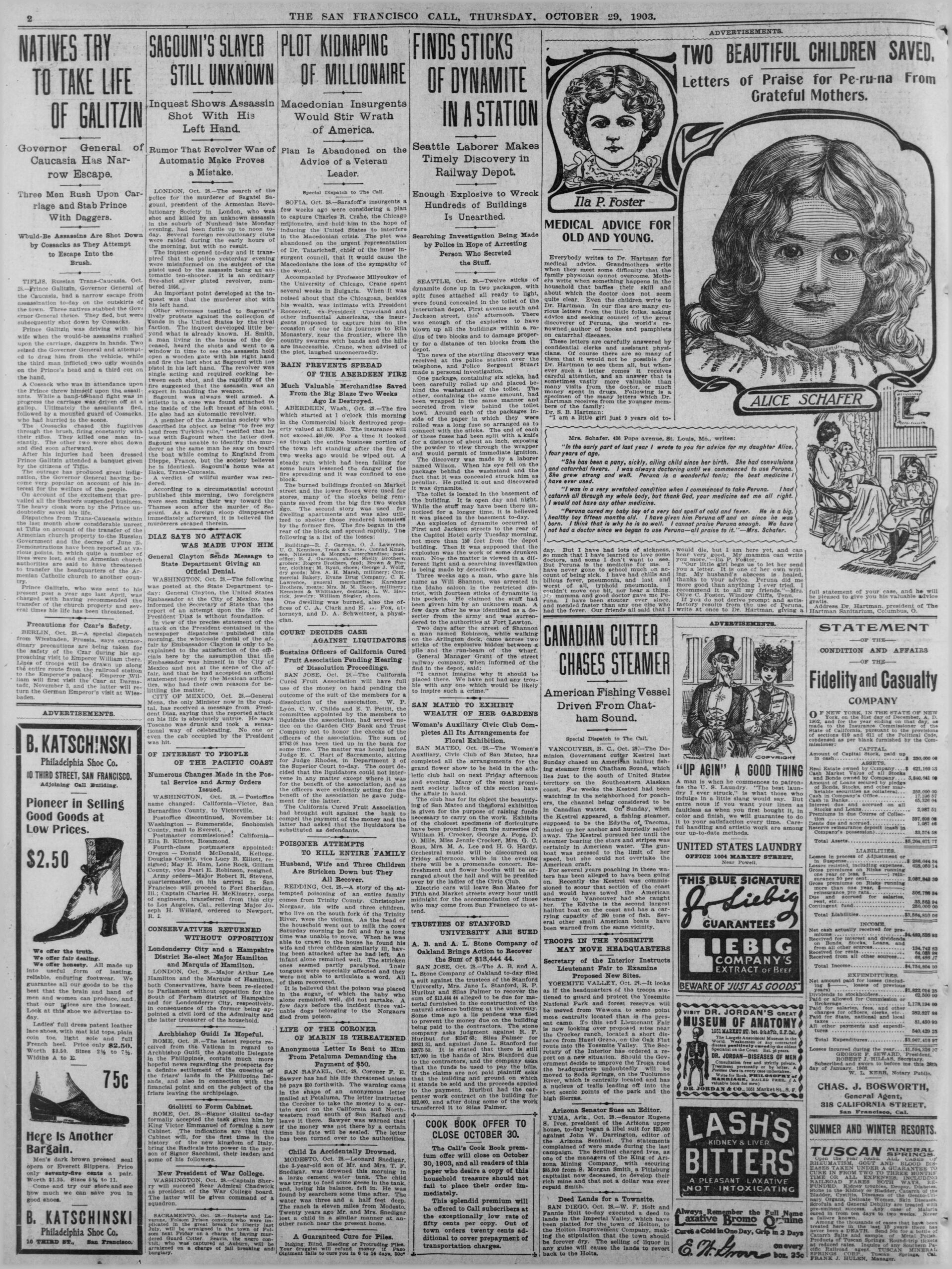
The San Francisco Call, 29 October 1903, page 2. This is the page printed from the above flong (tops of columns 3-4).

With a newspaper index service, it is possible to find the exact page a given flong was used to print. The example on this page is from the San Francisco Call of 29 October 1903, page 2. The flong would originally been the size of the entire newspaper page, but just the tops of columns 3 and 4 are used as the book cover. Presumably, other copies of Fairy Tales Up-to-Now exist somewhere bound with other sections of this page 2 flong. All copies examined so far have been from the Call, but Elder may have used flongs from other local newspapers as well.

The rear cover of Fairy Tales Up-to-Now is also a flong, but there was no attempt to match up flongs from the same page or date. Our example copy’s back cover is from 4 October 1903, molded three weeks before the flong used on the front cover.

Fairy Tales Up-to-Now was also issued in paper wraps instead of flongs, no doubt cheaper but far less whimsical.

Thanks to Molly Schwartzburg and Andre Chaves for information about flongs.

Updated 2026-01-22
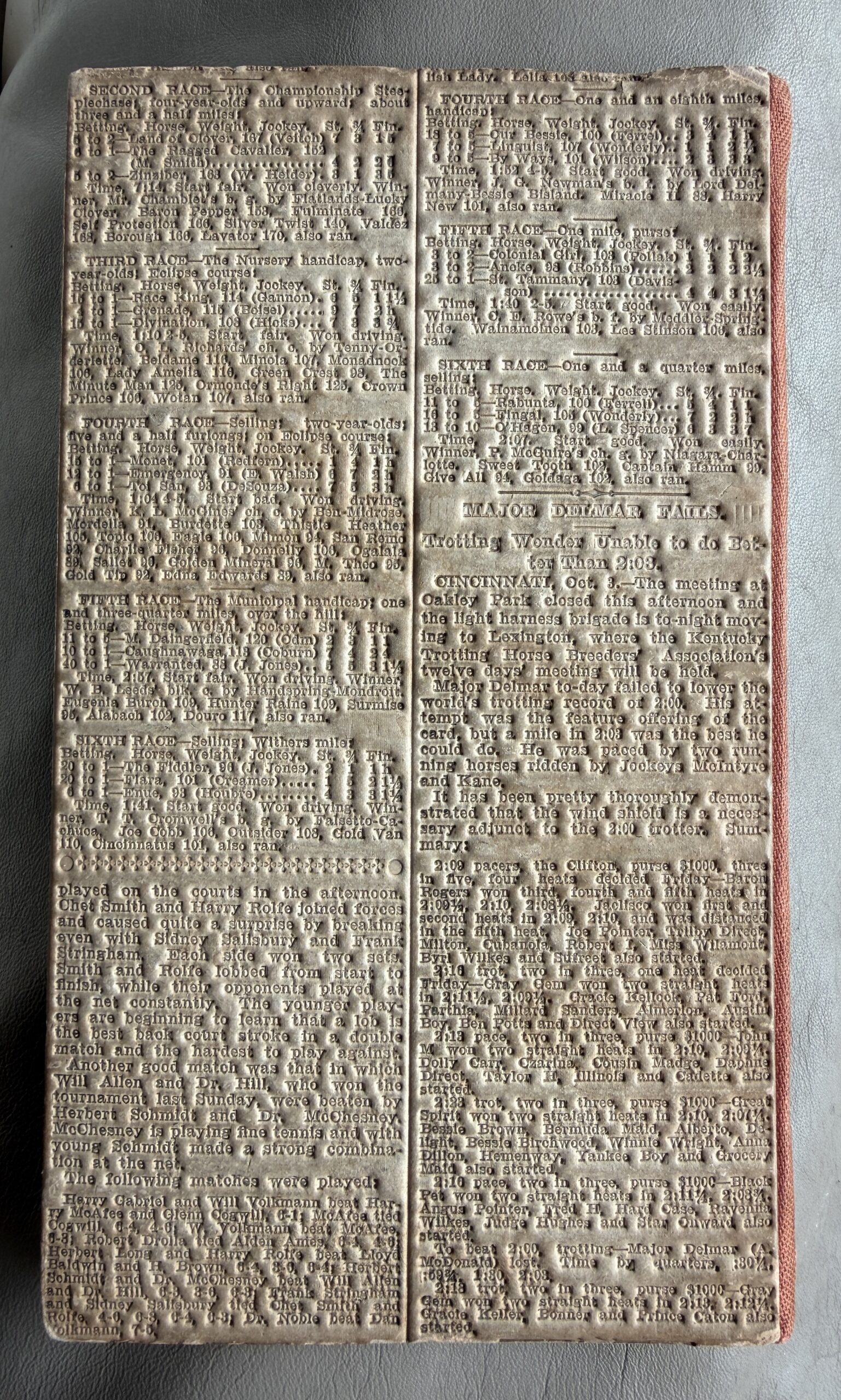
The back cover of the same copy of Fairy Tales Up-to-Now, used to print the Call of 4 October 1903, page 35, columns 3 and 4.
Alternate paper binding of Fairy Tales Up-to-Now. But why would you buy this one when you could have a flong?
Fairy Tales Up To Now title
Title page of Fairy Tales Up-To-Now
Fairy Tales Up To Now p06
pages 6-7 of Fairy Tales Up-To-Now
Fairy Tales Up To Now p10
pages 10-11 of Fairy Tales Up-To-Now

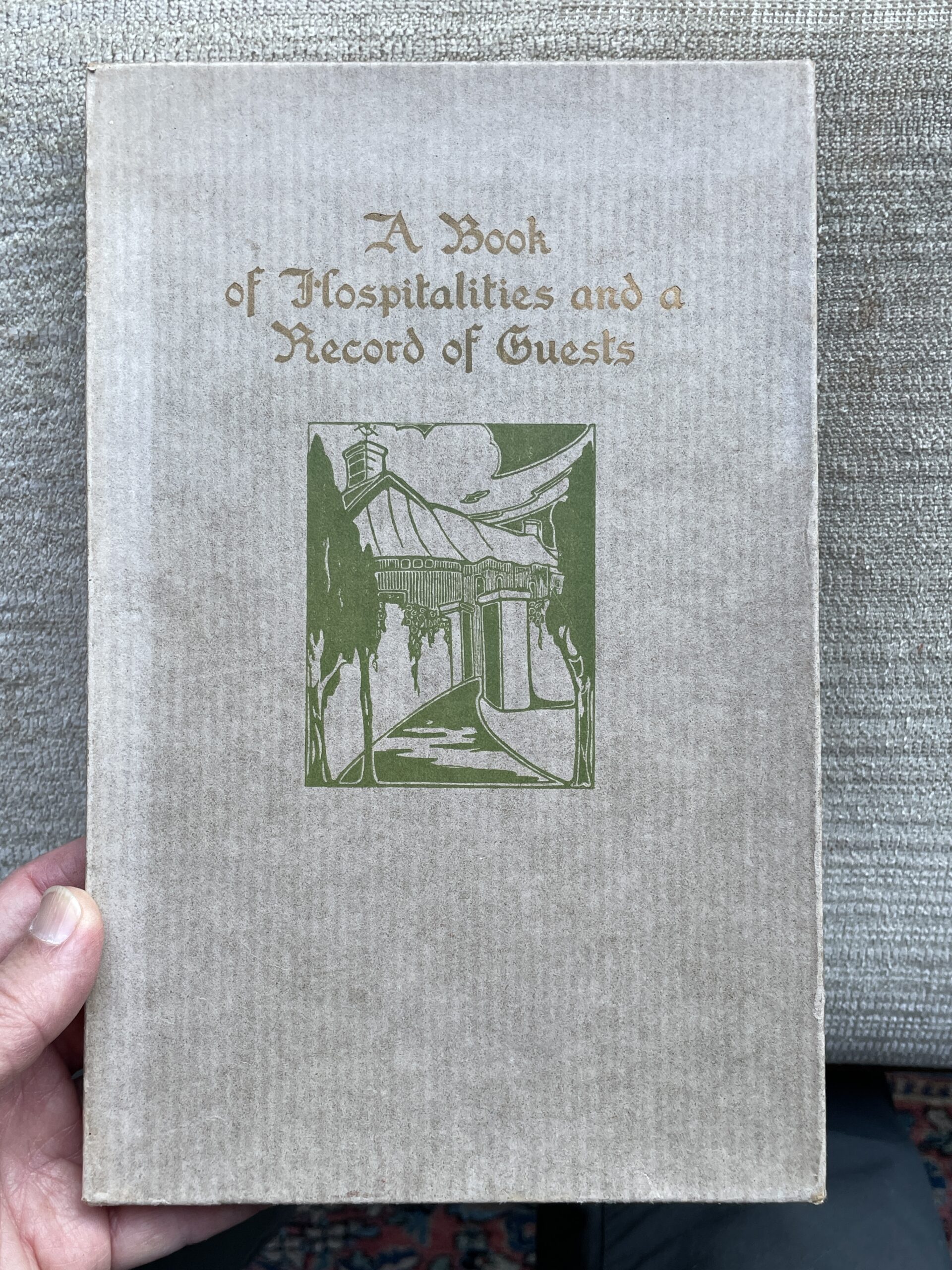
A Book of Hospitalities and a Record of Guests

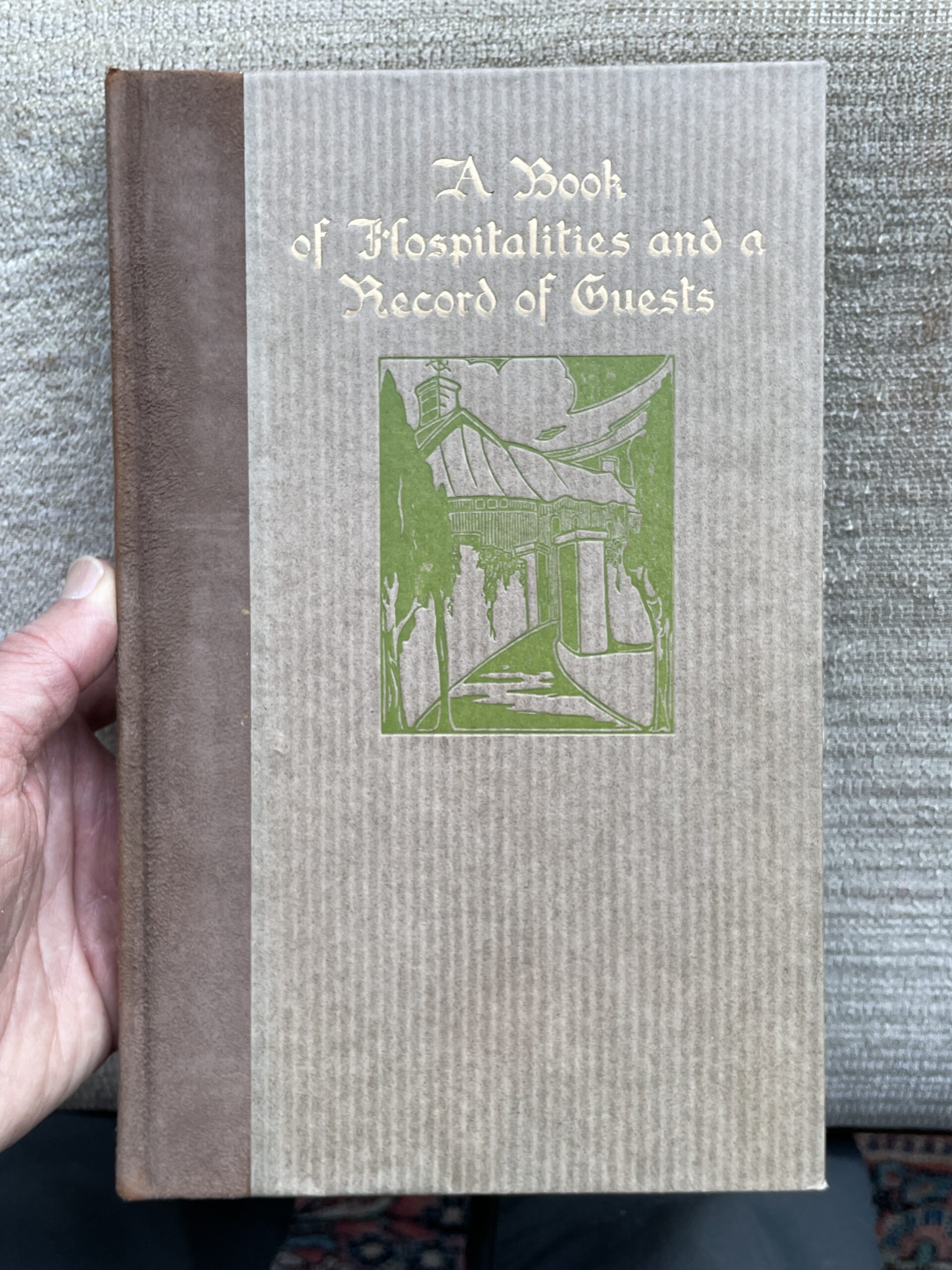
Cover of A Book of Hospitalities, paper on boards

Guest books aren’t seen much today except at weddings and funerals. It seems they were more popular in the early 1900s, as Paul Elder published four guest books between 1904 and 1910.

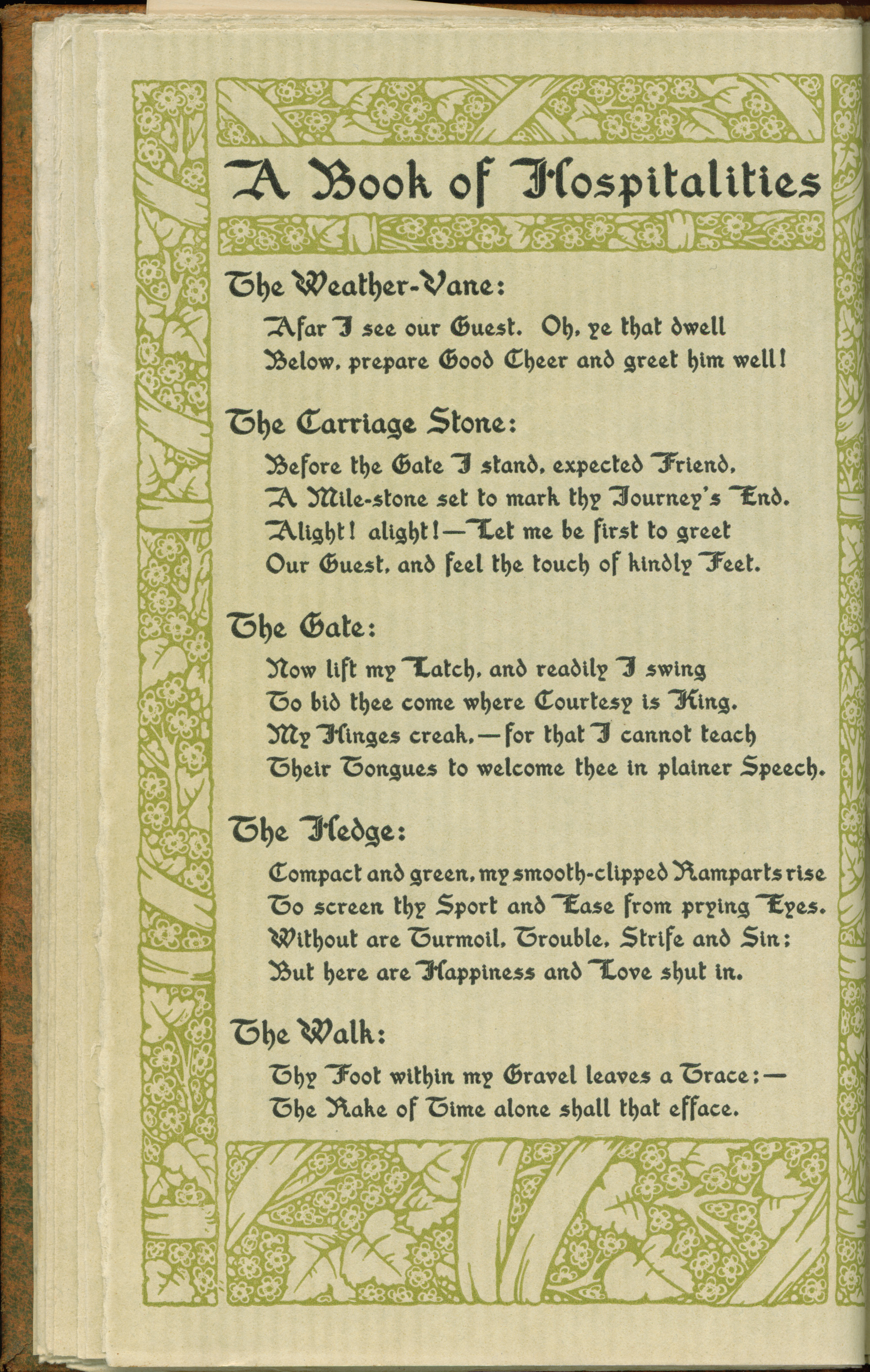
Arthur Guiterman’s Book of Hospitalities And a Record of Guests (1910) was probably intended to be placed in the guest bedroom. The first section (“A Book of Hospitalities”) contains a selection of sayings and epigrams for the house, and the second half (“A Record of Guests”) contains blank areas for the guests to write in. Guiterman was also involved in two other Elder publications: the magnificent 1908 Guest Book with artwork by Robert Wilson Hyde, and the 1907 humor book Betel Nuts, Or What They Say In Hindustan.

Arthur Guiterman (1871-1943) was born in Vienna to American parents and graduated from the College of the City of New York in 1891. He was the author of a dozen books, primarily poetry. He was also editor of Women’s Home Companion and Literary Digest. In 1910, he co-founded the Poetry Society of America (which still exists and celebrated its centennial in 2010), and served as president in 1925.

Book of Hospitalities cover
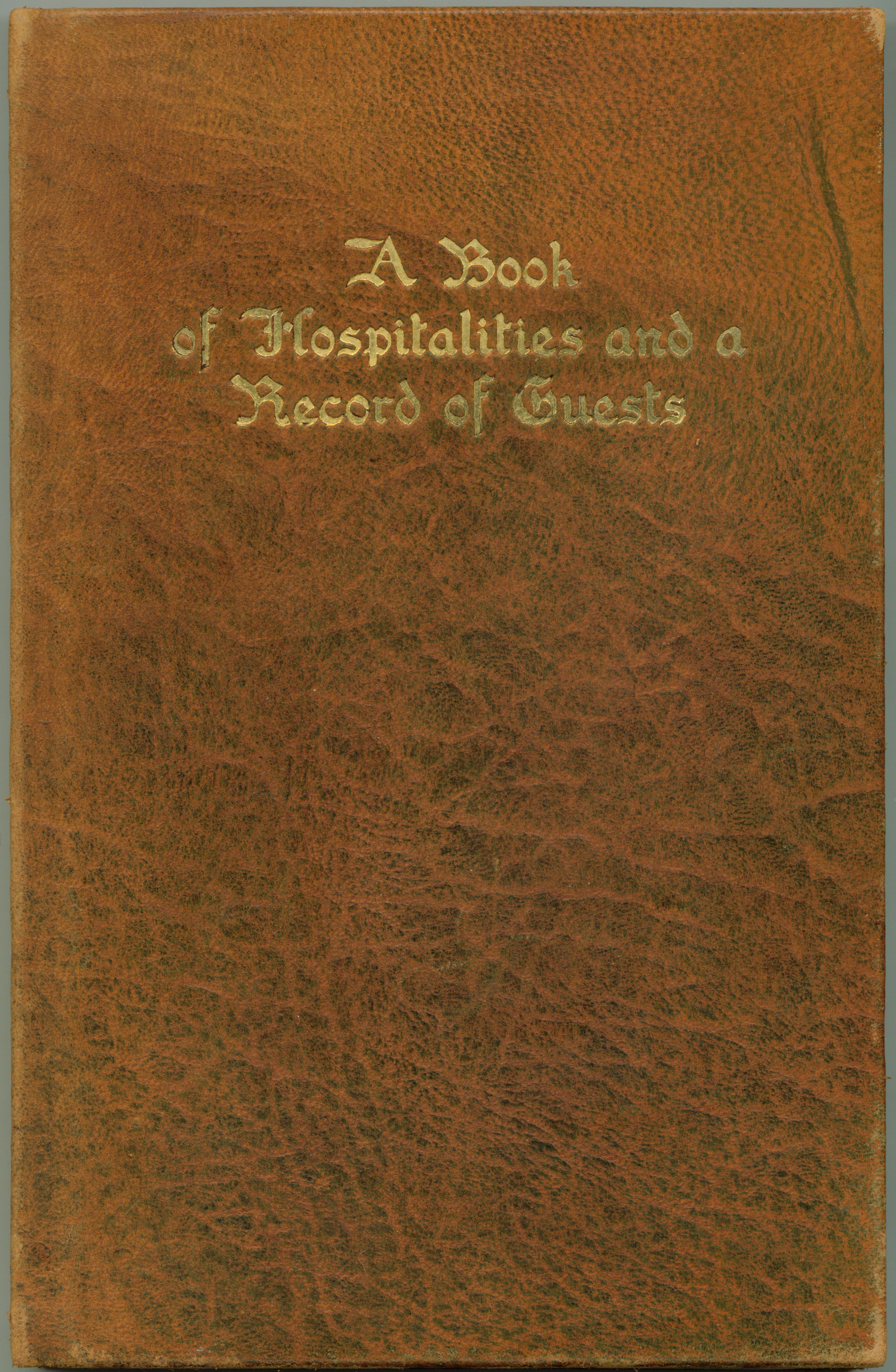
Cover of A Book of Hospitalities, leather on boards

I am particularly fond of Guiterman’s poem entitled “On the Vanity of Earthly Greatness”

The tusks which clashed in mighty brawls
Of mastodons, are billiard balls.
The sword of Charlemagne the Just
Is ferric oxide, known as rust.
The grizzly bear, whose potent hug,
Was feared by all, is now a rug.
Great Caesar’s bust is on the shelf,
And I don’t feel so well myself.

Book of Hospitalities title
Title page of A Book of Hospitalities

A Book of Hospitalities was published in two bindings: paper on boards, and leather on boards, both with a presentation box. If you happen to own a copy of my 2004 Checklist of the Publications of Paul Elder, 2nd edition, you will see that the page borders are taken from Book of Hospitalities.

Updated 2026-01-19

A Book of Hospitalities, presentation box
Book of Hospitalities frontispiece
Frontispiece of A Book of Hospitalities
Book of Hospitalities foreword
Foreword of A Book of Hospitalities


Book of Hospitalities main text
Text of A Book of Hospitalities


Arthur Guiterman
Arthur Guiterman (1871-1943)


Love Sonnets of a Hoodlum

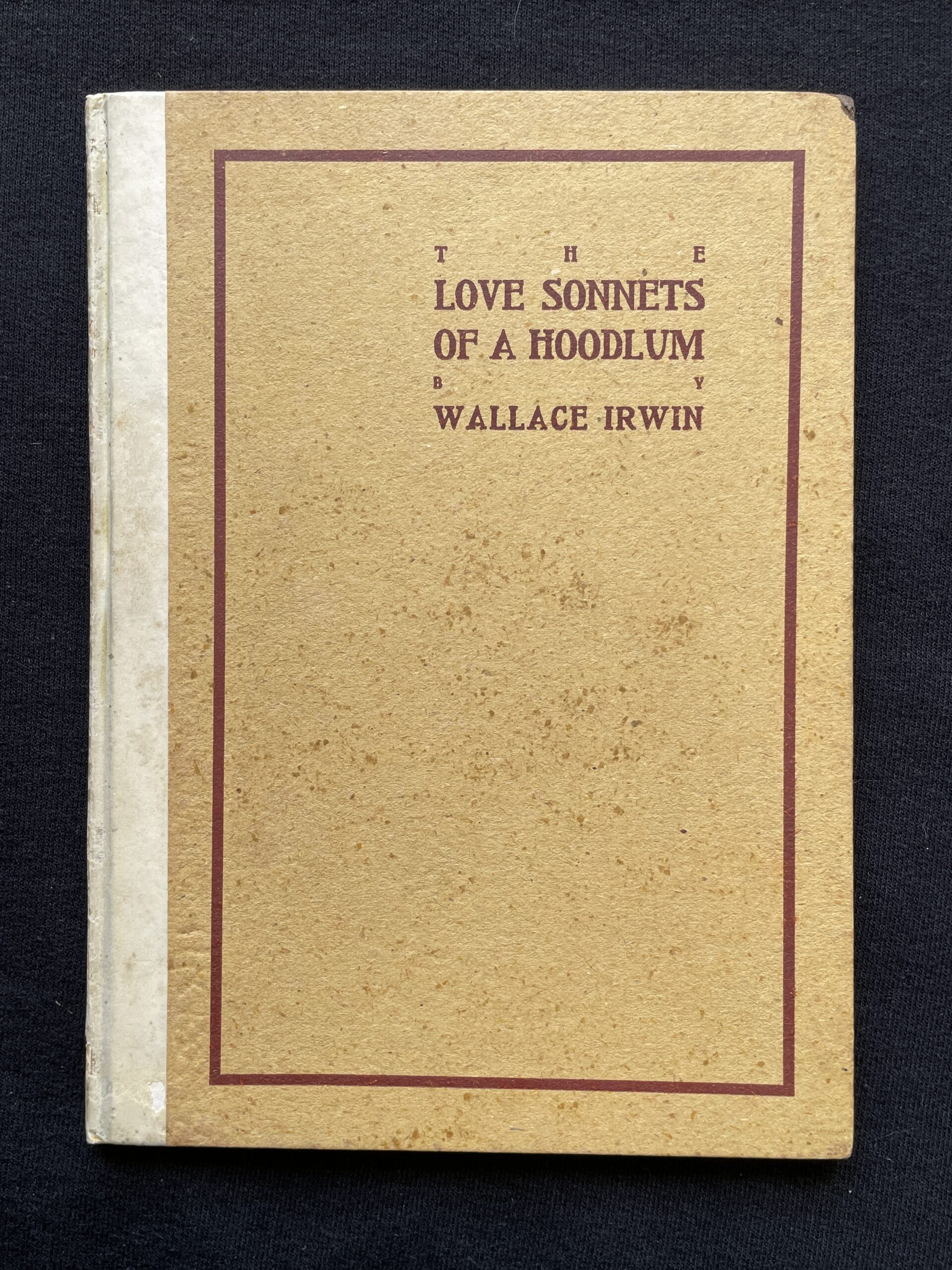
Love Sonnets Hoodlum cover
Rear (L) and front covers of Love Sonnets of a Hoodlum, in red paper wraps

Question: of the 400+ books that Paul Elder published, which one sold the most copies?

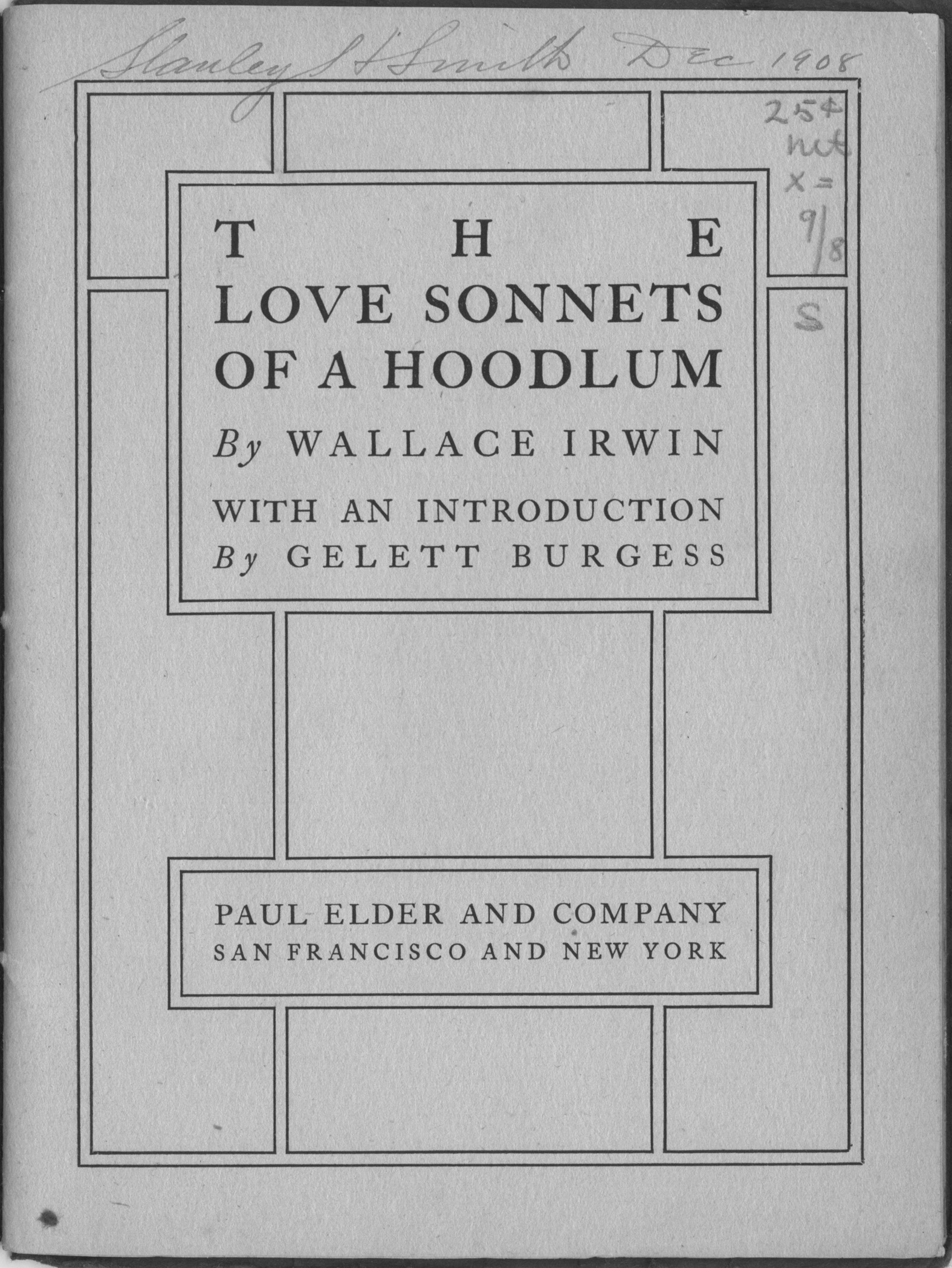
The surprising answer is Wallace Irwin’s Love Sonnets of a Hoodlum. First published in 1901, this slim volume of jaunty verse remained in print at least through 1907. Fellow San Francisco humorist Gelett Burgess (of “Purple Cow” fame) added a mock scholarly introduction. The reviews were lukewarm, particularly of Burgess’s introduction, but sales were like nothing Elder had ever seen. Between November 1901 and March 1902 alone, The Love Sonnets of a Hoodlum sold 12,000 copies.1San Francisco Chronicle, February 23, 1902, p4

Love Sonnets Hoodlum title
Title page of Love Sonnets of a Hoodlum

Wallace Irwin (1875-1959) was a well-known humorist in the early 1900s. Born in Oneida, New York and raised in Colorado, Irwin attended Stanford University where he edited two humor magazines, but was expelled for writing satirical poetry about the faculty. Afterwards, Irwin wrote for the Overland Monthly and San Francisco Examiner, and hung out with the local bohemian crowd. (Getting kicked out of a university seems to have been a requirement for local humorists: in 1894, Gelett Burgess was fired by UC Berkeley after pulling down a statue of pro-temperance campaigner Henry Cogswell. Burgess clearly saw a kindred soul in Irwin.)

For a book that sold so well, its creation was almost an accident. In his memoir, Irwin wrote that Burgess was looking through Irwin’s papers one day and noticed a slang sonnet written some years before. Burgess said, “It would be fun to make that part of a classic sonnet cycle, such as Petrarch wrote.”2Wallace Irwin, “I Look at Me,” typed manuscript, 132–33. Wallace Irwin papers, Bancroft Library, University of California, Berkeley. Irwin continued:

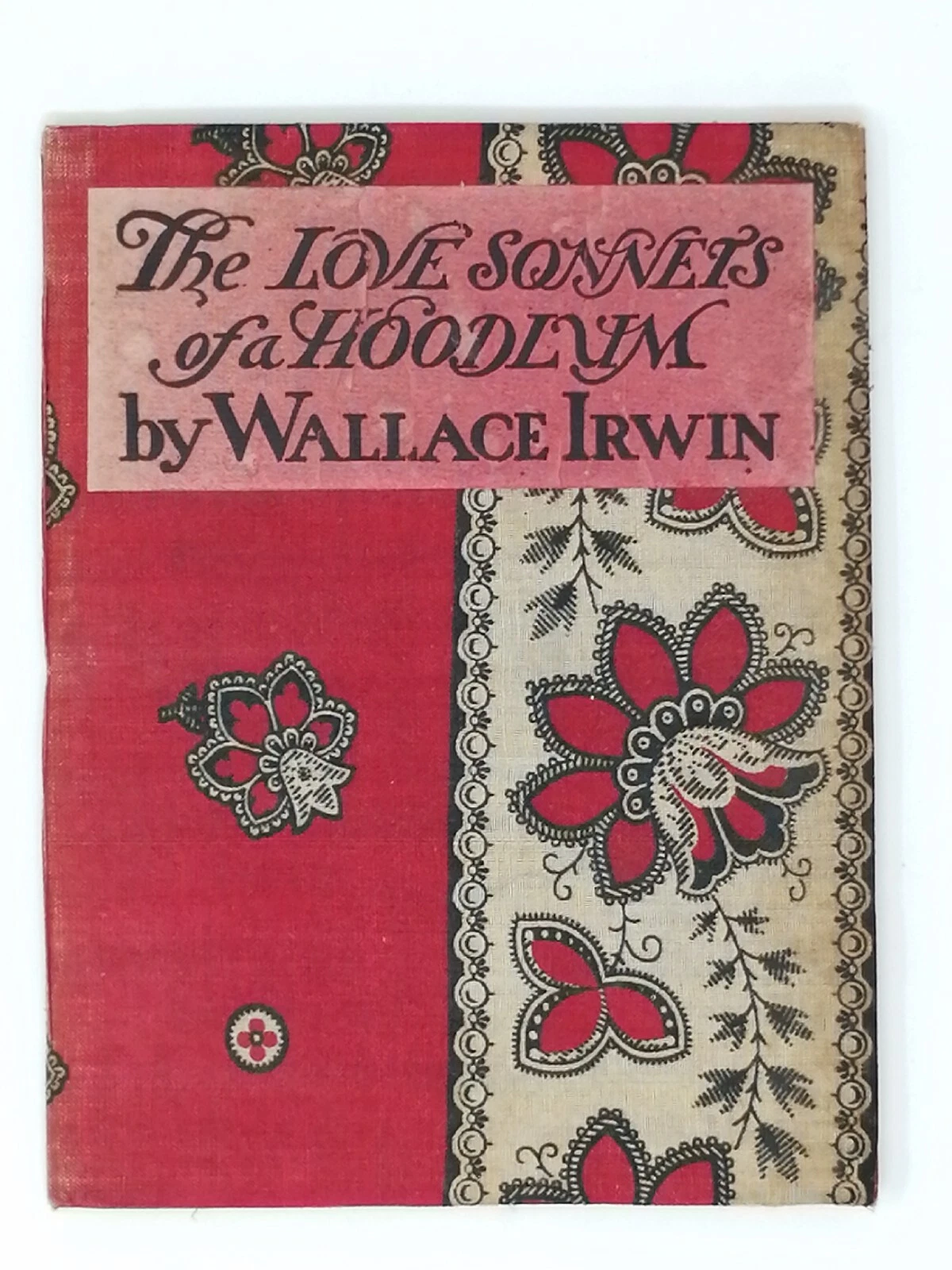
Love Sonnets of Hoodlum in fabric wraps

[The sonnets] rippled off the typewriter with no intention of being more than a literary prank. Burgess was generous enough to write the introduction, a mockpedantic essay in highly styled English. My neighbor Morgan Shepard and his partner Paul Elder recklessly offered to publish it as a sort of a gay pamphlet with a sale price of 25 cents. Its lacquer red paper cover featured the gentle cynicism “Showing how Vanity is still on deck / And humble Virtue gets it in the neck.” The bargain price contributed to its popularity, no doubt. A stingy first edition leaped toward more and larger editions so that the callow author was struck dumb by the prodigy. Reviewers were praising it all over the country. . . . And the sales went up to 130,000.

Autograph edition of Love Sonnets of a Hoodlum

The Love Sonnets of a Hoodlum appeared in both red paper wraps and colorful fabric wraps. Ten fabric-covered examples have been seen so far, all different, and all (with one exception) made with bright white-and-red fabrics similar to the one shown on this page. There was also an autograph edition of 100 copies, in paper over boards.

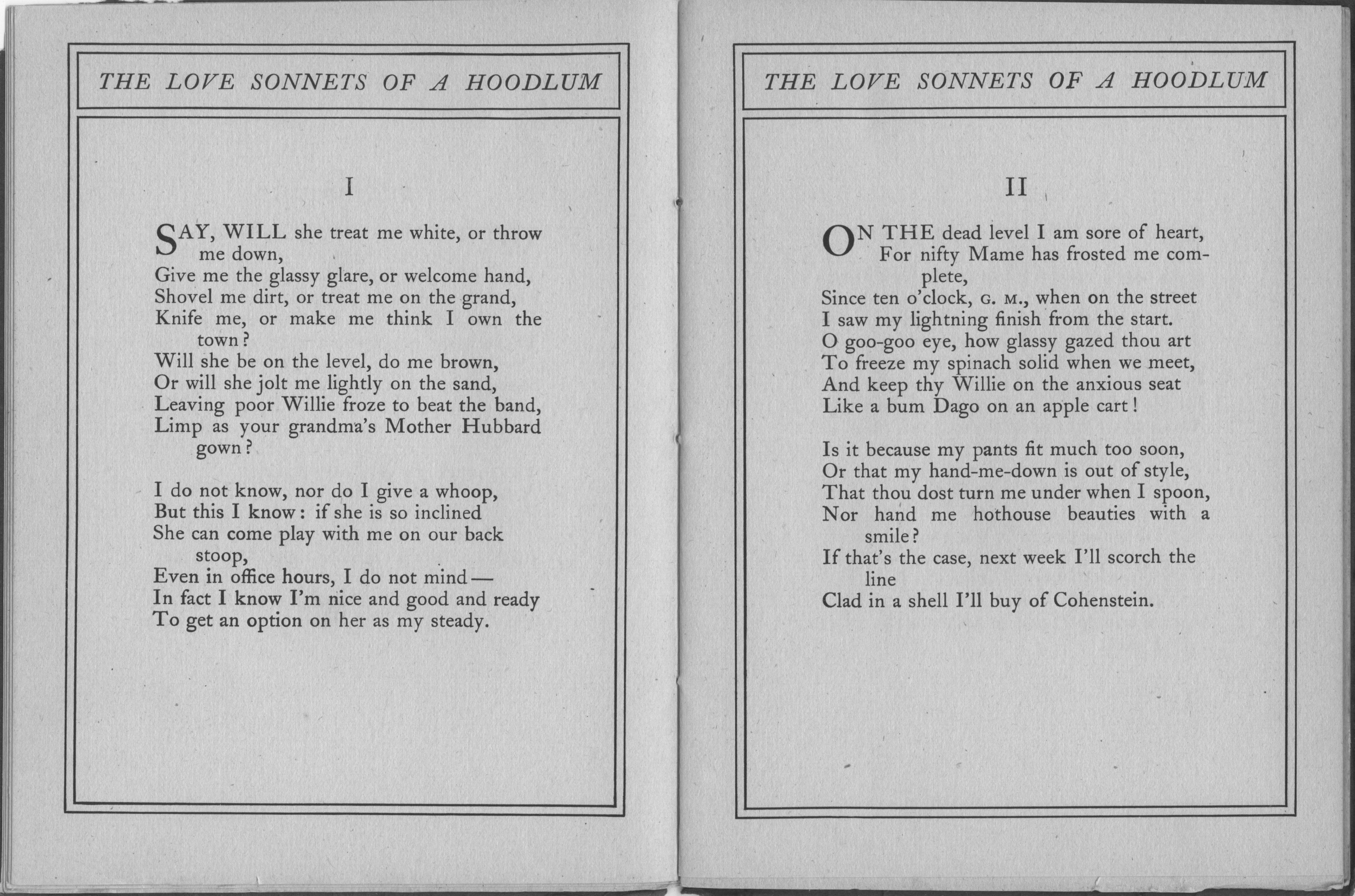
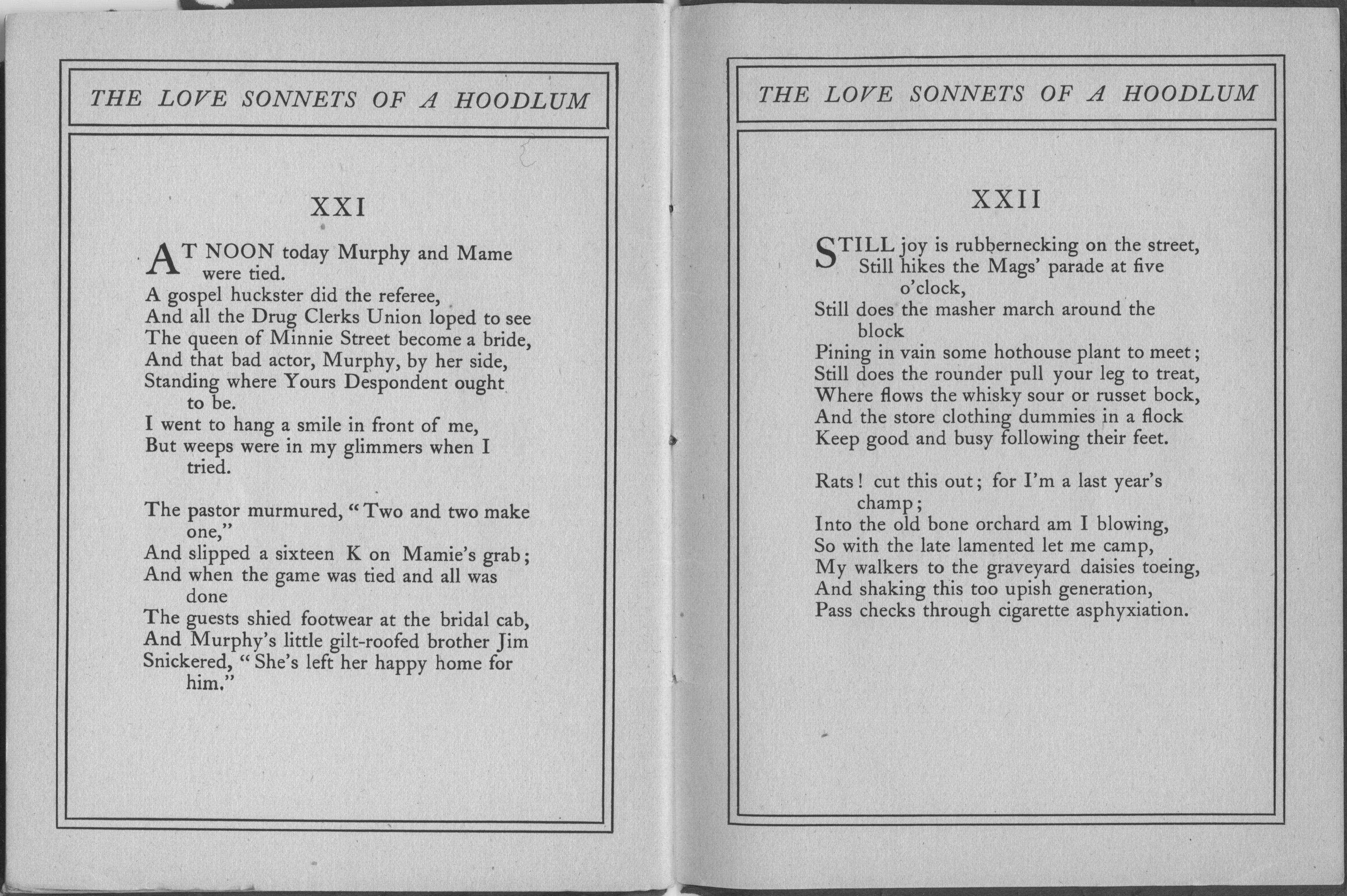
Irwin’s humor has not aged well. In Love Sonnets of a Hoodlum, our hoodlum hero fancies a lady and attempts to win her favor, but neither Irwin’s slang nor his references will be familiar to today’s readers.

Most disturbing to modern sensibilities, however, is Irwin’s racial humor. In Sonnet II below, he caricatures both Italians (“Dago”) and Jews (“Cohenstein”). More was to come: in 1907 Irwin began a long serial for Colliers magazine purporting to be the letters of a 35-year-old Japanese “boy,” going so far as to call the fourth volume Yellow Peril, and posing for the cover photograph himself in yellow makeup.

Irwin wrote many other works, including the 1935 novel The Julius Caesar Murder Case, which is generally credited as the first mystery novel set in antiquity.

Updated 2026-01-19

Love Sonnets Hoodlum prologue
Prologue to Love Sonnets of a Hoodlum
Love Sonnets Hoodlum i
Sonnets I and II
Love Sonnets Hoodlum xxi
Sonnets XXI and XXII


  • 1
    San Francisco Chronicle, February 23, 1902, p4
  • 2
    Wallace Irwin, “I Look at Me,” typed manuscript, 132–33. Wallace Irwin papers, Bancroft Library, University of California, Berkeley.

Animal Analogues

Animal Analogues cover
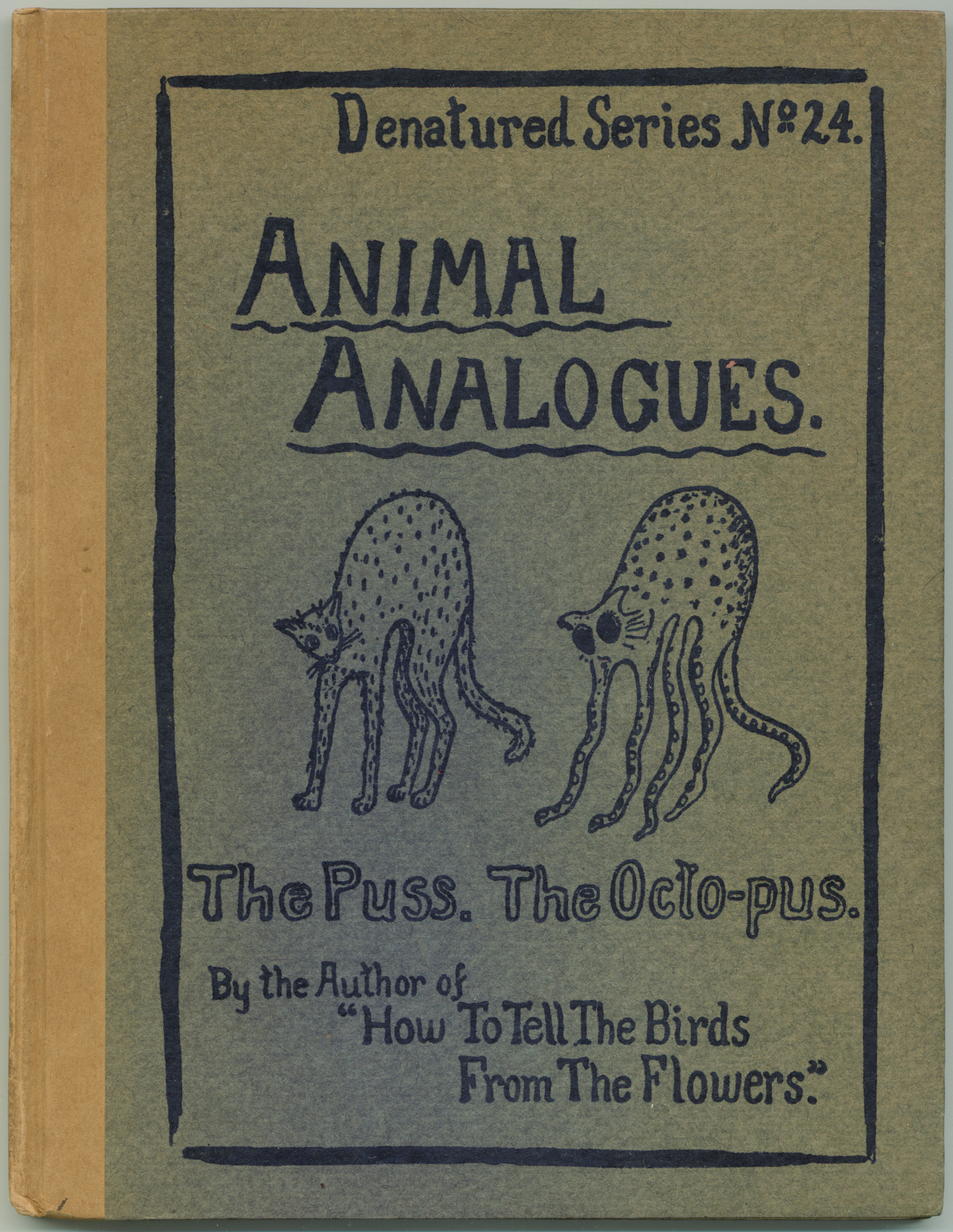
Cover of Animal Analogues

If you liked How To Tell the Birds From the Flowers, then you’ll love Animal Analogues. That’s what Paul Elder thought too, and so in 1908 he published Robert Williams Wood’s sequel to similar acclaim. As any author can tell you, sequels are notoriously difficult to write, but Wood pulled it off, with poetry and drawings to delight old and young alike.

The cover says “Denatured Series No. 24”, but this is a joke, as was the “Nature Series No. 23” on the cover of How To Tell the Birds From the Flowers. Wood wrote no further books in this series.

Updated 2026-01-18

Animal Analogues title
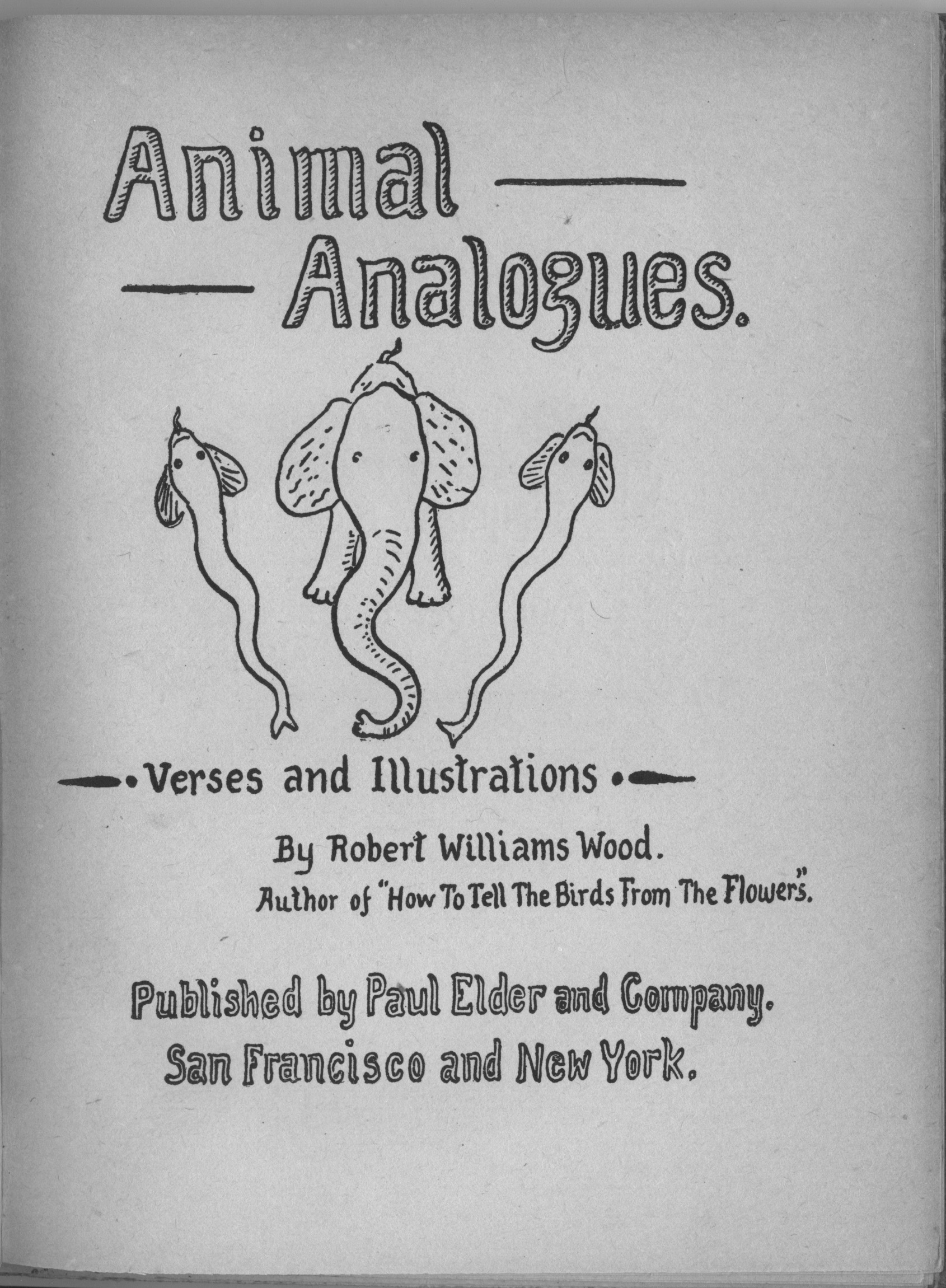
Title page of Animal Analogues
Animal Analogues p10
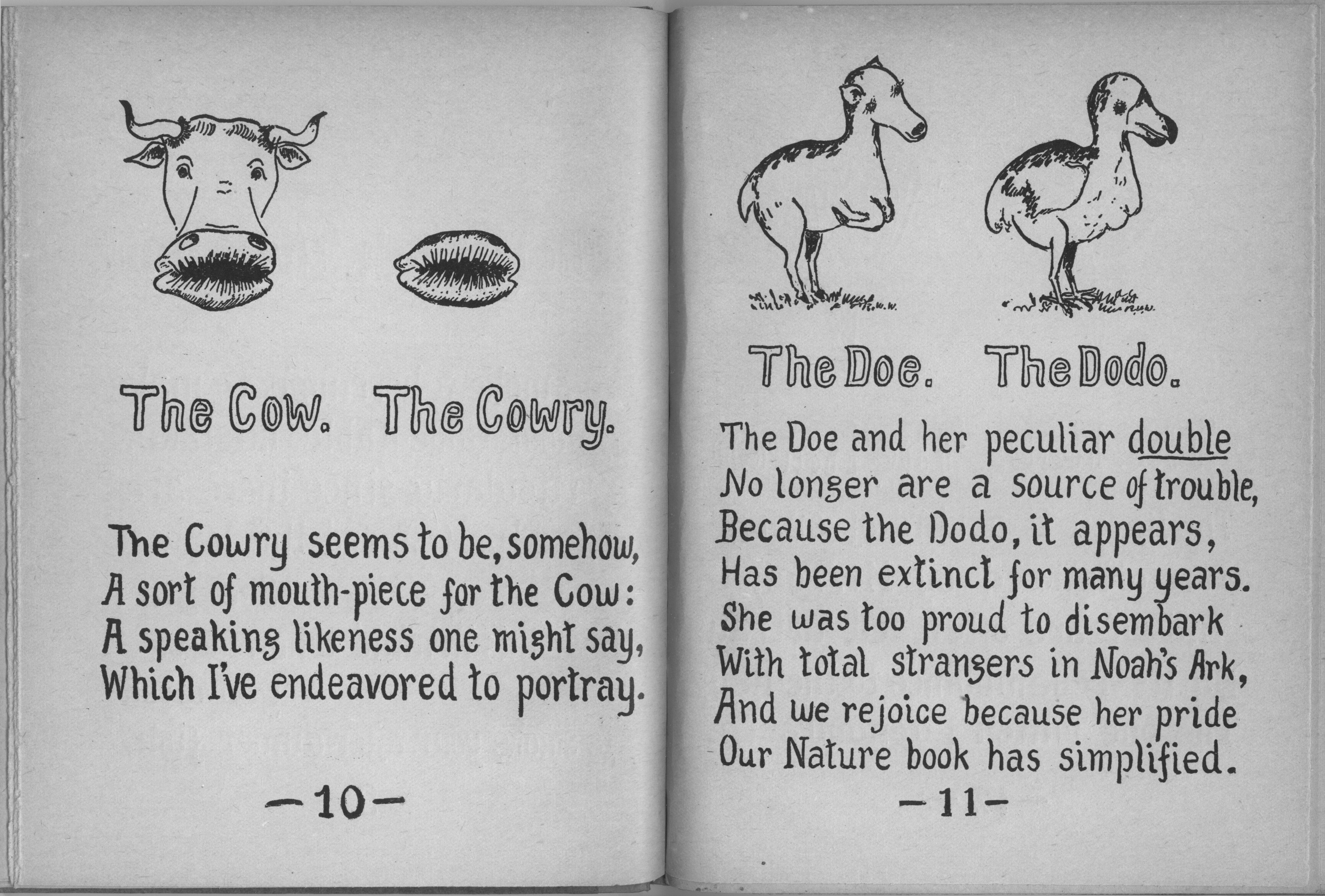
Pages 10-11 of Animal Analogues
Animal Analogues p14
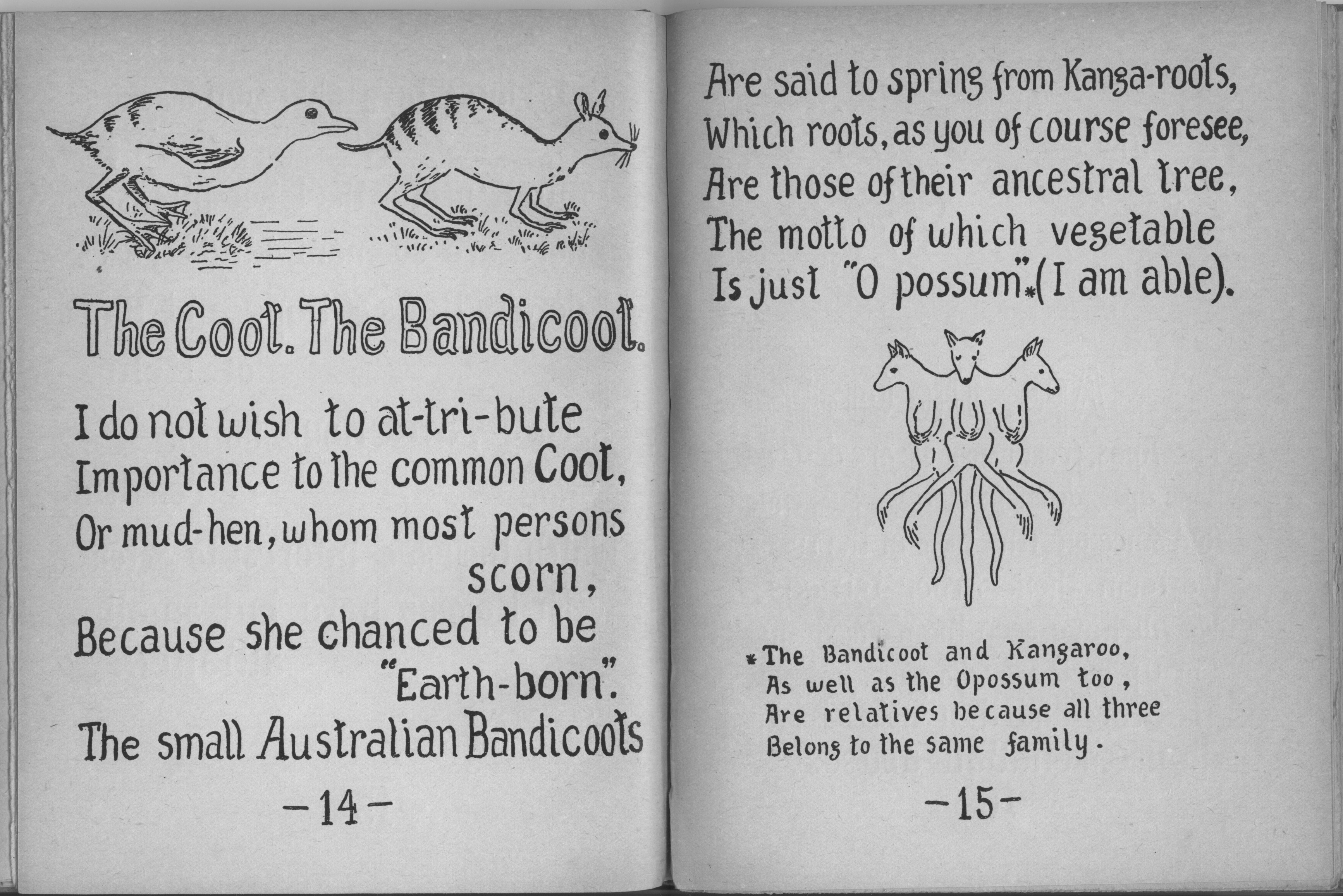
Pages 14-15 of Animal Analogues
Animal Analogues p20
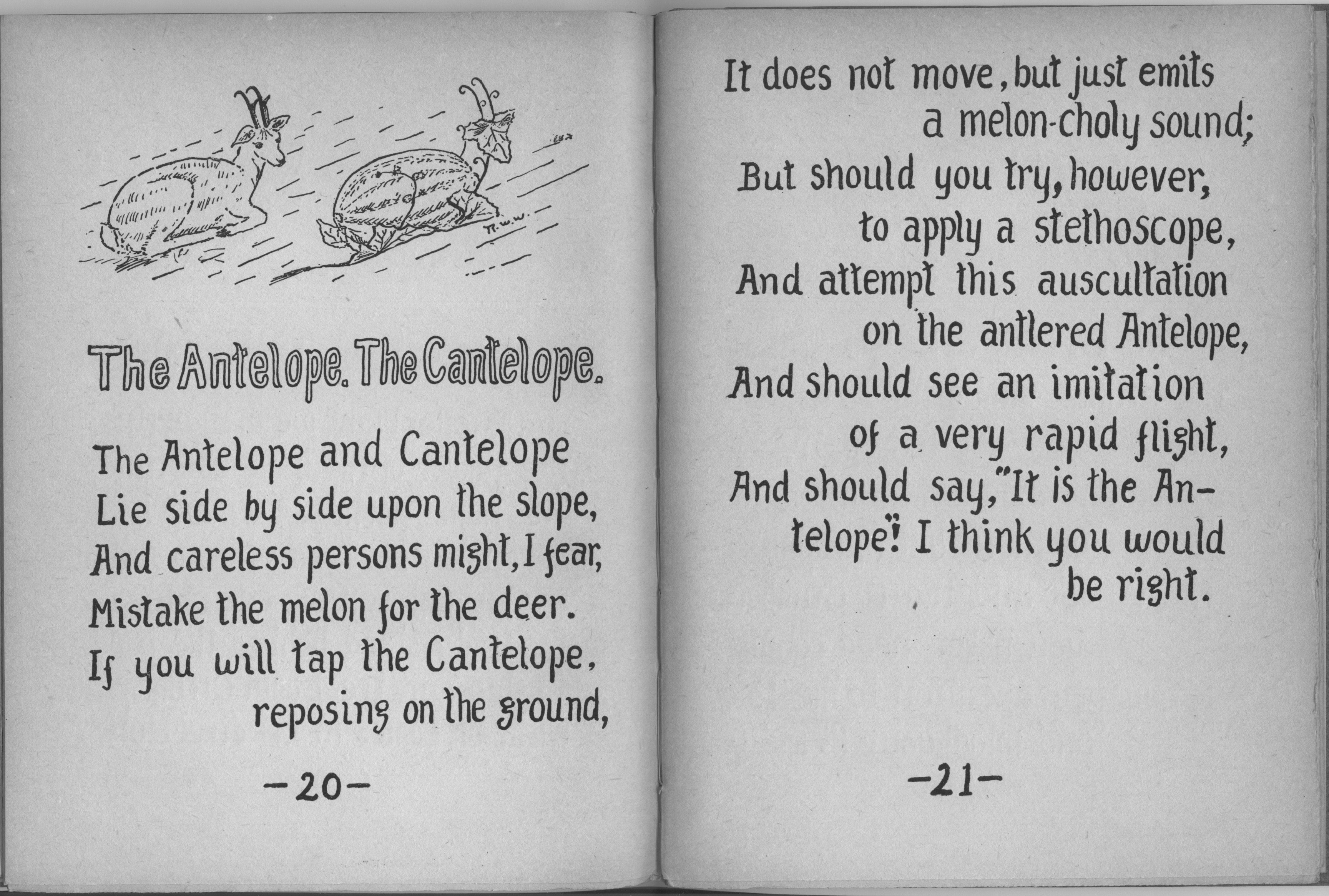
Pages 20-21 of Animal Analogues
Animal Analogues p28
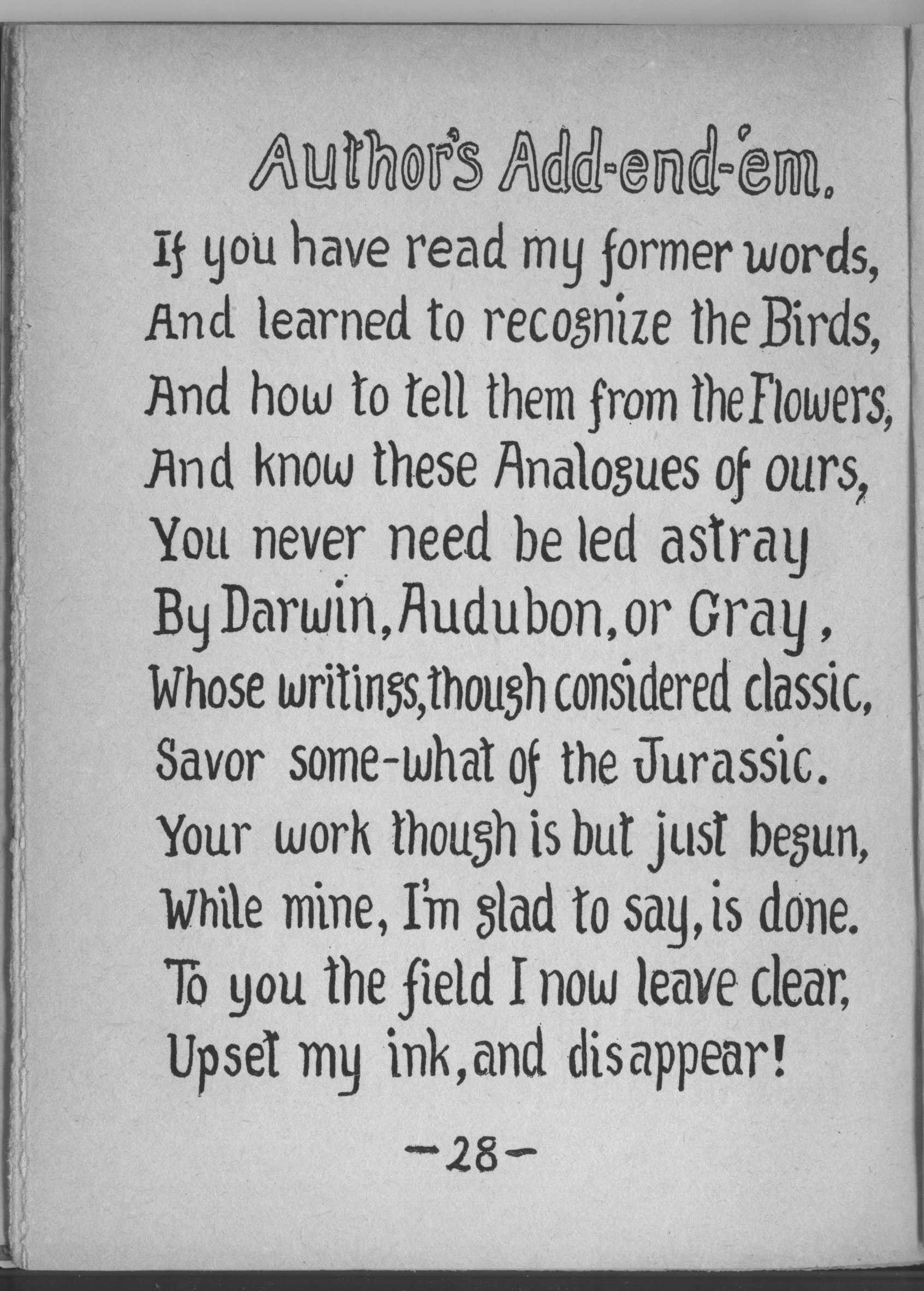
Page 28 of Animal Analogues

How To Tell the Birds From the Flowers

How to Tell Birds cover
Cover of How To Tell the Birds From the Flowers

As with animated cartoons, the best children’s books are ones that satisfy both the children and the adults. Paul Elder published a number of innovative children’s books, but perhaps the most delightful is How To Tell the Birds From the Flowers by Robert Williams Wood, which appeared in 1907.

There is no traditional typesetting in the book; everything was drawn and lettered by Wood. Each page contains drawings of a bird (for example, the catbird) and a flower (the catnip), plus an amusing poem on how to distinguish them. It’s a perfect bedtime storybook.

The California quail is said
To have a tail upon his head,
While contrary-wise we style the Kale,
A cabbage head upon a tail.
It is not hard to tell the two,
The Quail commences with a queue.

How to Tell Birds alt cover
Alternate binding of How To Tell the Birds From the Flowers

Robert Williams Wood (1868-1955) was a professor of physics at Johns Hopkins University from 1901 until his death. He specialized in optics and was a pioneer in both infrared and ultraviolet photography. In 1903, Wood invented an optical filter glass which allows ultraviolet and infrared light and pass through, but blocks most visible light. He used this special glass to make a device called a “Wood’s lamp,” for use in dermatology to diagnose certain skin conditions which fluoresce under ultraviolet light. Today we call these lamps “black lights,” though because of technology improvements black lights now use different filter materials in the glass. Wood also published many papers on spectroscopy, phosphorescence, and diffraction.

How to Tell Birds title
Title page of How To Tell the Birds From the Flowers

Although the cover says “Nature Series No. 23”, that name was concocted for this book and there are no earlier titles. Wood subtitled his 1908 sequel Animal Analogues as “Denatured Series No. 24.”

Instead, Wood co-wrote two prescient science fiction books with Arthur Cheney Train. The first, The Man Who Rocked the Earth (1915), is known for describing the effects of an atomic explosion thirty years before the first atomic bomb was created. Its sequel, The Moon Maker (1916), describes interplanetary space travel, including a plan to send a spaceship to destroy an asteroid that’s on a collision course with Earth.

Update, April 2017: In 1917, Dodd, Mead and Company copyrighted a new edition entitled “How To Tell The Birds From The Flowers, and Other Wood-cuts.” Your editor has seen a 19th edition of this title from 1939, so it was clearly a very popular title for Dodd Mead. Paul Elder was still publishing his own books in 1917, so it seems he either lost, or more likely sold, the publishing rights.

Updated 2026-01-18

How to Tell Birds p16
Page 16-17 of How To Tell the Birds From the Flowers
How to Tell Birds p20
Page 20-21 of How To Tell the Birds From the Flowers
How to Tell Birds p28
Page 28 of How To Tell the Birds From the Flowers