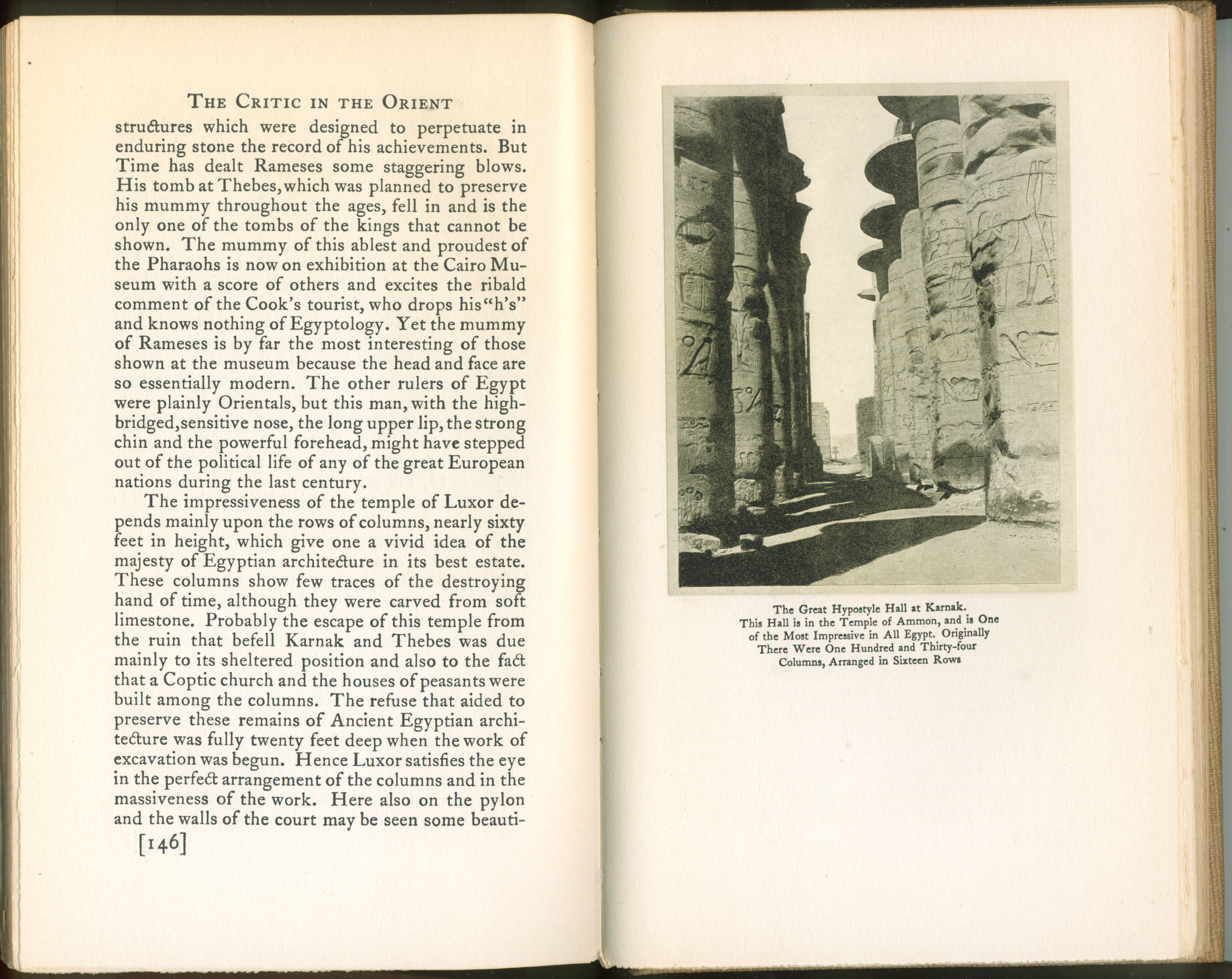
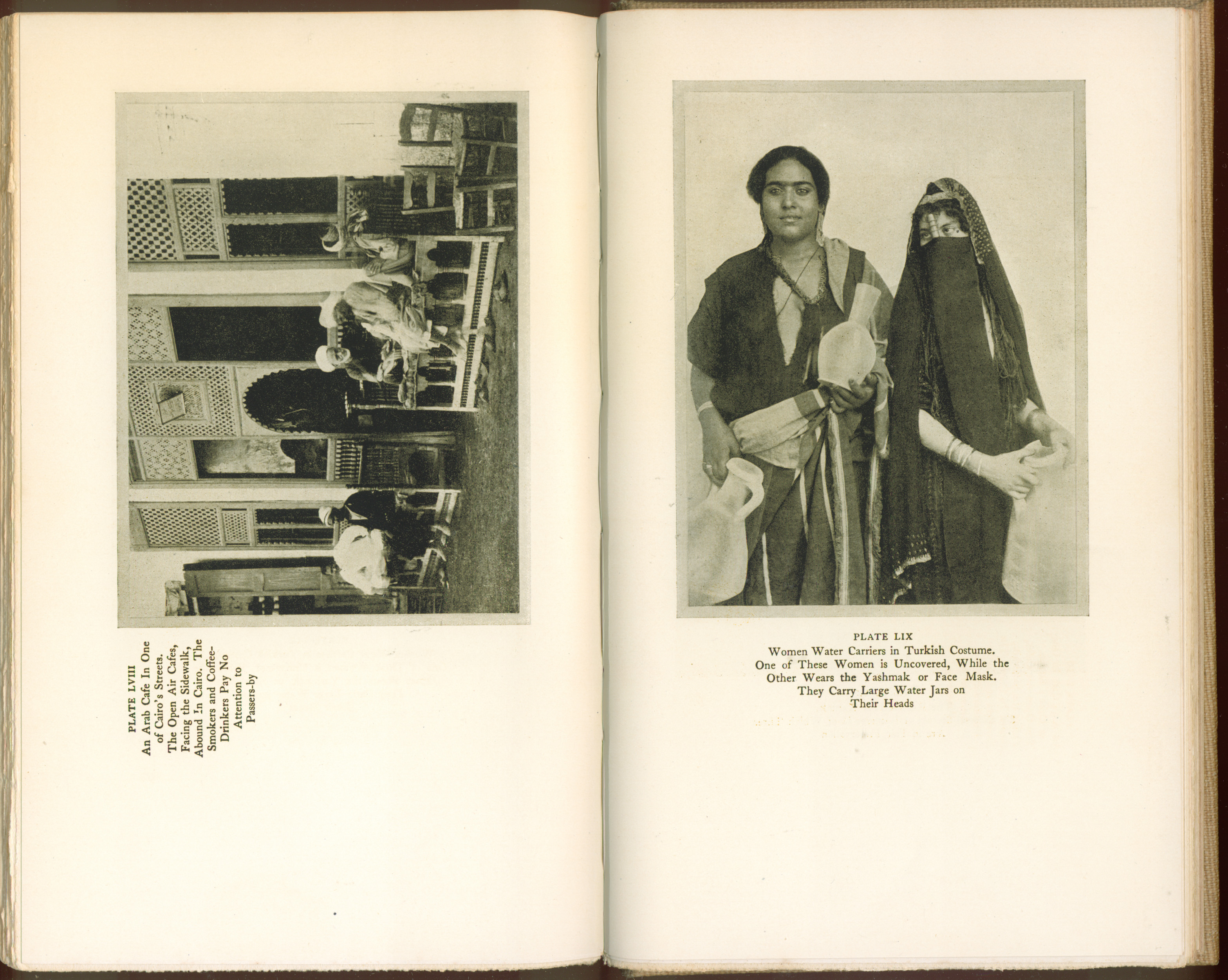
This book of impressions of the Far East is called The Critic in the Orient, because the writer for over thirty years has been a professional critic of new books–one trained to get at the best in all literary works and reveal it to the reader. This critical work would have been deadly, save for a love of books so deep and enduring that it has turned drudgery into pastime and an enthusiasm for discovering good things in every new book which no amount of literary trash was ever able to smother.
In 1912, San Francisco Chronicle sent critic George Hamlin Fitch (1852-1925) on a seven-month trip around the world, from which he cabled daily dispatches for publication in the newspaper. After his return, Fitch distilled his stories into a two-book set; the present volume and The Critic in the Occident (which will be featured next time). The books were published by Paul Elder in September 1913.
Title page and frontispiece of “Critic in the Orient”
Fitch’s itinerary in the East was:
Japan, The Picture Country of the Orient
Manila, Transformed by the Americans
Hong Kong, Canton, Singapore and Rangoon
India, The Land of Temples, Palaces and Monuments
Egypt, The Home of Hieroglyphs, Tombs and Mummies
Page 10 of “Critic in the Orient”
One of the pitfalls of vintage travel literature is encountering language that we would now call patronizing or even bigoted. I am not qualified to write a comprehensive sociological criticism of Fitch’s work, but I see more to praise than to condemn. Most painful to modern ears is his use of “race” when today we would use “nationality,” and noting that India is “the seat of the Aryan civilization and that, though the Hindoo is as dark as many of the American negroes, he is of Aryan stock like ourselves.”
On the other hand, to his credit Fitch admits his preconceptions about Japan were wrong, and devotes the opening 48 pages to that country.
One of the best results of foreign travel is that it makes on revise his estimate of alien races. When I started out it was with a strong prejudice against the Japanese, probably due to my observation of some rather unlovely specimens whom I had encountered in San Francisco. A short stay in Japan served to give me a new point of view of both the people and the country of the Mikado.
Page 14 of “Critic in the Orient”
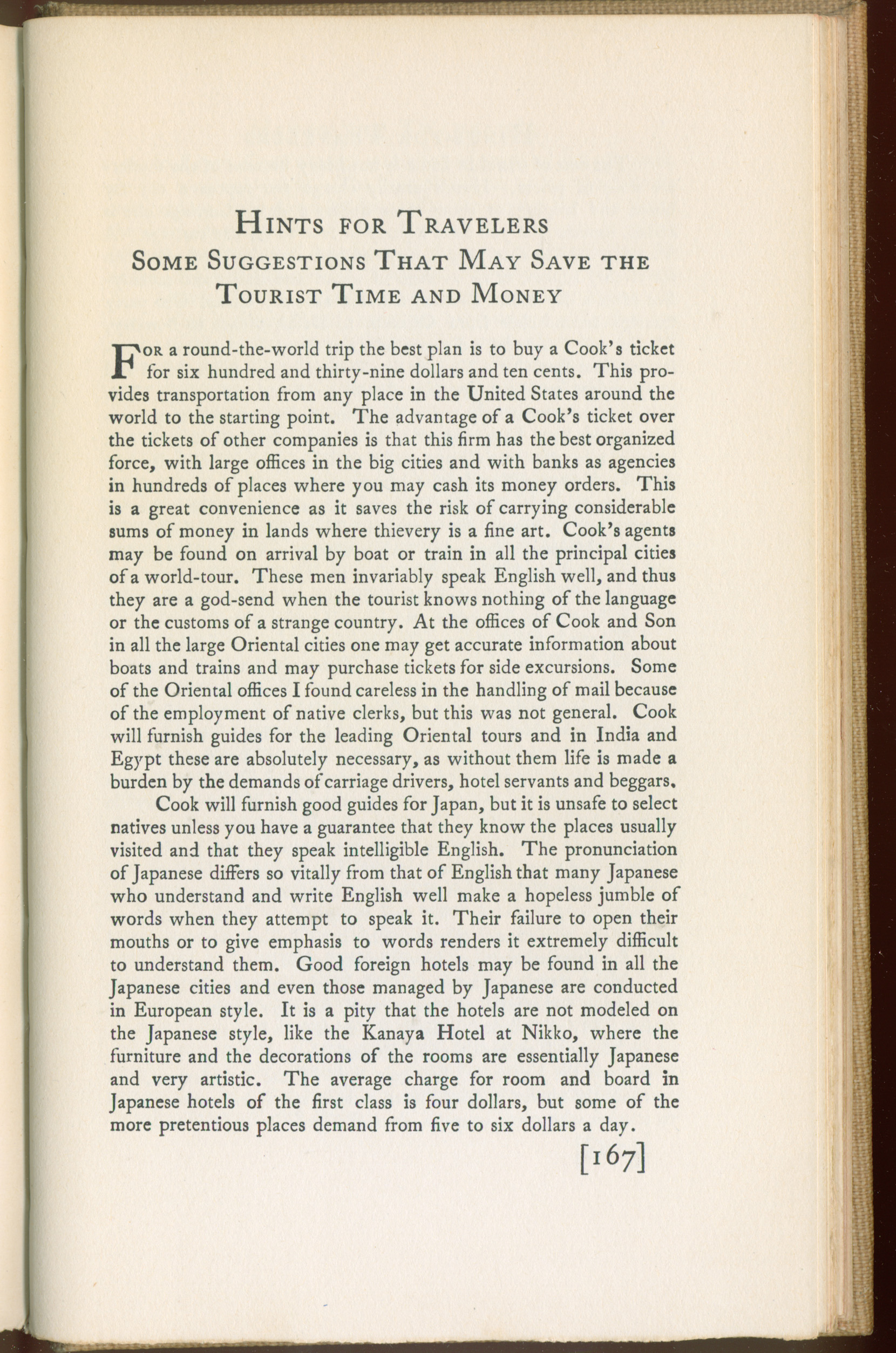
Fitch ends with a couple valuable reference sections: “Hints for Travelers,” and, in keeping with Fitch’s belief that the literate traveler is a happy traveler, a bibliography. In the Hints section, Fitch starts by recommending which agency to use to go on your own world tour:
For a round-the-world trip the best plan is to buy a Cook’s ticket for six hundred and thirty-nine dollars and ten cents. This provides transportation from any place in the United States around the world to the starting point. The advantage of a Cook’s ticket is that this firm has the best organized force, with large offices in the big cities and with banks as agencies in hundreds of places where you may cash its money orders. This is a great convenience as it saves the risk of carrying considerable sums of money in lands where thievery is a fine art.
Of course, $639 was a huge sum in 1913, when the average worker’s annual salary was about half that. Then there was the matter of taking seven months off work, plus the expenses along the way. Extended world travel, then as now, was mostly a rich man’s pastime.
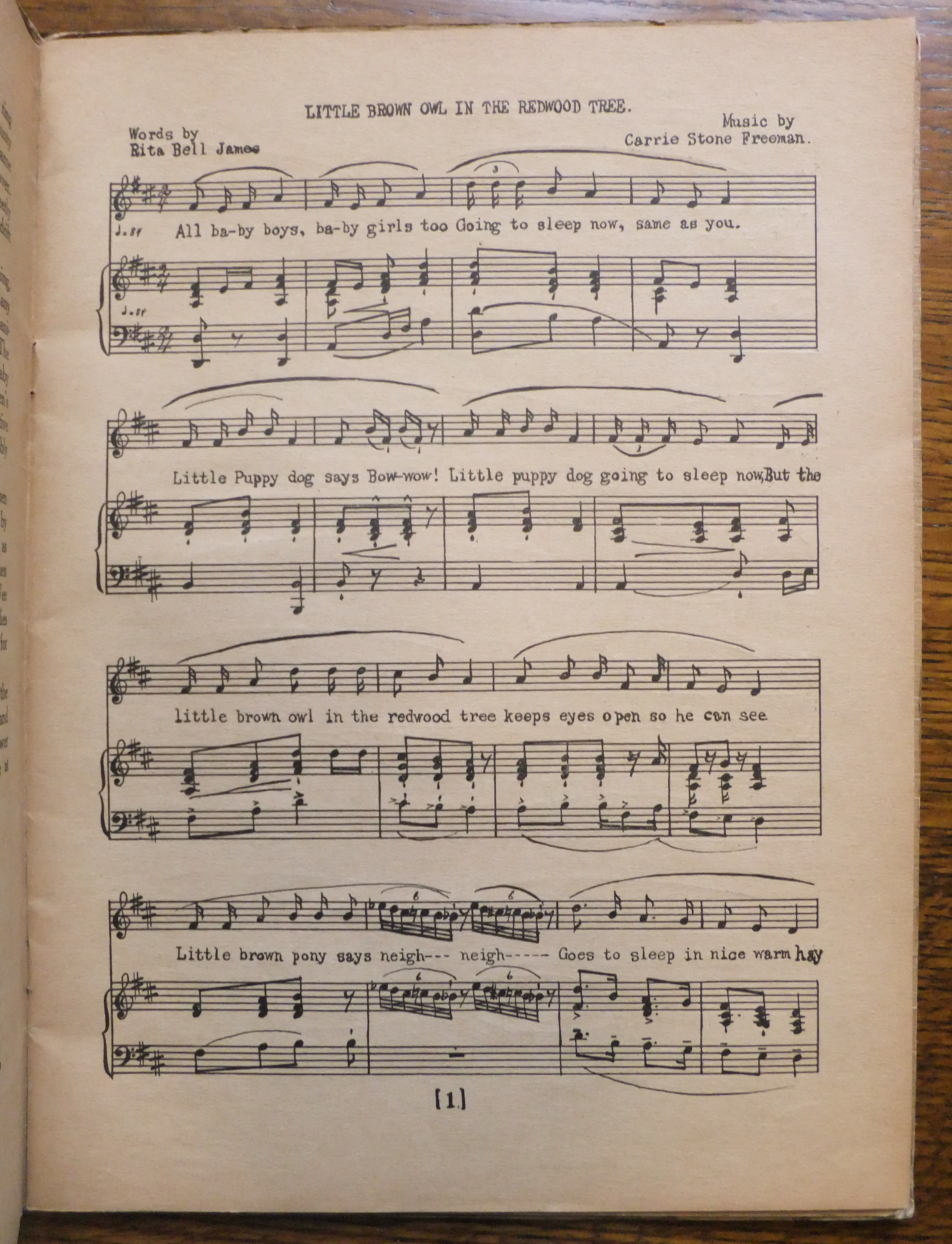
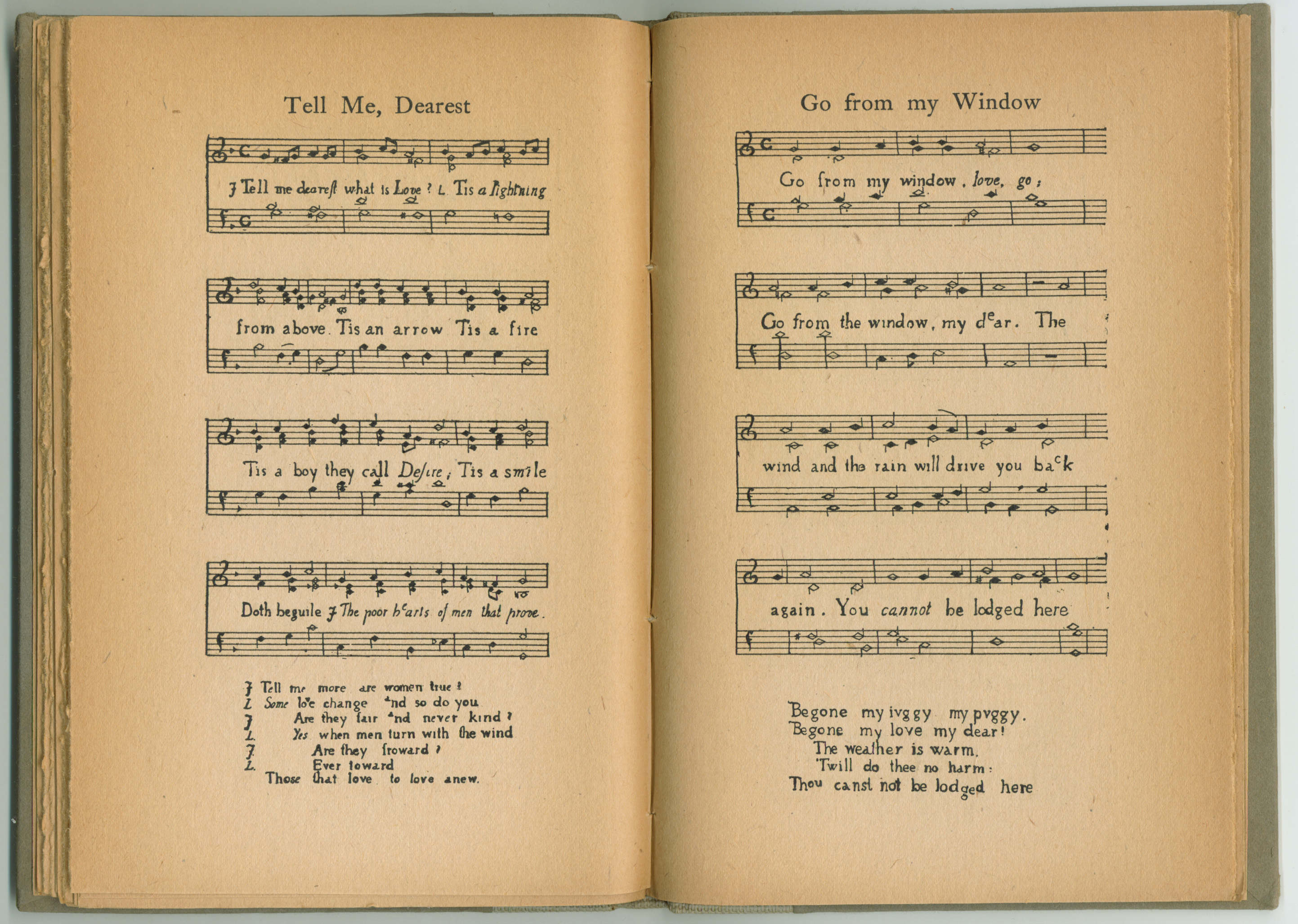
Slumber Sea Chanteys (1910) was the only sheet music Paul Elder ever published (there are a few pages of music in Knight of the Burning Pestle). It is a selection of children’s lullabies on nautical themes. It is also the first Paul Elder I ever bought, though I only realized it five years later when I began to collect Elder in earnest.
Composer Carrie Stone Freeman was profiled in the Music section of the Los Angeles Herald on 4 Dec 1910:
Local composers were well represented at the last meeting of the Harmonia Club Thursday afternoon … Among the songs of special interest to club members were those by Mrs. John J. Abramson, president of the club and hostess for the day, and Carrie Stone Freeman. Mrs. Freeman has written successfully for the voice and her publications include not only the Slumber Sea Chanteys, which are proving so delightful for little folk to sing, but are also most beautiful for the trained singer or a real by-land song, but also “Invitation,” Twilight,” “Lullaby” and “Eastertime Psalm.”
Freeman was also profiled in the Oxnard Courier of 16 Mar 1917:
Composer Carrie Stone Freeman in 1910.
Carrie Stone Freeman, chairman of music for Southern California Women’s club, has a new theory of learning music from nature. Mrs. Freeman is well known in this section in club work and has visited with clubs in this county many times. This is her advice: Listen to the birds and learn to sing. Try to catch and put into musical notation the clear, vibrant joyous calls of the Meadowlark and the mockingbird. Go where you will, is the big outdoors, land or water, and learn from the greatest music master in the world–Nature.
Here is the unique “teachology” of a brilliant Los Angeles woman who bids fair to catch the eye of the nation with her simple solution for developing one of the primal instincts of man–love of music. She is Carrie Stone Freeman, state chairman of music for the Los Angeles and Southern districts of the California Federation of Women’s Clubs. “Trying to catch the notes of the birds,” said Mrs. Freeman, “not only gives a person the opportunity to learn some of the truest sound values, but it also trains the ear. “Spare moments can be utilized for this study, for instance, while a train stops on a siding, while you are standing waiting for a car, if at some interurban point where the fields are at hand or as you sit in your garden reading or sewing. The birds are everywhere.”
Mrs. Freeman is speaking to club women in almost every part of the state, so popular is her subject proving. Just a few days ago she received a manuscript copy of the new song written by the well known American composer, Mrs. H. H. A. Beach; words by Ina Coolbrith of San Francisco. It is dedicated to Mrs. Freeman and is called “Meadowlark.” The motif of the composition is one of the meadowlark calls which Mrs. Freeman frequently uses in announcing her arrival at the artistic Freeman home at the western terminus of Sixteenth Street. Mrs. Beach heard her using it, while a house-guest, and begged permission to build a song on it.
Asked what she thinks of “ragtime,” Mrs. Freeman said “I don’t think. It was a tidal wave for a while and naturally it is receding. I think it will soon die altogether. I never talk against it. I simply offer something better in its stead.”
Co-author Lucia Chase Bell (1848-1938) also wrote the Elder publication Obil, Keeper of Camels. Her husband, Thomas Cowan Bell (1832-1919), was one of the founders of the Sigma Chi fraternity.
I can find no information about co-author and illustrator Rita Bell James.
Title page of “Slumber Sea Chanteys”Page 3 of “Slumber Sea Chanteys”
In March 1903, the English Club of Stanford University performed a production of “The Knight of the Burning Pestle,” an early 17th-century pastiche play by the English poet and dramatist Francis Beaumont. They were no doubt trying to capitalize on the huge success of the Classics Department’s production of Antigone in 1902, which, in addition to local performances, went on a road show to southern California. So, the English Club followed the same script: they performed the work at both Stanford and UC Berkeley, and they commissioned Paul Elder to publish a short book about it. That book, The True Historie of the Knyght of the Burning Pestle, happened to appear during the months when “Elder & Shepard” was transitioning to “Paul Elder & Company.” Thus the title page names “Paul Elder and Morgan Shepard” while the copyright page credits “The Tomoyé Press,” which, like “Paul Elder & Company,” wouldn’t be formally incorporated until May.
Cover of “Knight of the Burning Pestle”
In 1903, it was thought that “Knight of the Burning Pestle” had been jointly written by Beaumont and John Fletcher, but modern scholarship now credits only the former. Francis Beaumont (1584-1616), a contemporary of Shakespeare, is remembered today as a dramatist, but during his lifetime was known as a poet. “The Knight of the Burning Pestle” is a satire on chivalry, along the lines of Don Quixote, and is considered the first complete parody play in the English language.
The title page credits the author as “The English Club of Stanford University,” but the book was almost certainly written by Raymond Macdonald Alden (1873-1924), then assistant professor of English literature at Stanford. Two months later, Alden would write Consolatio, also published by Elder.
The book begins with a short introduction called “On Seeing An Elizabethan Play,” followed by three short essays by “R. M. A.” (Alden): “The Theatre”, “The Knight of the Burning Pestle”, and “The Songs and Music.”
Page 40 of “Knight of the Burning Pestle”
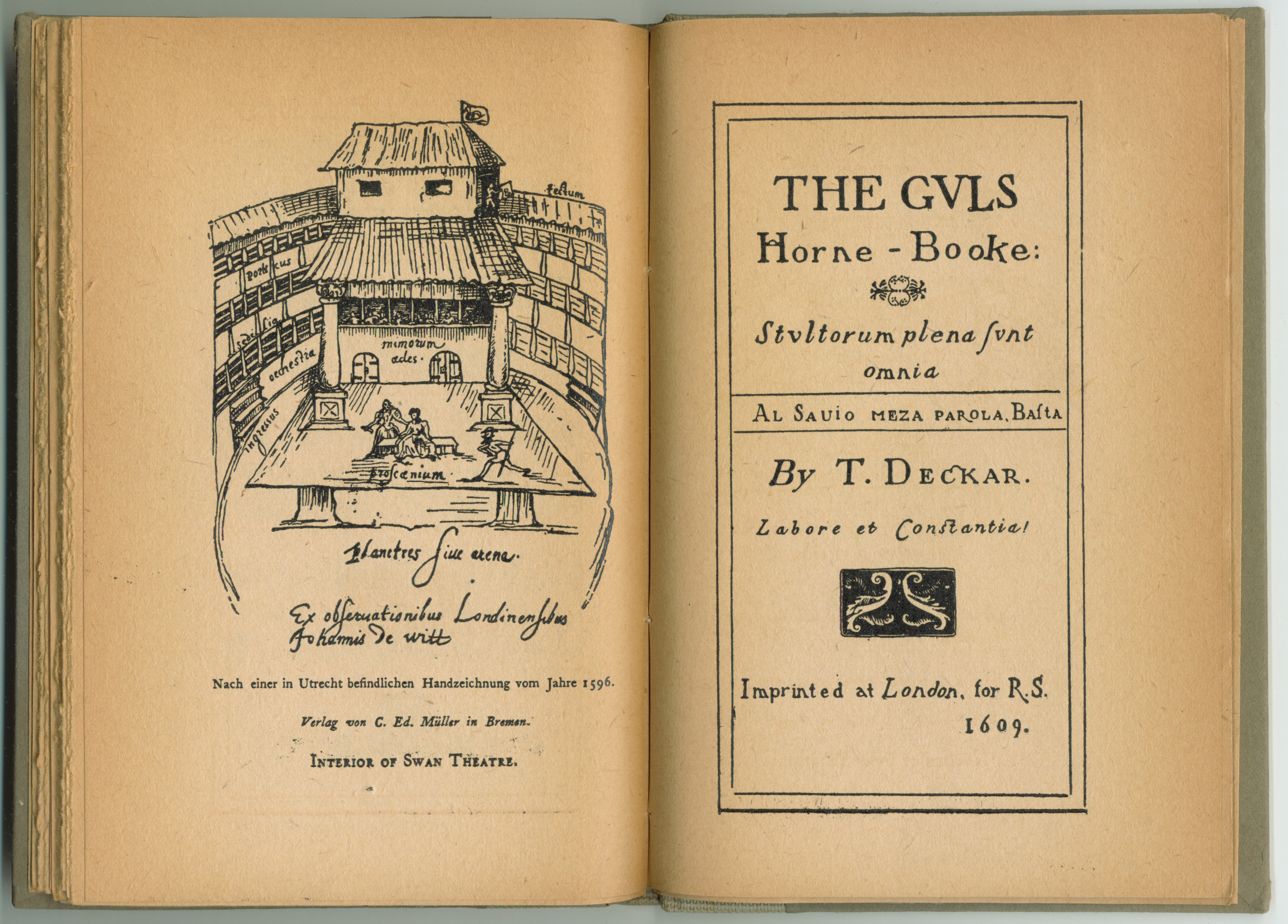
Following the music essay, the book includes a number of facsimiles: music to several songs, the interior of the Swan Theatre, and the title page of Thomas Dekker’s Guls Horne-Booke. Lastly, the authors include the text of Chapter VI of the Hornbook, “How a Gallant Should Behave Himself In a Play-house.”
Bibliographically speaking, Elder has made it difficult to ascertain what the title of this book really is. Normally, the title is what’s printed on the title page, which is in this case is The True Historie of the Knyght of the Burning Pestle. The cover, however, reads “On Seeing An Elizabethan Play, with some particular discourse of The Knight of the Burning Pestle.” And in the colophon on page 59, the authors call the book “The Knight of the Burning Pestle.” I have chosen the text of the title page.
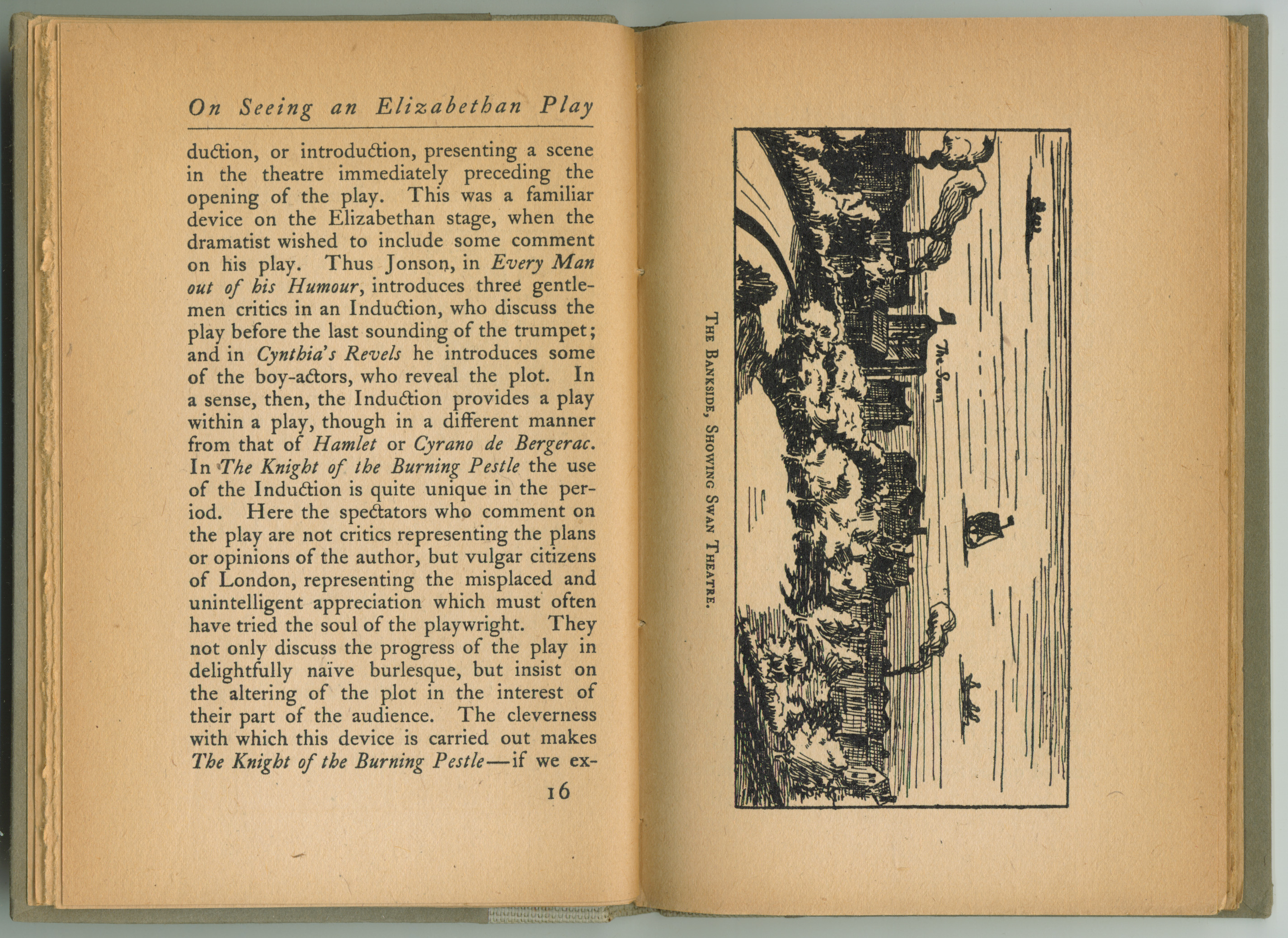
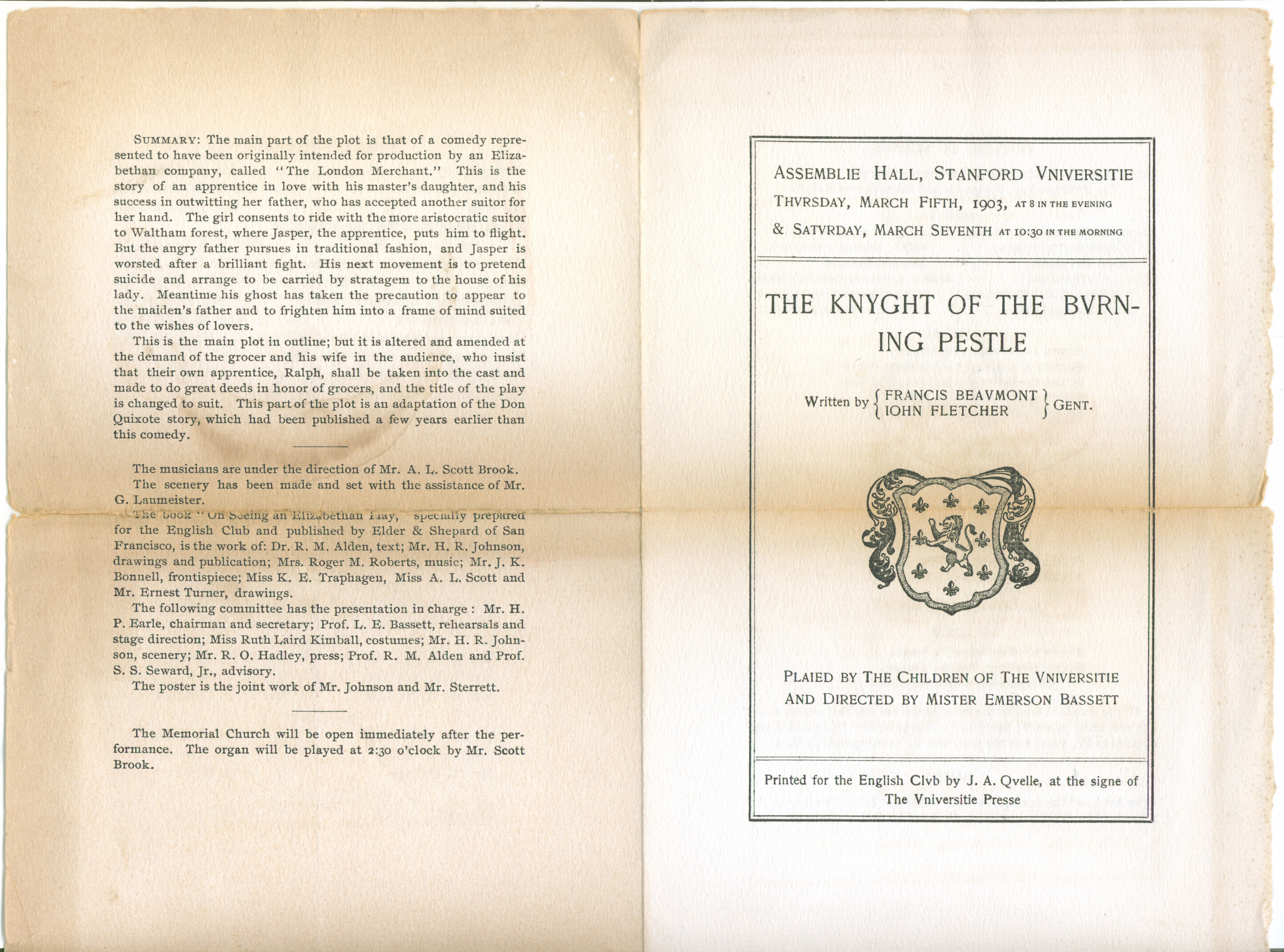
Facsimile of the Swan Theatre and “The Guls Horne-Booke” on p45-6 of “Knight of the Burning Pestle”Page 16 of “Knight of the Burning Pestle”Notice of the Berkeley performance of “Knight of the Burning Pestle” of 28 March 1903Program from the performanceInside of the program
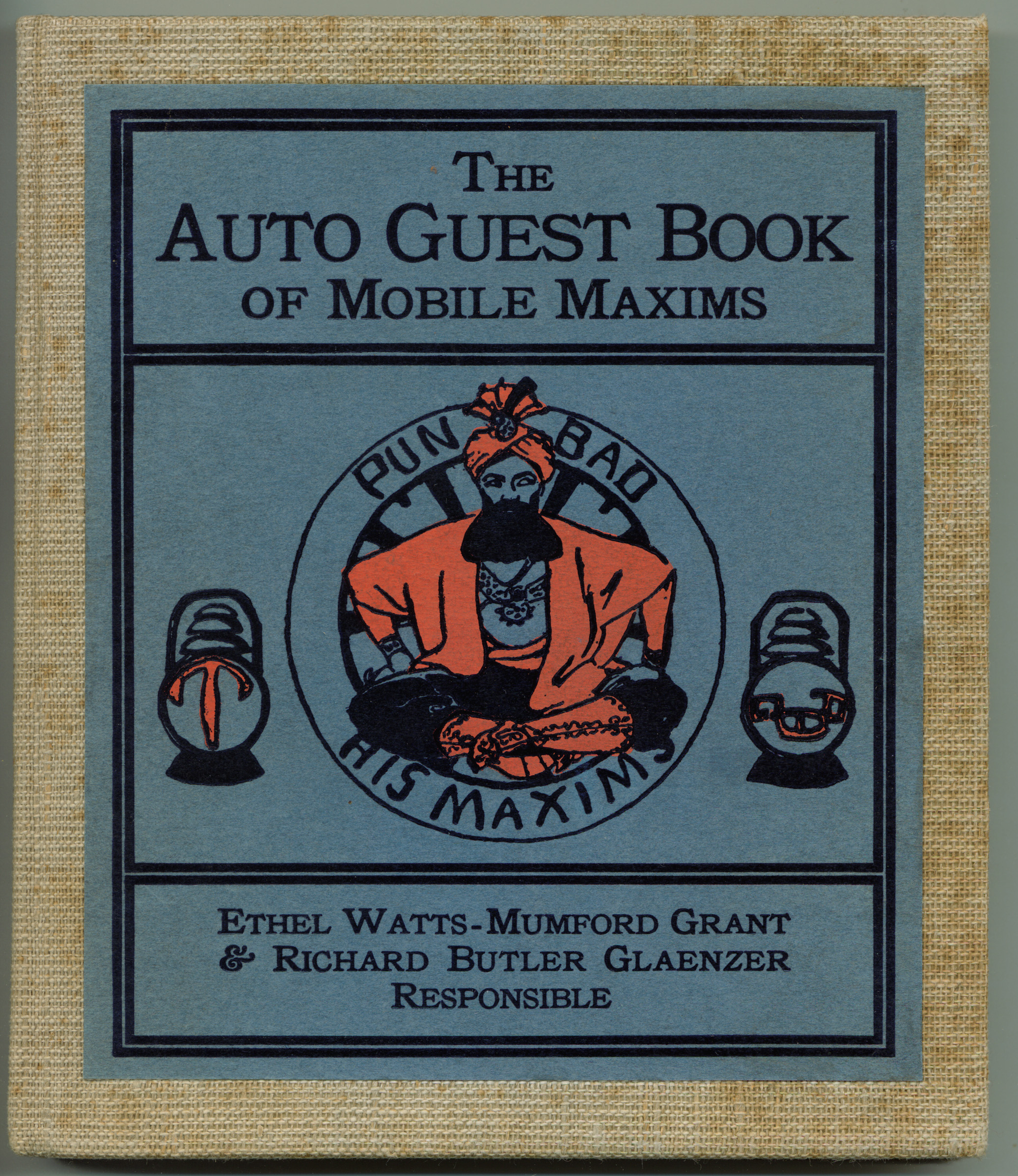
On an inventive twist from a guest book designed for the guest bedroom, here is a guest book designed for one’s automobile. The Auto Guest Book was published in 1906 on the heels of the success of the early Cynic’s Calendars, with the illustrations and aphorisms by the team of Ethel Grant (1876?-1940) and Richard Glaenzer (1876-1937).
In 1906 automobiles were still toys for the rich, beyond the means of most Americans. Nevertheless, Elder presumably had enough car-owning customers to justify this book.
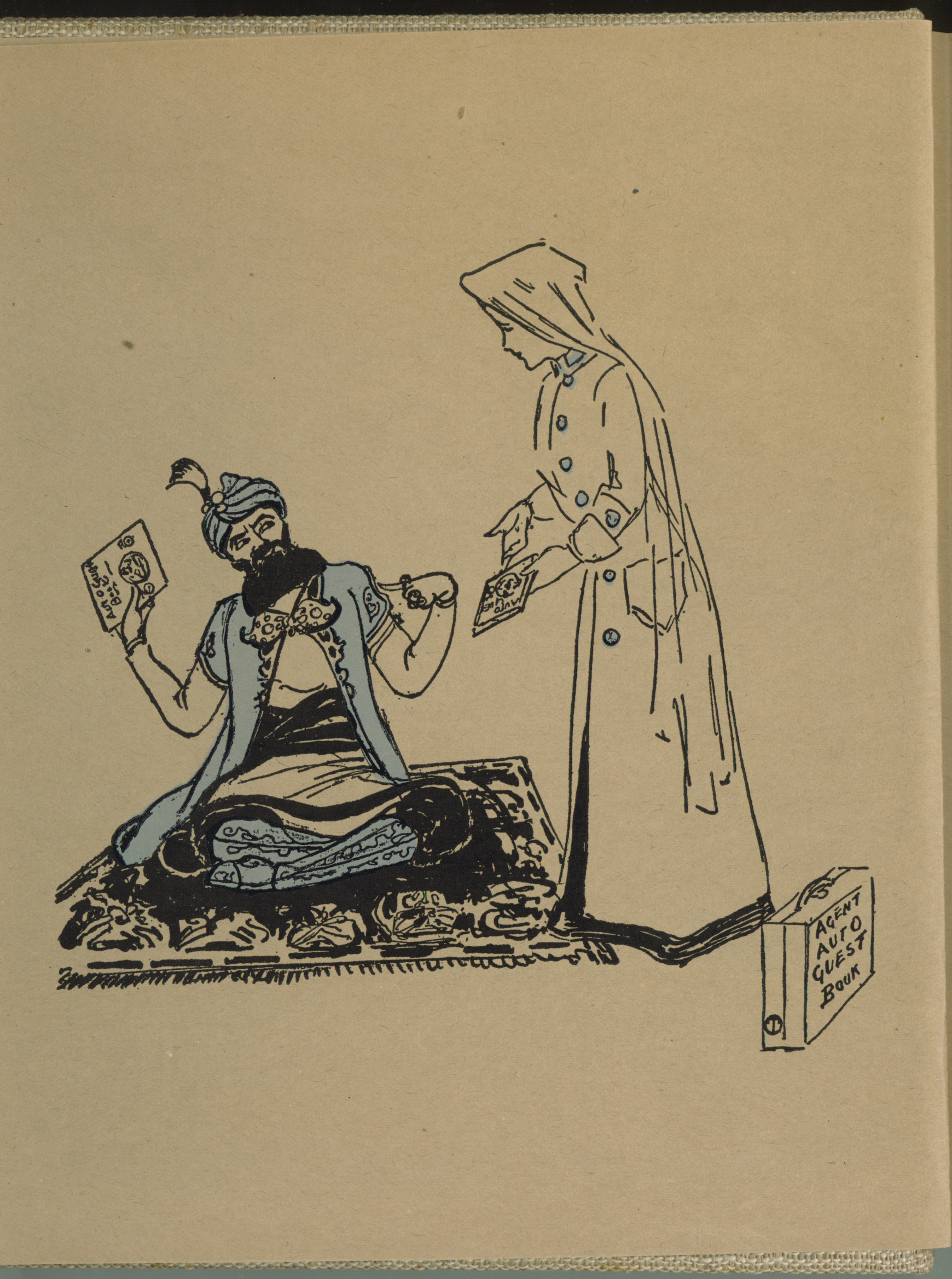
Paul Elder was not immune to the use of ethnic stereotypes, though fortunately he only published a few such examples. The Auto Guest Book has a “Sheikh of Araby” theme, with maxims by “Punbad the Railer,” and illustrations of turbaned men, veiled women and Oriental carpets.
Cover of the leather edition of “Auto Guest Book”Title page of “Auto Guest Book”Frontispiece of “Auto Guest Book”A page for recording an automobile outing“Where there’s a bill there’s a way”“So near and yet — chauffeur”
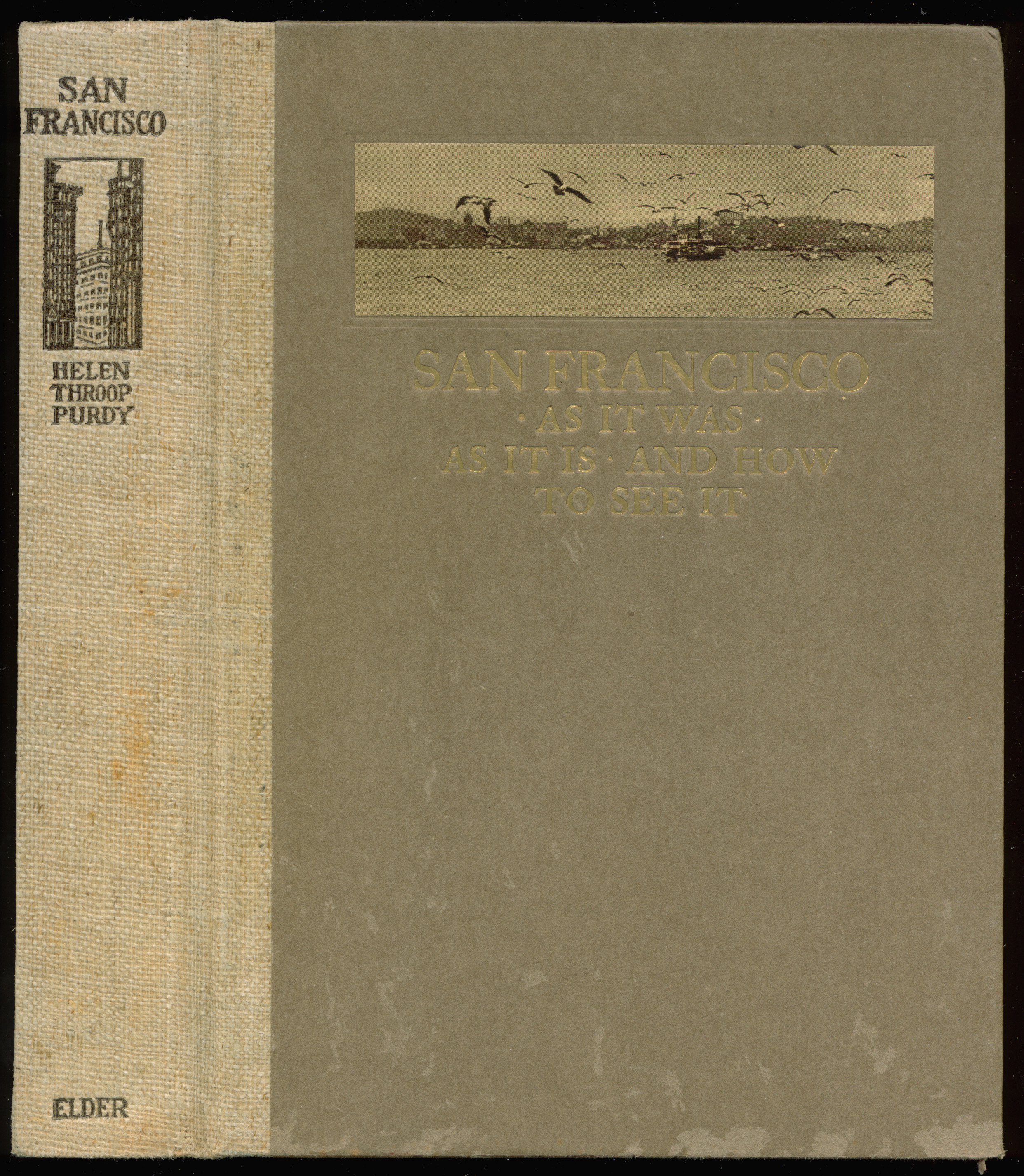
After Paul Elder opened his bookshop in 1898, it is perhaps surprising that he waited fourteen years to publish a book about San Francisco. Maybe it just took him that long to find the right author. Helen Throop Purdy’s comprehensive guide to the City, San Francisco — As It Was, As It Is, And How To See It, was published in September 1912 and remains a useful reference to post-earthquake San Francisco.
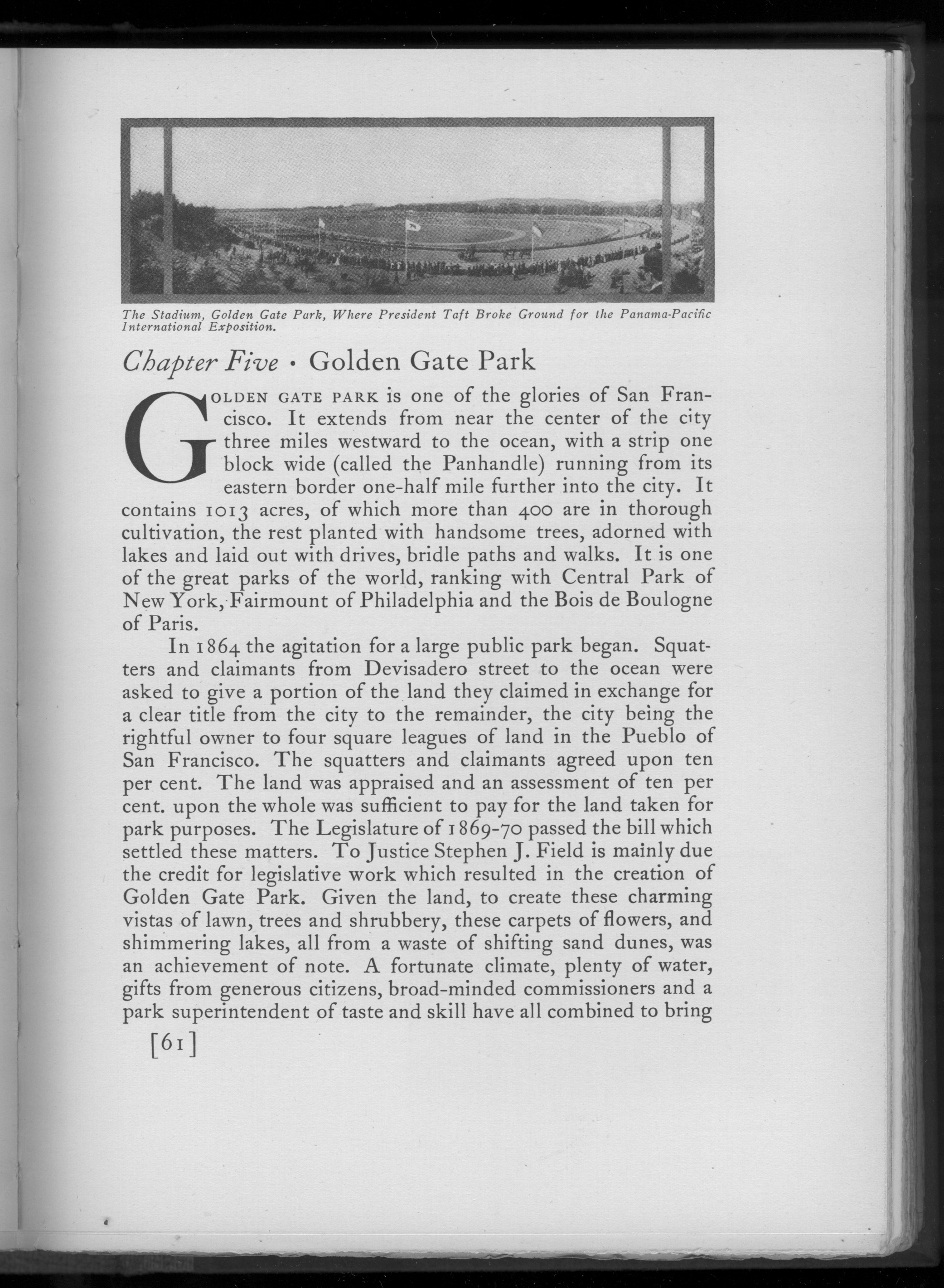
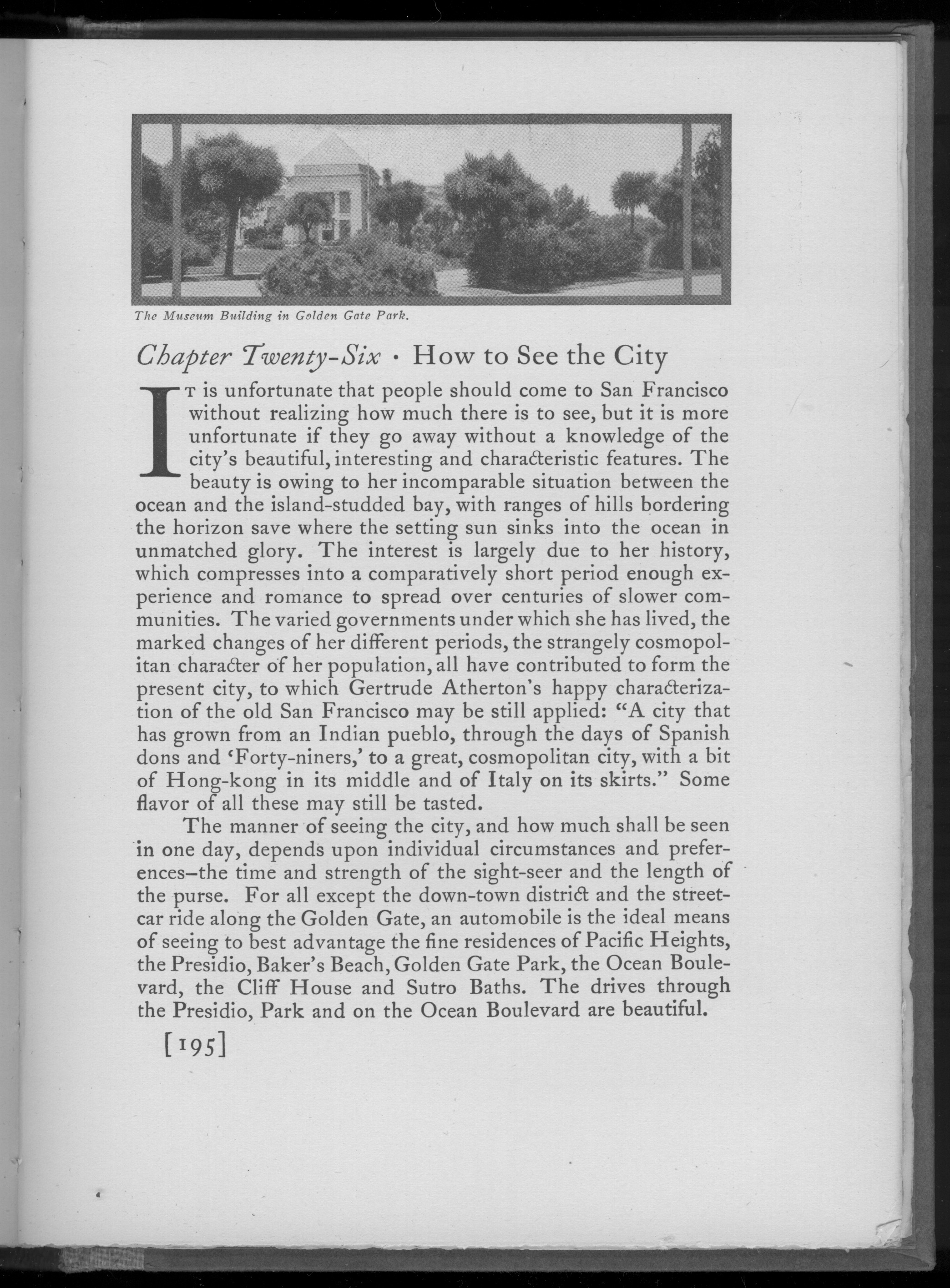
The book is profusely illustrated: almost every page has a photograph. Also included are maps, an index, and the layout of the Panama-Pacific International Exposition, still three years in the future.
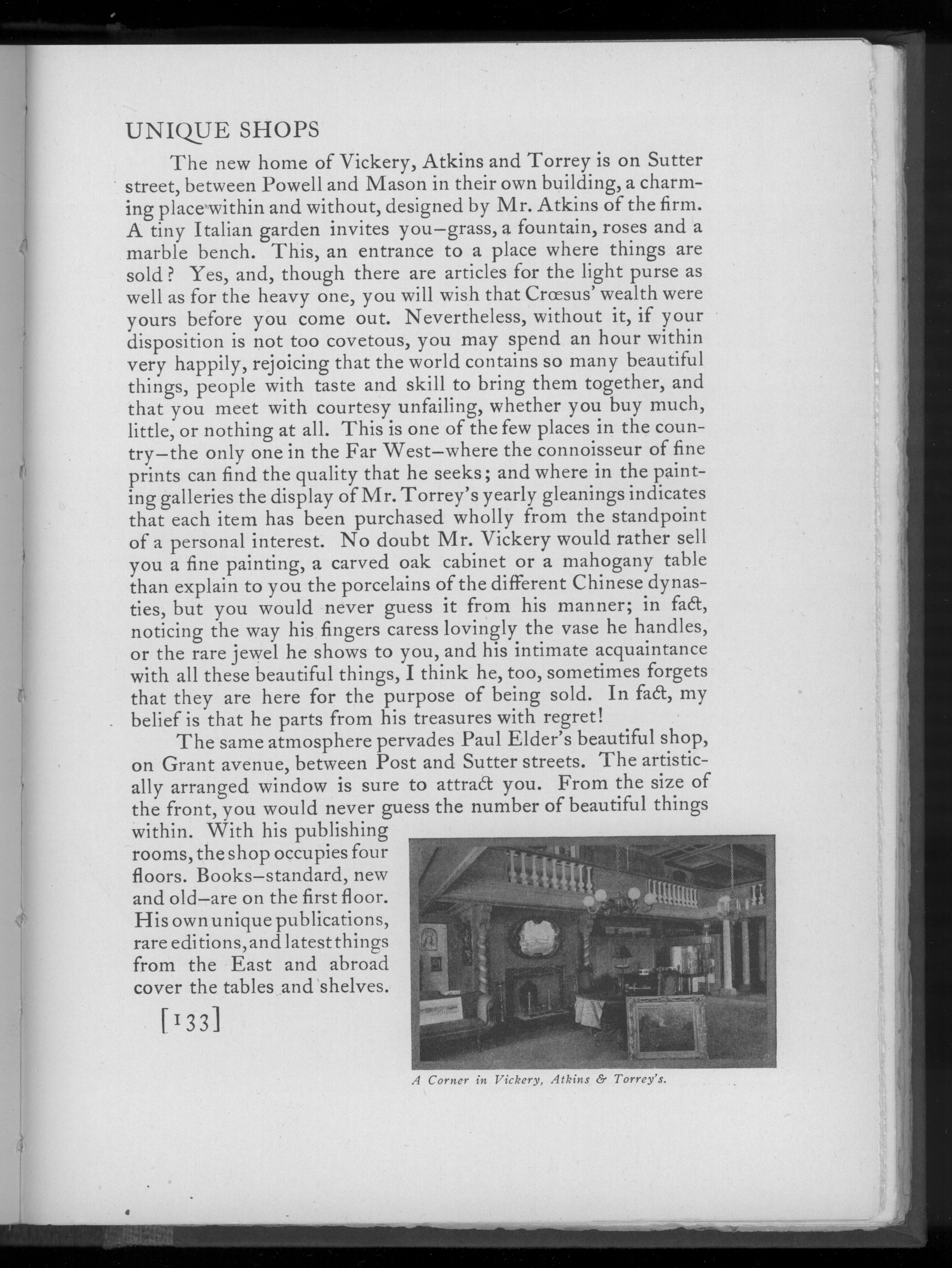
Not surprisingly, Purdy takes time to describe her publisher’s shop in glowing terms: “The same atmosphere [that of Vickers, Atkinson & Torrey] pervades Paul Elder’s beautiful shop on Grant Avenue, between Post & Sutter streets. The artistically arranged window is sure to attract you. From the size of the front, you would never guess the number of beautiful things within.”
Title page of “San Francisco”
Helen Price Throop (2 May 1856–19 January 1945) was born in Palmyra, New York, a descendant of American colonists. She graduated from Elmira College in 1876, and married William Edgar Purdy in 1879. In 1901, they and their three children came to San Francisco, and after the 1906 earthquake they purchased a home 2737 Alcatraz St. in Berkeley, where Helen lived for the rest of her life. She was a member of the California Writers Club, the Stevenson Club and the Historical Society of America. She also belonged to the Mayflower Society, the Founders and Patriots, the Colonial Dames of America and the Daughters of the American Revolution.
After William Purdy’s death in 1927, she married Ransom Pratt; he died in 1932. Helen, William and Ransom are all buried in their family plots in the Palmyra Cemetery in New York.
Page 61 of “San Francisco”. The history of Golden Gate Park.Page 133 of “San Francisco”, where Purdy describes Paul Elder’s shopPage 195 of “San Francisco”, with a photo of the old De Young museum.