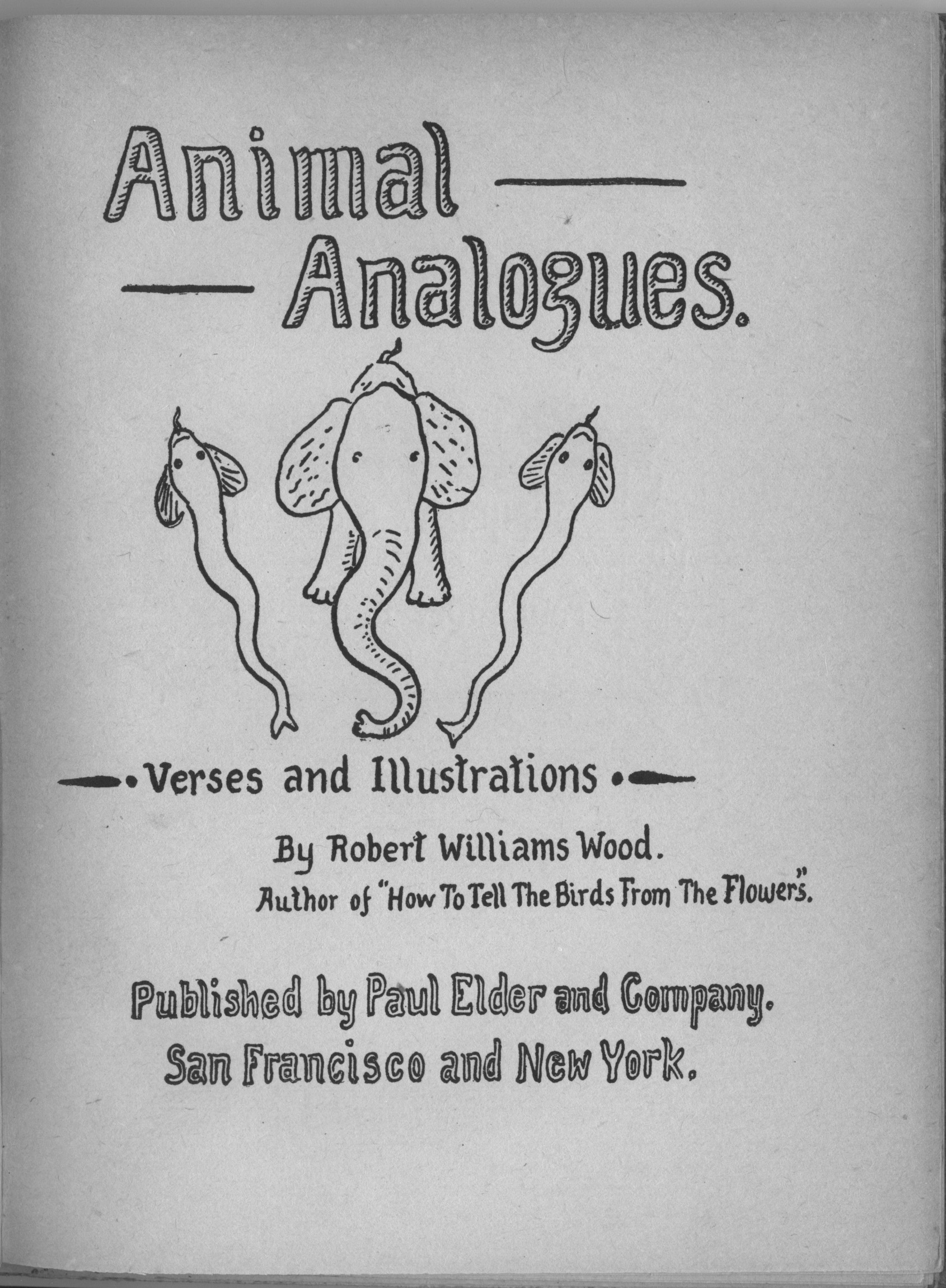
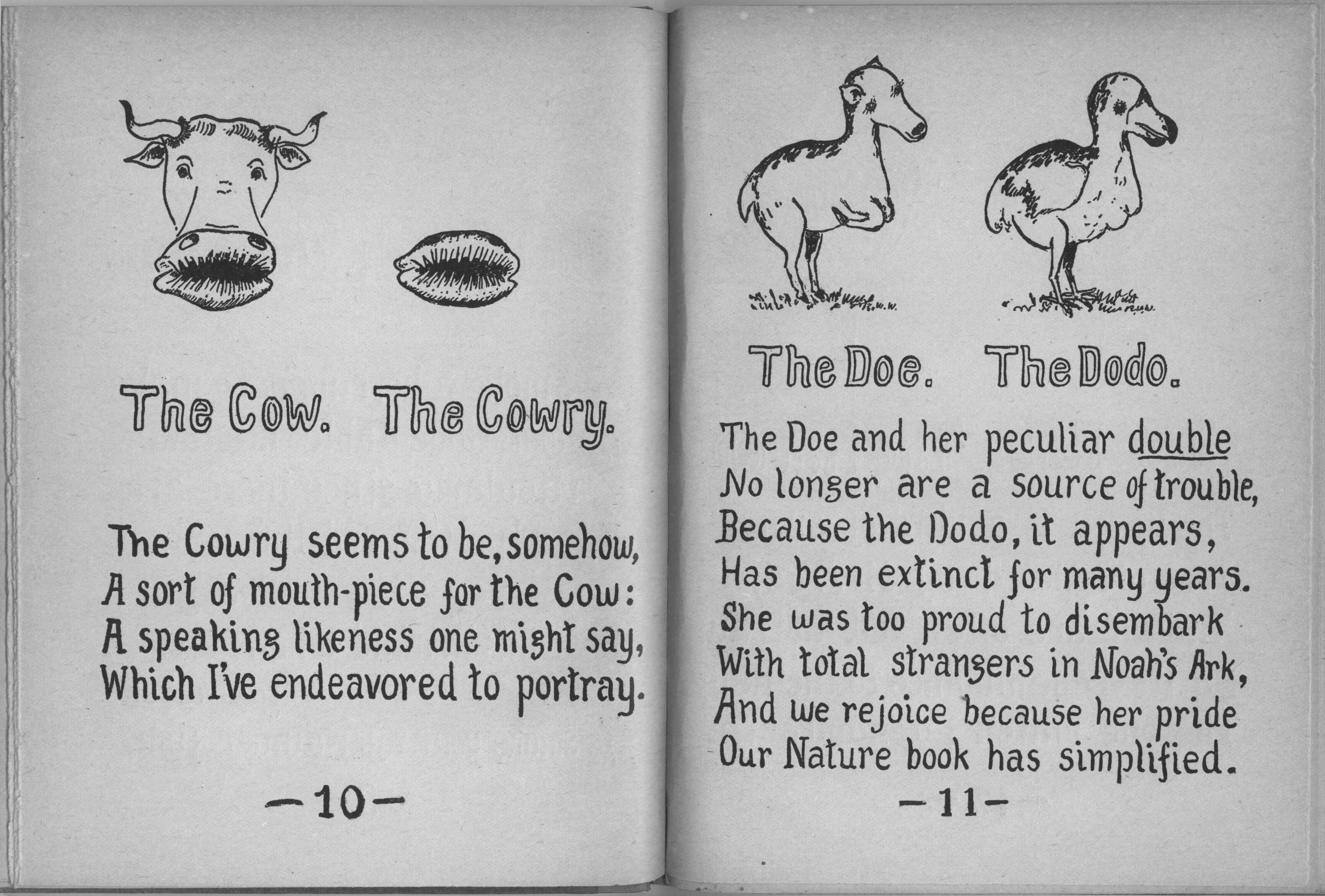
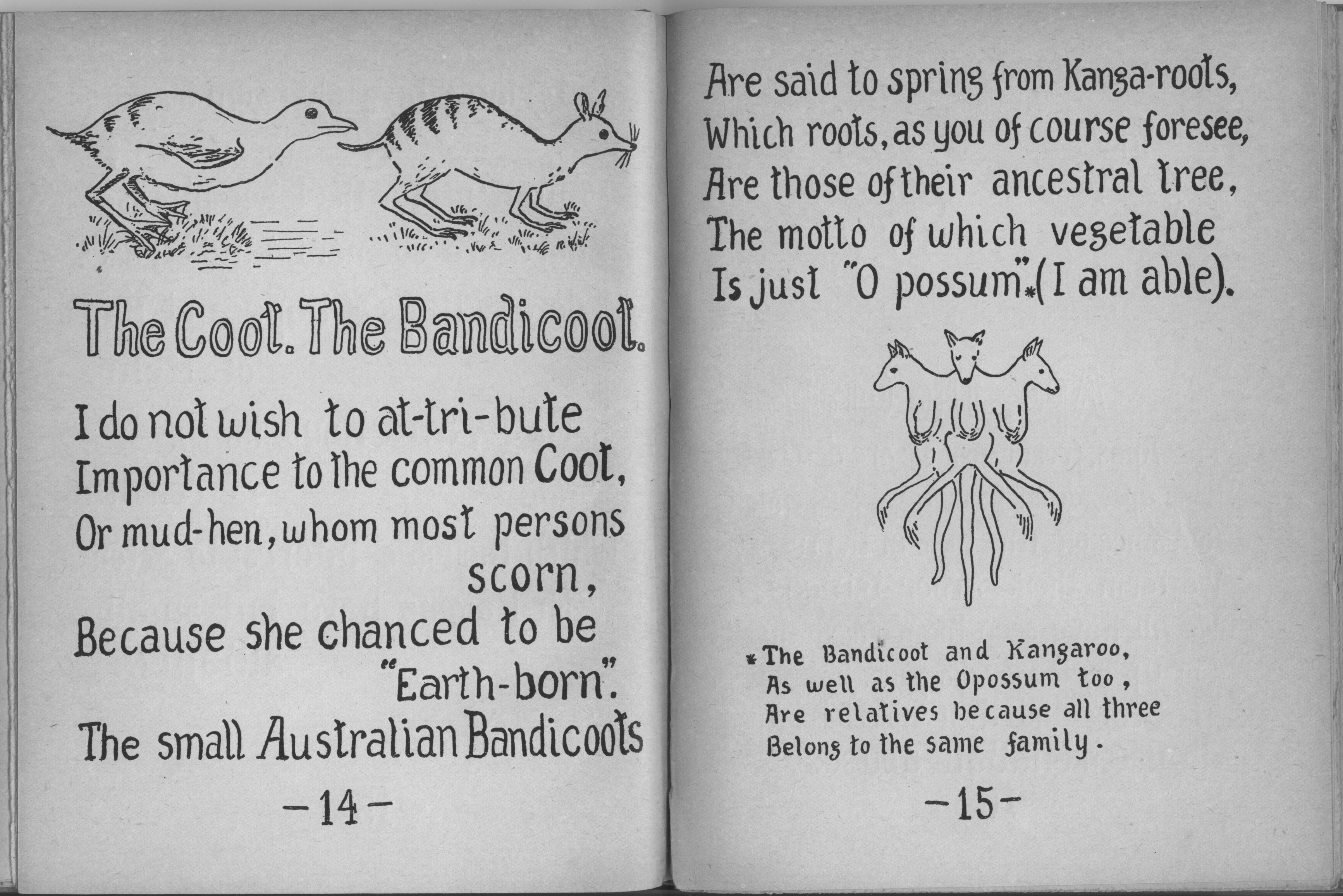
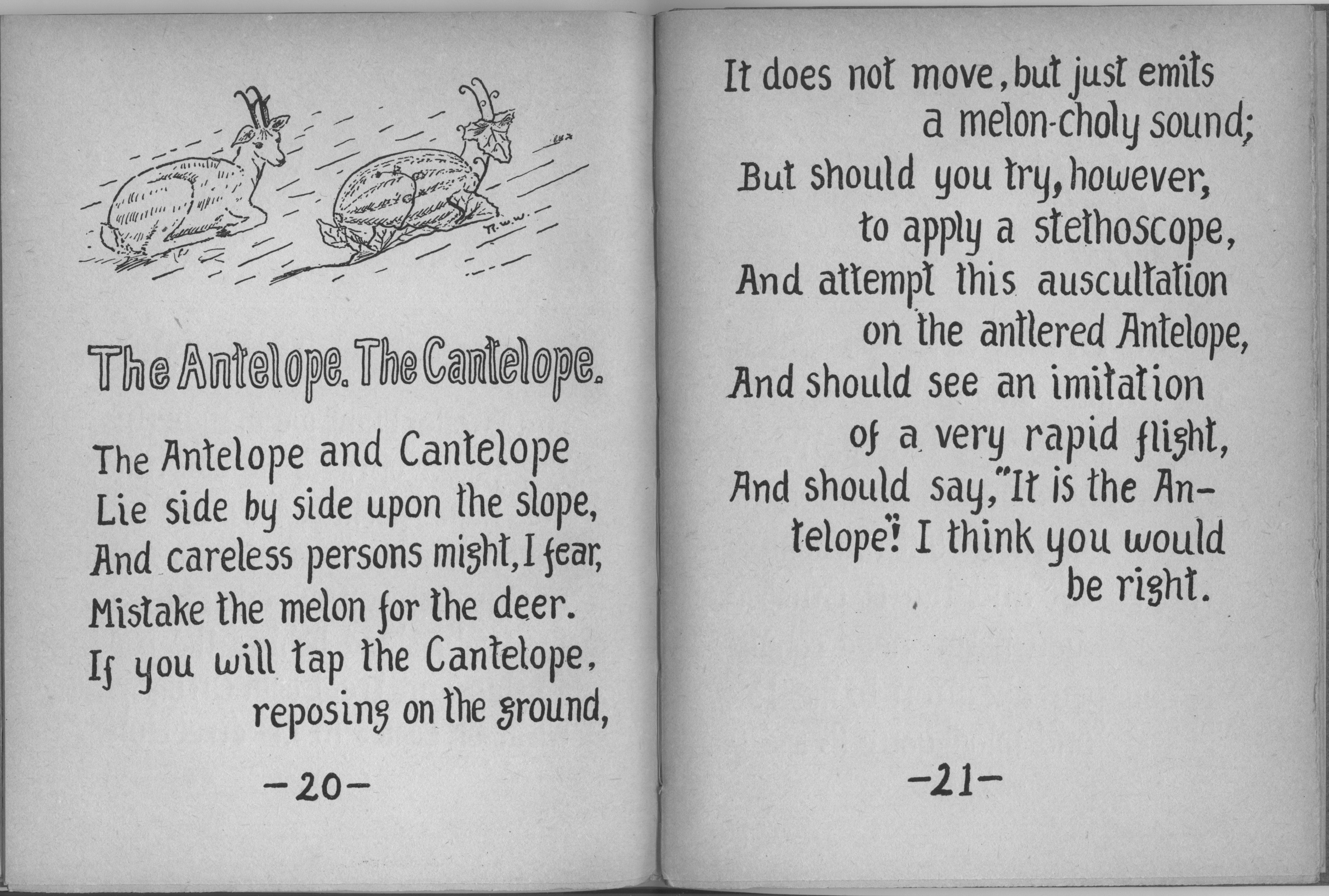
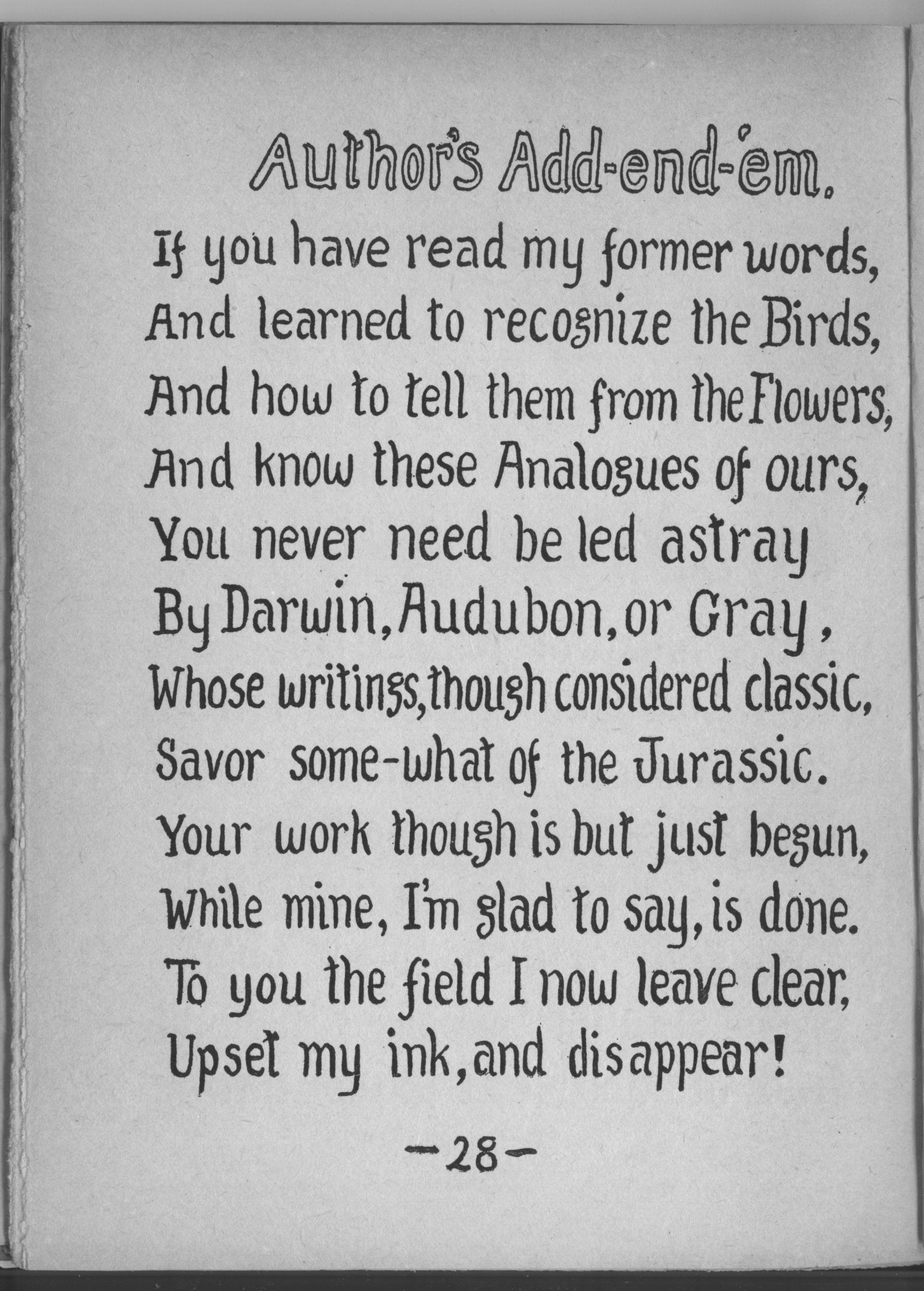
If you liked How To Tell the Birds From the Flowers, then you’ll love Animal Analogues. That’s what Paul Elder thought too, and so in 1908 he published Robert Williams Wood’s sequel to similar acclaim. As any author can tell you, sequels are notoriously difficult to write, but Wood pulled it off, with poetry and drawings to delight old and young alike.
The cover says “Denatured Series No. 24”, but this is a joke, as was the “Nature Series No. 23” on the cover of How To Tell the Birds From the Flowers. Wood wrote no further books in this series.
Updated 2026-01-18
Title page of Animal AnaloguesPages 10-11 of Animal AnaloguesPages 14-15 of Animal AnaloguesPages 20-21 of Animal AnaloguesPage 28 of Animal Analogues
As with animated cartoons, the best children’s books are ones that satisfy both the children and the adults. Paul Elder published a number of innovative children’s books, but perhaps the most delightful is How To Tell the Birds From the Flowers by Robert Williams Wood, which appeared in 1907.
There is no traditional typesetting in the book; everything was drawn and lettered by Wood. Each page contains drawings of a bird (for example, the catbird) and a flower (the catnip), plus an amusing poem on how to distinguish them. It’s a perfect bedtime storybook.
The California quail is said
To have a tail upon his head,
While contrary-wise we style the Kale,
A cabbage head upon a tail.
It is not hard to tell the two,
The Quail commences with a queue.
Alternate binding of How To Tell the Birds From the Flowers
Robert Williams Wood (1868-1955) was a professor of physics at Johns Hopkins University from 1901 until his death. He specialized in optics and was a pioneer in both infrared and ultraviolet photography. In 1903, Wood invented an optical filter glass which allows ultraviolet and infrared light and pass through, but blocks most visible light. He used this special glass to make a device called a “Wood’s lamp,” for use in dermatology to diagnose certain skin conditions which fluoresce under ultraviolet light. Today we call these lamps “black lights,” though because of technology improvements black lights now use different filter materials in the glass. Wood also published many papers on spectroscopy, phosphorescence, and diffraction.
Title page of How To Tell the Birds From the Flowers
Although the cover says “Nature Series No. 23”, that name was concocted for this book and there are no earlier titles. Wood subtitled his 1908 sequel Animal Analogues as “Denatured Series No. 24.”
Instead, Wood co-wrote two prescient science fiction books with Arthur Cheney Train. The first, The Man Who Rocked the Earth (1915), is known for describing the effects of an atomic explosion thirty years before the first atomic bomb was created. Its sequel, The Moon Maker (1916), describes interplanetary space travel, including a plan to send a spaceship to destroy an asteroid that’s on a collision course with Earth.
Update, April 2017: In 1917, Dodd, Mead and Company copyrighted a new edition entitled “How To Tell The Birds From The Flowers, and Other Wood-cuts.” Your editor has seen a 19th edition of this title from 1939, so it was clearly a very popular title for Dodd Mead. Paul Elder was still publishing his own books in 1917, so it seems he either lost, or more likely sold, the publishing rights.
Updated 2026-01-18
Page 16-17 of How To Tell the Birds From the FlowersPage 20-21 of How To Tell the Birds From the FlowersPage 28 of How To Tell the Birds From the Flowers
On 8 June 2012, the San Francisco Chronicle ran an article about 19th-century tombstones turning up on Ocean Beach. Passers-by were puzzled, if not uneasy. “Why are there tombstones on the beach?” they asked. Perhaps they also stopped to wonder “Now that I think about it, why are there no cemeteries in San Francisco?” The answer is: there used to be, but not any more. Of San Francisco’s 27 historical cemeteries, only two (at Mission Dolores and the Presidio) survive: the rest were moved to Colma. The long, slow process began in 1900, when the City passed an ordinance forbidding new burials in San Francisco, and was completed in the early 1940s, when the last graves at Laurel Hill Cemetery were transferred to Colma.
The reasons behind the move were many. Many people didn’t want to live next to a graveyard; others felt land values were lower near cemeteries. Many in the 19th century still believed that “miasma,” polluting vapors emanating from decay, caused disease. Developers were happy to capitalize on those fears, as they wanted the land for residential and commercial use. Opposing the removals were religious groups—primarily the Catholic Church—and preservationists, who noted the lengthy list of San Francisco pioneers buried there.
Laurel Hill (left) and Calvary (right, behind Lone Mountain) cemeteries in 1938, shortly before burials were moved to Colma. Geary Boulevard runs up and down the center of the photo. Ewing Field, a baseball park in operation between 1914 and 1938, can be seen between Calvary and Lone Mountain. (OpenSFHistory.org)
Although the city of San Francisco paid for moving the coffins, the families had to pay the cost of moving the headstones and monuments. Many, if not most, could not afford this, so the city took the stones and used them in very unromantic places: some as paving materials for gutters lining the walks of Buena Vista Park, others for Ocean Beach and the breakwater near the St. Francis Yacht Club. Particularly saddening was the loss of the large crypts and Egyptian-style monuments, most of which were unceremoniously dumped into San Francisco Bay. (Your editor asks: San Francisco wouldn’t pay for moving funeral monuments to Colma, but they would pay to haul the monuments onto a ship and dump them into the Bay?)
In 1937, Paul Elder published a pamphlet called Laurel Hill. It was part of the last gasp of resistance from those who opposed the move. The text begins with an unsigned article entitled “Laurel Hill: Esto Perpetua! Have Not Our Pioneers Their Rights?”
Calvary (center) and Laurel Hill (top left) cemeteries in 1938.
We are in receipt of communications, from time to time, from a group that seems bent upon the destruction of Laurel Hill Memorial Park, wherein emphasis is placed on the statement that no real estate considerations are prompting the attempt. It is good to hear this, but difficult, assuming the fact is so, to understand what other motives are prompting the drive to destroy one of our most cherished historical landmarks. Is it possible that San Franciscans of the present generation include some who object to honoring our pioneer dead? Does the presence in our midst of cemetery reminders of mortality irk certain persons who feel the life current pulsing warmly?
Next is “An Open Letter to the Board of Supervisors, from ‘An Old Timer'”
Calvary (center) and Laurel Hill (above and to the left) cemeteries in 1947, cleared of burials and graded for development.
We feel that the final passage of an ordinance directing the transfer somewhere beyond the county line of the venerated dust of the makers of our history is quite too brutal in its finality … Unlike the western reaches of this burial ground, the eastern part that confronts the passerby on Presidio Avenue is beautiful, it is lovingly tended, it is the Stoke Pogis of San Francisco, and its tombs bear names that explain why San Francisco became a great city. Gentlemen, you must know—because you have had every opportunity of knowing—how many of our United States Senators, how many of our Governors, how many of those others who made our beloved city, lie at rest in those few acres—in the fine old phrase, in God’s acre.
The former Laurel Hill cemetery (center right) with new housing under construction (OpenSFHistory.org)
After several more unsigned articles, the text concludes with twelve pages of names copied from headstones and monuments at Laurel Hill. The list is by no means complete, since over 47,000 people are known to have been buried there. Only this section of the pamphlet has page numbers, but the numbers begin at “65,” suggesting that this section is an excerpt of a longer work. In general, the pamphlet shows all the signs of being thrown together at late, perhaps even desperate, notice. The preservationists simply couldn’t believe that the City would desecrate its own pioneers in this manner. Yet it happened.
Later in 1937, the Catholic Church removed its opposition to the removal of Laurel Hill’s Catholic section, and the cemetery’s fate was sealed. The last graves were moved in the early 1940s.
Updated 2026-01-18
The William B. Bourne monument at Laurel HillList of some of the burials at Laurel Hill
Cover of the 1903 first edition of Songs of Content
In April 1903, the young author Ralph Erwin Gibbs was at his desk in his study when he heard a loud crack: a tree was falling over in his yard. Knowing his pet dog was outside, he rushed outside to save it, but was himself killed by the falling tree. He was just 27 years old.
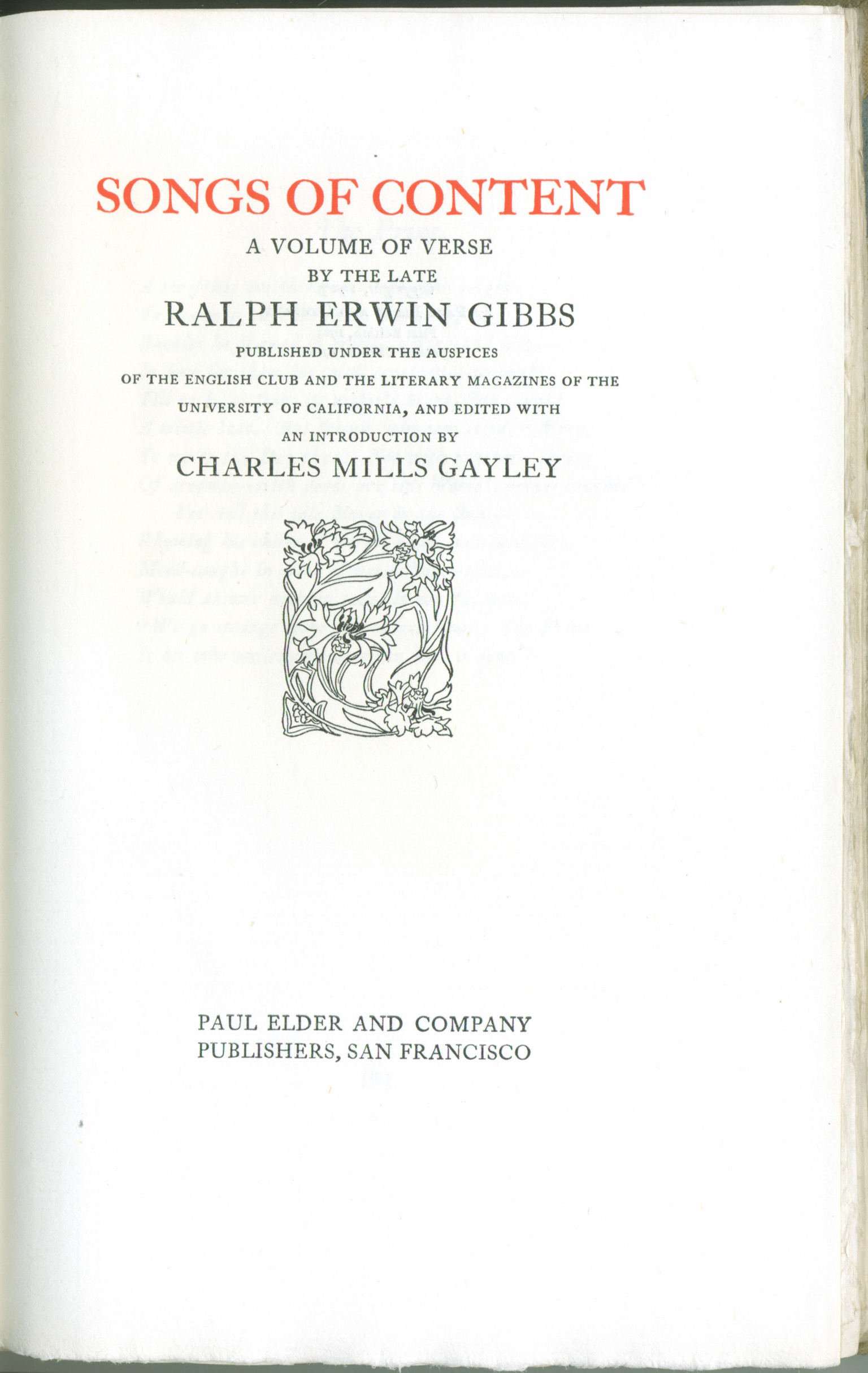
Gibbs was born in San Francisco on 22 March 1876 and attended public schools in Oakland. He graduated from the University of California in 1898, and continued on to earn a master’s degree in science in 1900. For some time, he had been writing stories and poems for two University publications, the Occident and the Magazine. He gradually became more interested in literature and poetry, and soon turned to writing full-time. In 1900, he became an assistant at the University Library and in the English department, where he became a protégé of Charles Mills Gayley (1858-1932), professor of Classics and English (and for whom Gayley Road on the UC campus is named). After Gibbs’s death, Gayley received the family’s permission to gather up the manuscripts and publish them as Songs of Content. In his moving introduction to Gibbs and his poetry, Gayley wrote:
Cover of the 1911 second edition of Songs of Content
I had not worked deep into his manuscripts before the conviction came that not to have preserved the best of them for the public would have been no mere mistake, but an injustice. Of his lyrics the more beautiful, and of his poems of life and death the more seriously considered, deserve an honorable place in the estimation of Californians. If my interest in the author does not deceive me, they will win their way not only where promise untimely stricken is deplored but where the comfort and the grace of art are for their own sakes welcomed.
Elder published a second edition in 1911, with the identical text but higher-quality binding and imported laid paper. Such a second edition was very unusual for Elder; the only other example is Charles Keeler’s Bird Notes Afield.
Updated 2026-01-18
Ralph Erwin Gibbs (1876-1903)Title page of 1st edition Songs of ContentTitle page of the 1911 second edition Songs of Content
Cover of “West Winds”, brown paper on boards. The logo of the California Writers Club appears on the spine.
The California Writer’s Club was founded in 1909 by a breakaway faction of the Press Club of Alameda, which had itself formed from various informal gatherings of Bay Area literati, including Jack London, George Sterling and Herman Whitaker. Their first publication, a compilation of fifteen short stories entitled West Winds, appeared in 1914. Its subtitle was California’s Book of Fiction – Written by California Authors and Illustrated by California Artists. The book’s western theme dovetailed with publisher Paul Elder’s own mission statement: he had styled himself “A Western Publisher” since 1904.
Contributors to West Winds included London, Whitaker, Charles F. Lummis, Agnes Morley Cleaveland (whose 1941 memoir No Life For a Lady is still in print) and Harriet Holmes Haslett (author of the 1917 Elder publication Dolores of the Sierra). Featured artists included Maynard Dixon and Perham Nahl (one of the three original teachers at the California College of the Arts). Noted photographer Anne Brigman designed the title page decoration.
Cover of “West Winds”, green cloth over boards
The California Writer’s Club still exists today and has eighteen chapters and 1300 members across the state. Three subsequent West Winds compilations appeared over the years, though none of those was published by Elder.
Two cover variants have been seen: 1) brown paper over boards, with the California Writers Club logo appearing on the spine of the book and dustjacket, and 2) green cloth over boards, without the logo on the book’s spine.
Title page of “West Winds”, with frontispiece by Perham Nahl and decoration by Anne BrigmanFirst page of Jack London’s story “The Son of the Wolf”Maynard Dixon’s illustration for Jack London’s story “The Son of the Wolf”