In 1902, May E. Southworth wrote a cookbook for Elder & Shepard called One Hundred & One Sandwiches. It was sold very well, and Elder asked Southworth to write more. In the 1904 Catalog From a Western Publisher (catalog C20), he writes:
The many who have experienced the gustatory joys of 101 Sandwiches will give a hearty reception to four additional volumes, affording them that multiple of the famous 101 Epicurean Thrills
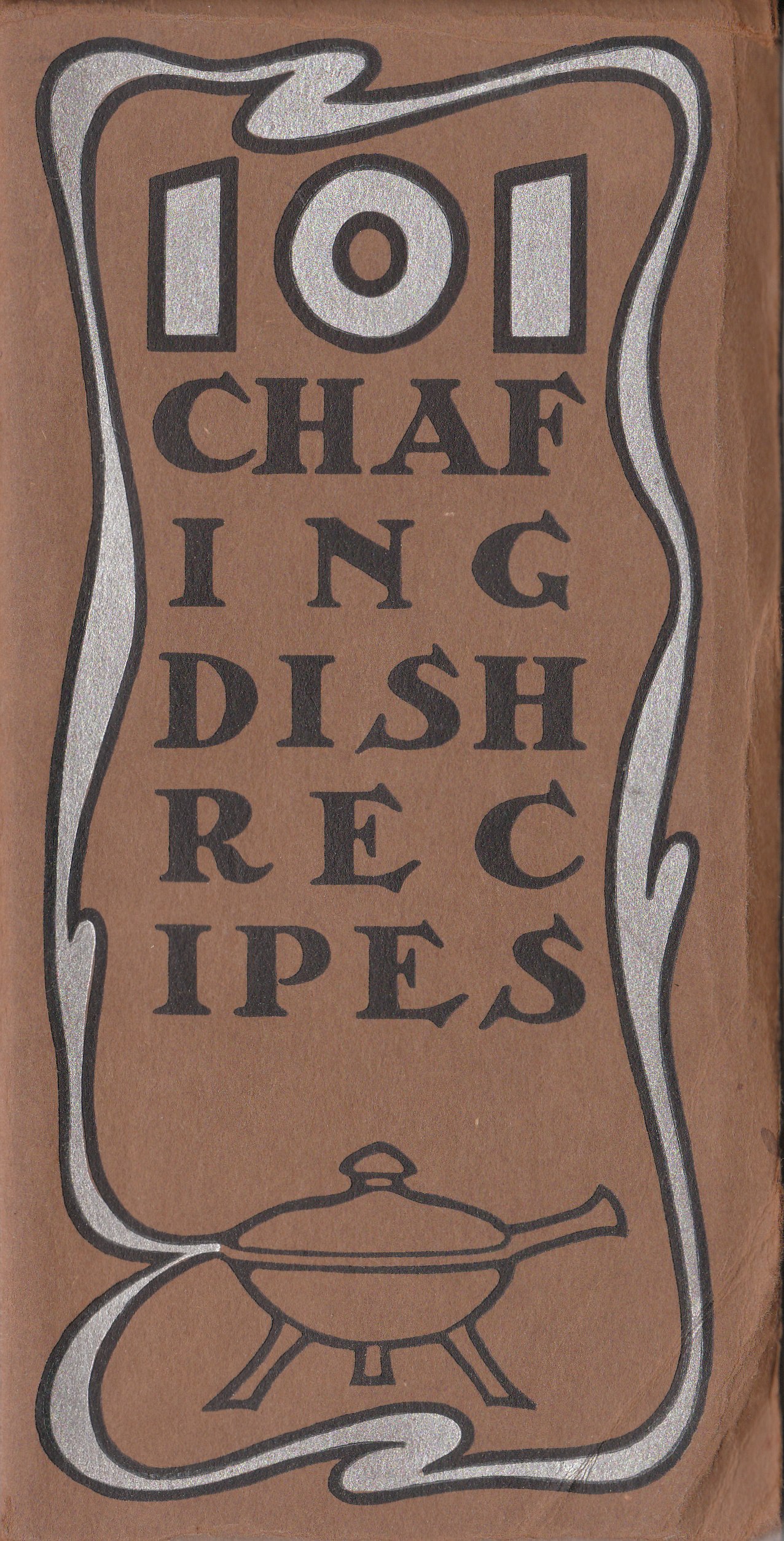
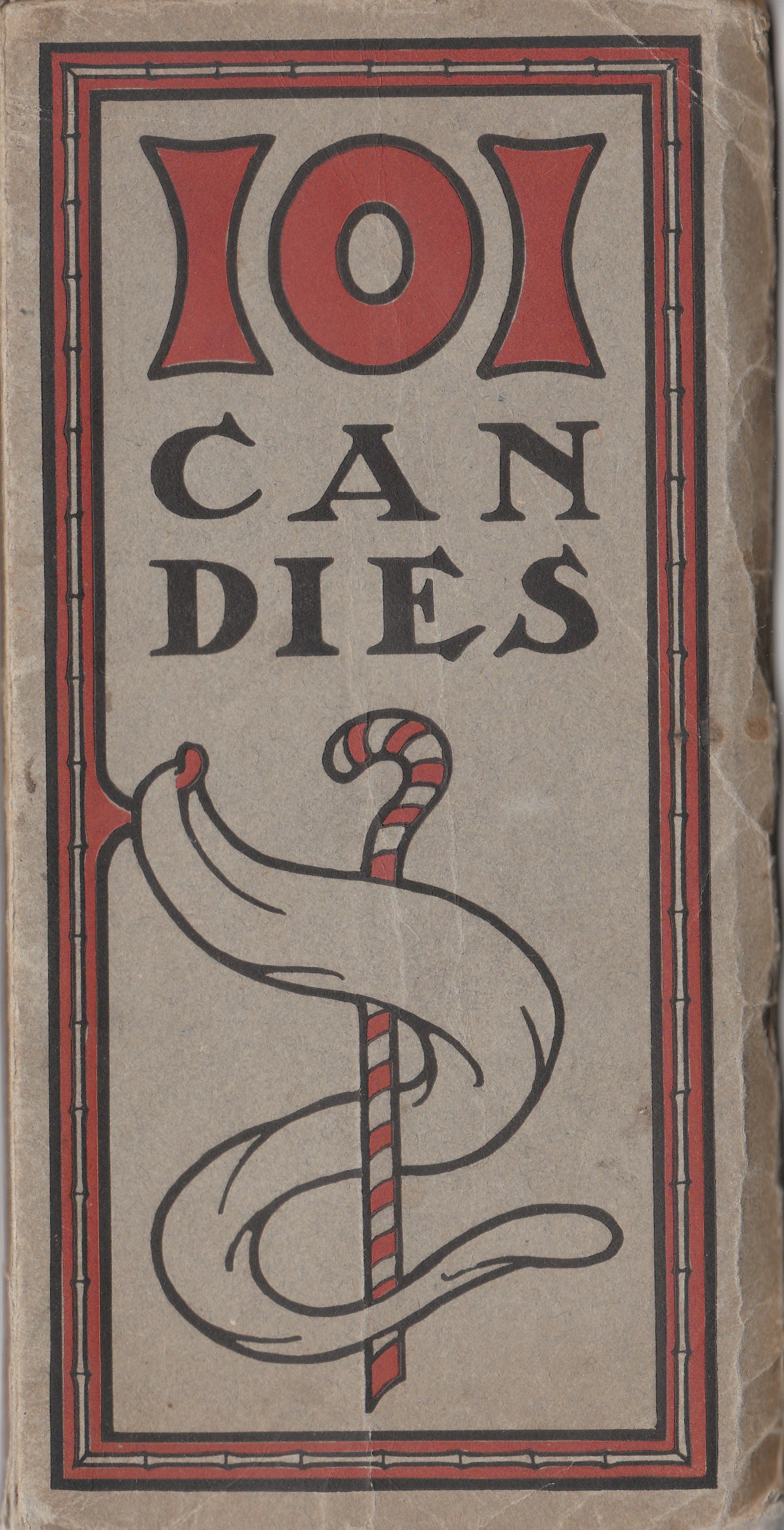
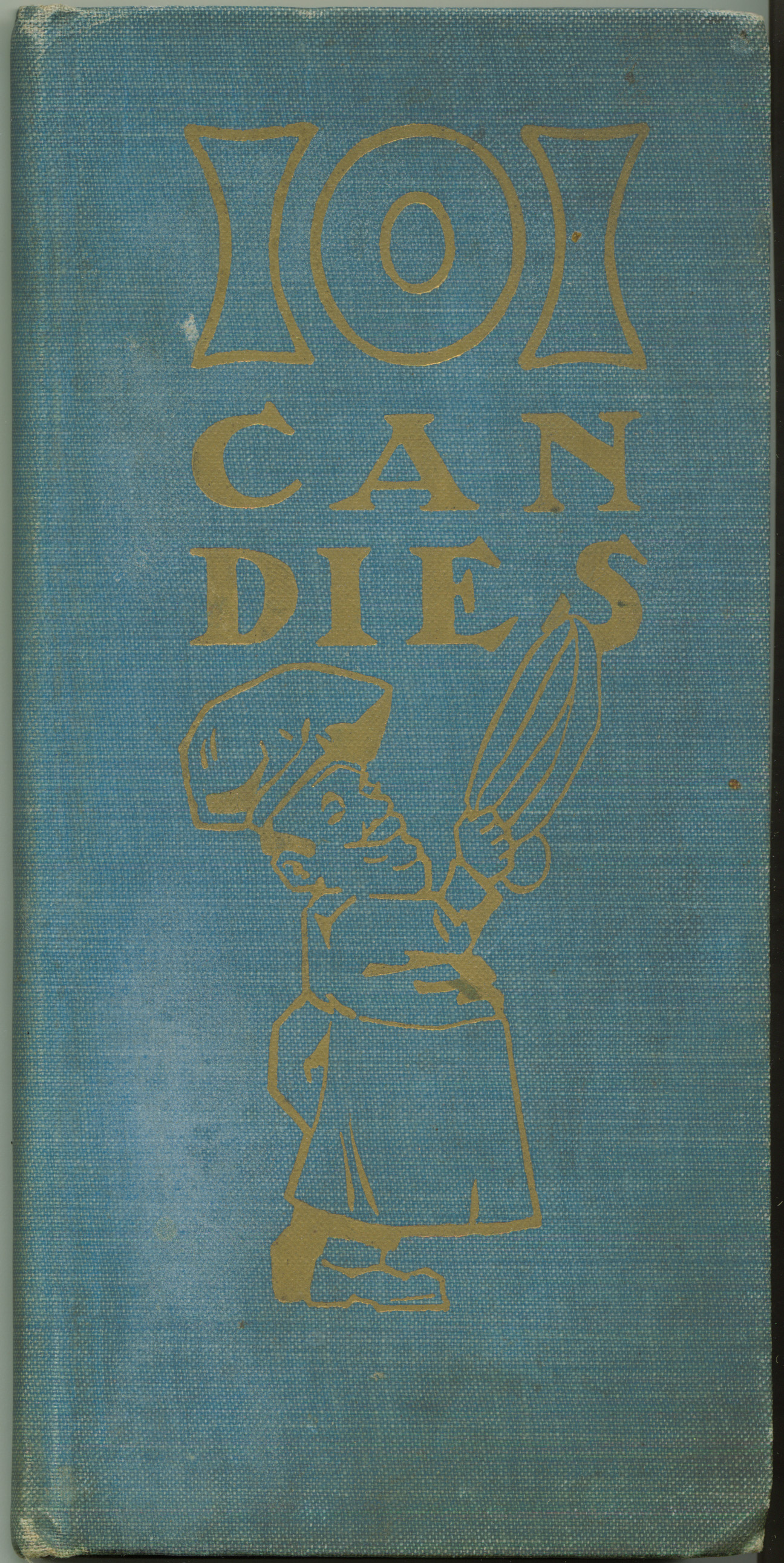
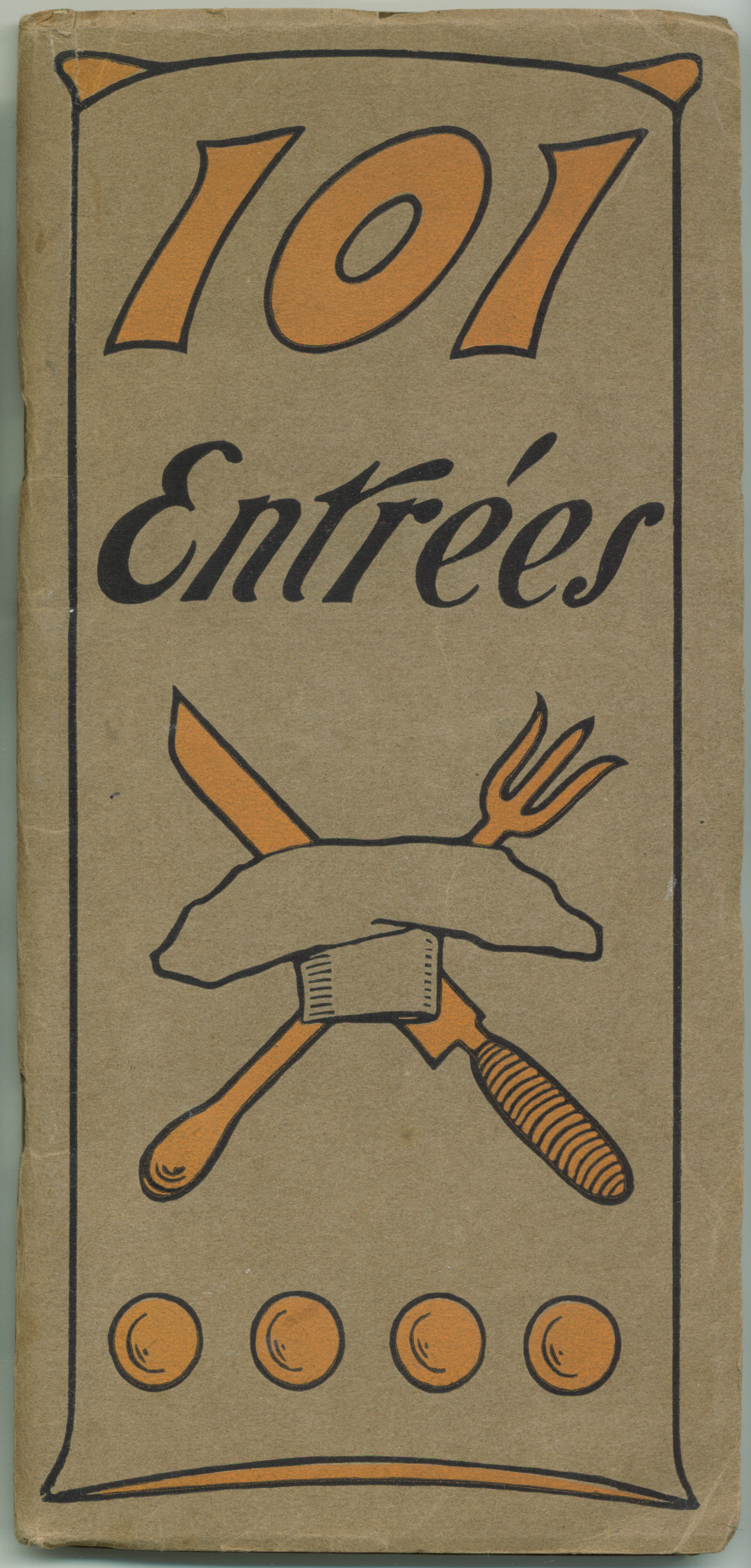
The four new cookbooks were Salads, Chafing-Dish Recipes, Beverages, and Candies. The five cookbooks, including Sandwiches, were reprinted with a Tomoye Press title page and whimsical cover art by Spencer Wright. They were issued in two bindings: paper wraps, and the “Kitichen edition” of canvas over boards. Elder named the series “101 Epicurean Thrills,” and by 1908 there were eleven titles in the series:
One Hundred & One Beverages
One Hundred & One Candies
One Hundred & One Chafing-Dish Recipes
One Hundred & One Desserts
One Hundred & One Entrées
One Hundred & One Layer Cakes
One Hundred & One Mexican Dishes
One Hundred & One Salads
One Hundred & One Sandwiches
One Hundred & One Sauces
One Hundred & One Ways of Serving Oysters
In 1914, Southworth followed up the series with a cookbook entitled Midnight Feasts: 202 Salads and Chafing-Dish Recipes.
101 Sandwiches, 1902 cover artwork.101 Sandwiches, 1904 revised cover artwork, in cloth over boards101 Salads101 Chafing Dish Recipes101 CandiesAlternate cloth cover of “101 Candies”101 Desserts101 Entrees101 Mexican Dishes101 Layer Cakes, cloth over boards101 Ways of Serving Oysters
My favorite illustrations from the Elder & Shepard years can be found in George Eli Hall’s 1902 story A Balloon Ascension at Midnight. In 1901, Hall was invited by a friend on a dramatic adventure: a night-time balloon ride over Paris. His companion is an “athletic young Frenchman” who has has discovered ballooning:
After having exhausted all the sensations that are to be found in ordinary sports, even those of “automobiling” at a breakneck speed, the members of the “Aéro Club” now seek in the air, where they indulge in all kinds of daring feats, the nerve-racking excitement that they have ceased to find on earth.
Hall’s courage is tested while climbing into the very small basket, but he soon is overwhelmed by the scene below him:
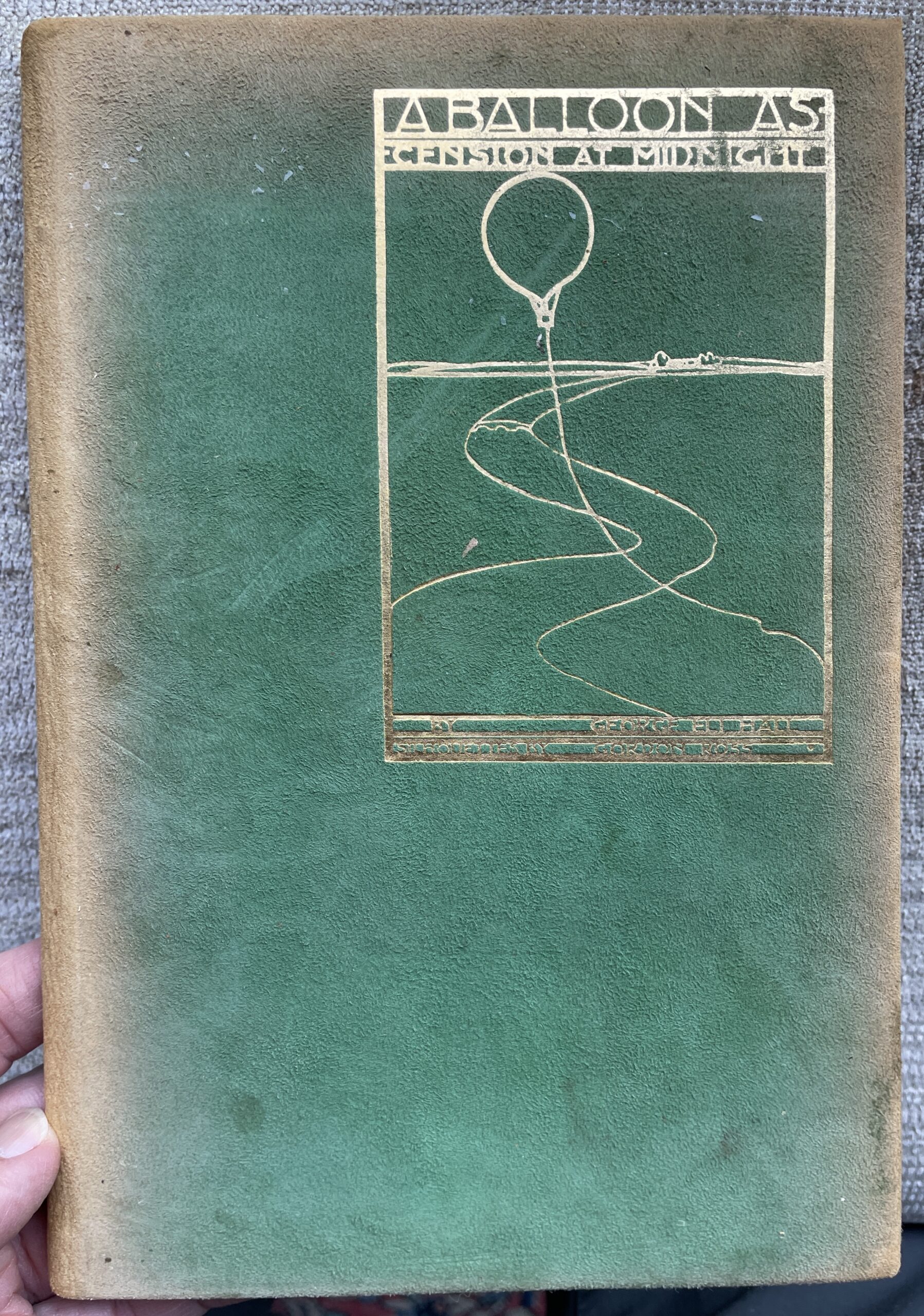
Cover of the deluxe edition of A Balloon Ascension at Midnight
It would have taken the pen of a Carlyle to describe our mysterious flight over Paris at midnight. The impression was so startling that for an hour we never spoke above a whisper…
The great boulevards roll out in every direction like ribbons of fire; we can hear, as we sail over them, the muffled rumbling of a thousand carriages, and we watch them as they dodge each other in their complicated course. A cry, a call, from time to time, reaches our ears; but the others are lost in the mighty silence above us.
At sunrise, they find they have drifted 80 kilometers over the French countryside. They make a scary landing near the village of Sens, as the balloon “bounds on several hundred feet, rolling like a huge football.” They are banged up and bruised, and their wine bottles are smashed, but they are alive and on dry land.
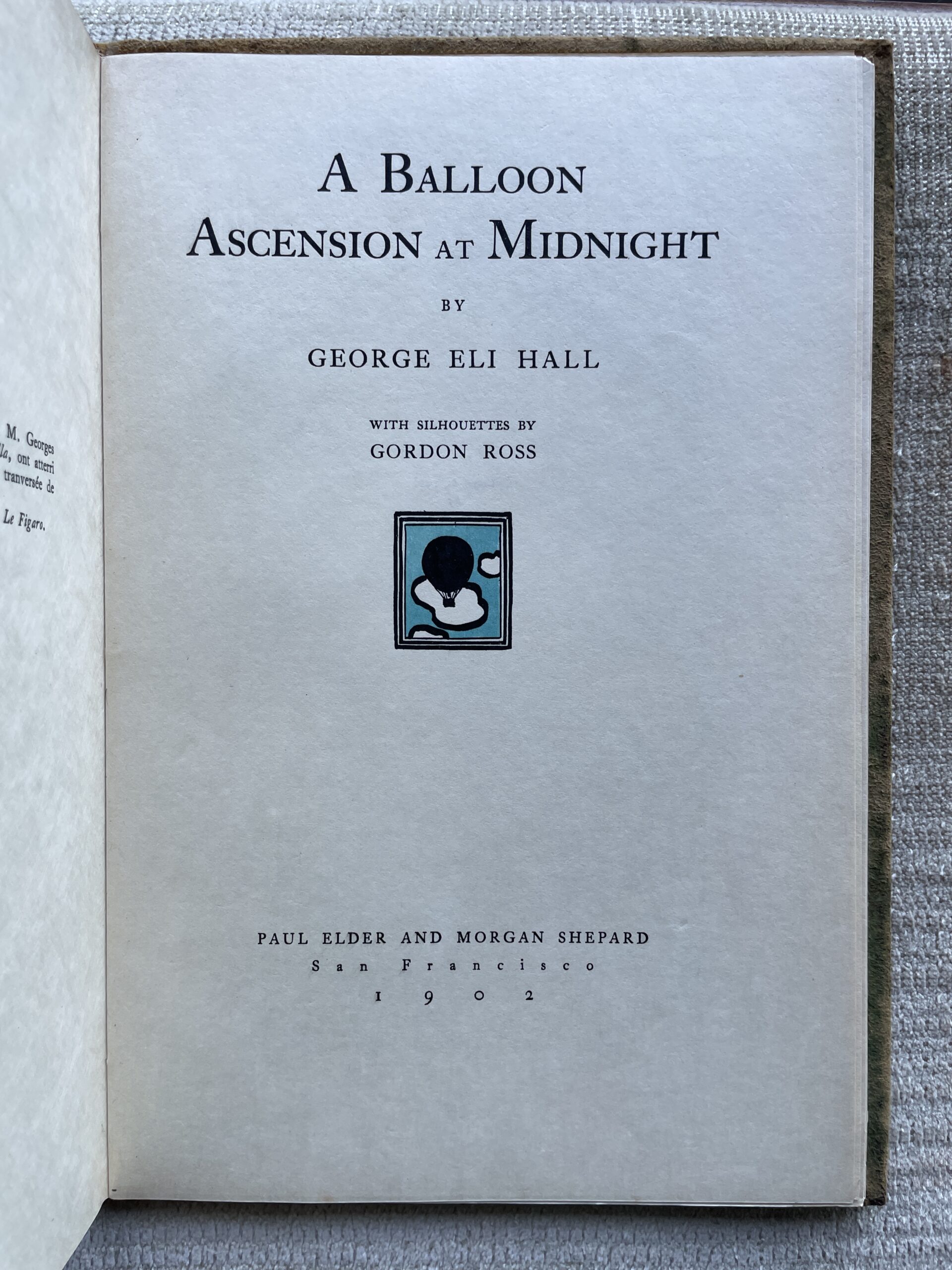
Title page of A Balloon Ascension at Midnight
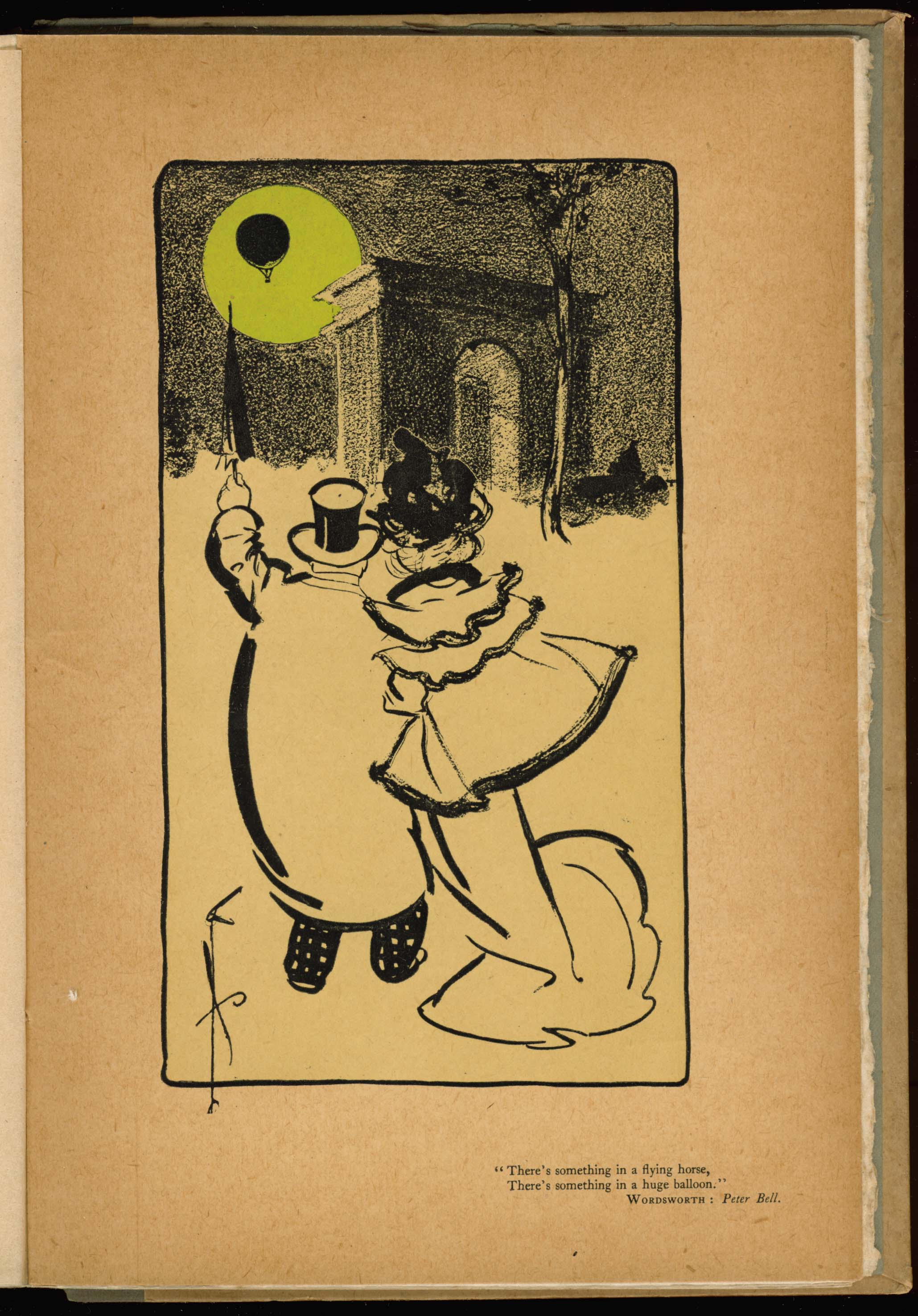
Gordon Ross’s color illustrations, including several of Notre-Dame cathedral, immediately sweep the reader back to the Belle Epoque. The book was published in two bindings: paper on boards, and a deluxe edition with green suede with gold trim, printed on vellum.
George Eli Hall was born on 17 March 1863 in Nice, France, the son of Charles Olmstead Hall and Mary Abby Dale. His first occupation was agent and importer, but about 1895, he became the Consul General of Turkey and Persia in San Francisco. The job evidently included some danger and intrigue: on 8 November 1898, the San Francisco Call, in a note entitled “Lurking Death for Turkey’s Consul,” said that Hall “had been receiving anonymous packages for the past week containing high and deadly explosives. At first the matter did not seem of much consequence to him, but as these munitions of war continued to constitute a portion of his daily mail, he became apprehensive and reported the matter to Chief of Police Lees.”
In September 1907, Hall arrived in Lima, Peru, no longer a diplomat but working in the oil business. On 12 June 1910, Hall married a local Peruvian woman named Maria Elena Rafaela Ludowieg y Cantuarias. They apparently had one child, but George died of heart failure in Lima just seventeen months later on 28 November 1911, only 48 years old, and was buried in the Cementerio General.
Gordon Alfred Ross was born in Collessie, Fife, Scotland on 15 March 1872, the oldest of six children of Reverend Hugh Ross and his wife Isabella. In the 1891 Scottish Census, he is 19 years old and listed as an “apprentice lithographic artist.” He emigrated to San Francisco in 1894, and studied at the Mark Hopkins Institute. About 1899, he married Helen G. Beatie; their daughter Helen Campbell Ross was born in 1901. Gordon Ross worked at the San Francisco Chronicle art department until 1904, when the family moved to New York and he became a full-time book illustrator. Ross died in Manhattan on 26 December 1946.1https://www.bobforrestweb.co.uk/The_Rubaiyat/N_and_Q/Gordon_Ross/Gordon_Ross.htm
Updated 2026-01-25
Frontispiece of A Balloon Ascension at Midnight. The sculpture is the famous “Le Stryge” on the parapet of Notre-Dame cathedral.The balloon soars over the Arc du TriompheThe balloon catches in a tree as they try to land in the countryside
Menehunes are popular characters in Hawaiian mythology; they are said to be a race of small people that live in the deep forest, far from the prying eyes of humans. The Menehunes arrived in Hawaii before the Polynesians, and were excellent craftspeople who built heiau(temples), roads, and fishing ponds.
In fact, a famous fishing lake called the Menehune Fishpond is located just south of Lihue, Kauaʻi. Officially called the ʻAlekoko Fishpond, it is believed to have been constructed in the 15th-century. Described as “the most significant fishpond on Kauaʻi, both in Hawaiian legends and folklore and in the eyes [of] Kauaʻi’s people today,” the fishpond was placed on the National Register of Historic Places in 1973.1https://npgallery.nps.gov/NRHP/GetAsset/NRHP/73000677_text
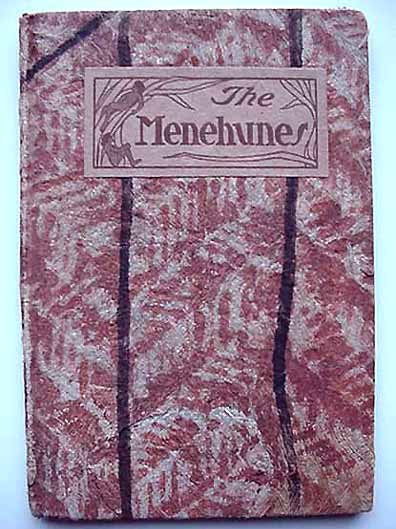
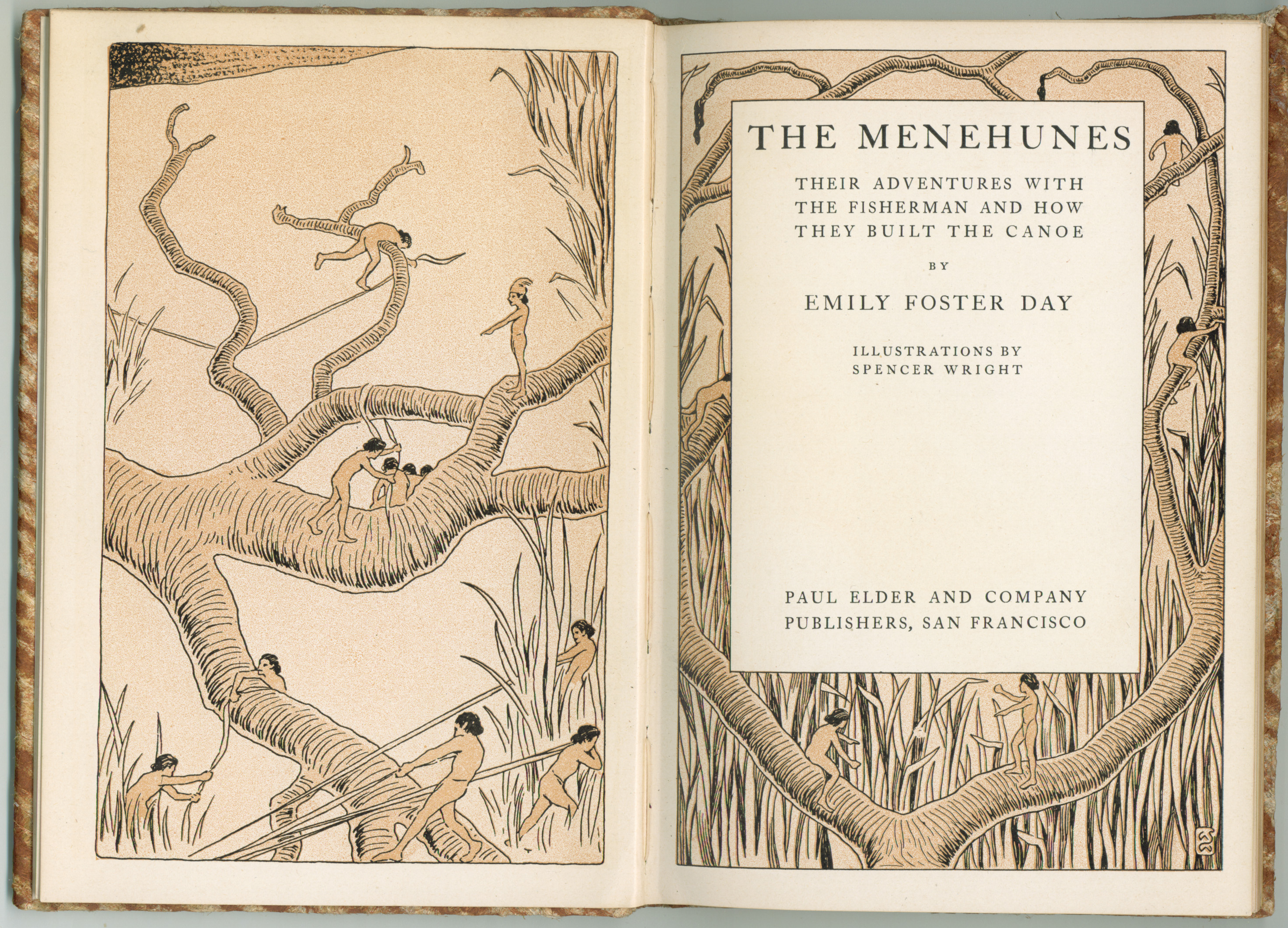
The Menehunes, subtitled Their Adventures With the Fisherman and How They Built the Canoe (1905), by Emily Foster Day, was one of Paul Elder’s many charming children’s books. This small volume was bound in Hawaiian kapafabric, with delightful illustrations by Spencer Wright.
Frontispiece and title page of “Menehunes”
In 1906, Emily wrote another book of Hawaiiana for Paul Elder, The Princess of Manoa.
Emily Foster was born in Onondaga, Ontario on 24 October 1860, the fourth of five children, and only daughter, of Charles Lucas Foster, a carpenter, and Elspeth Gauld. Emily’s grandparents were immigrants to Ontario from England and Aberdeenshire, Scotland, respectively. In 1885, Emily married Francis Root Day (1859-1906), a prominent doctor. In 1887, they moved from Chicago to Honolulu, where they spent the rest of their lives. Emily outlived Francis by nineteen years; they are buried at O’ahu Cemetery in Honolulu.
Updated 2026-01-25
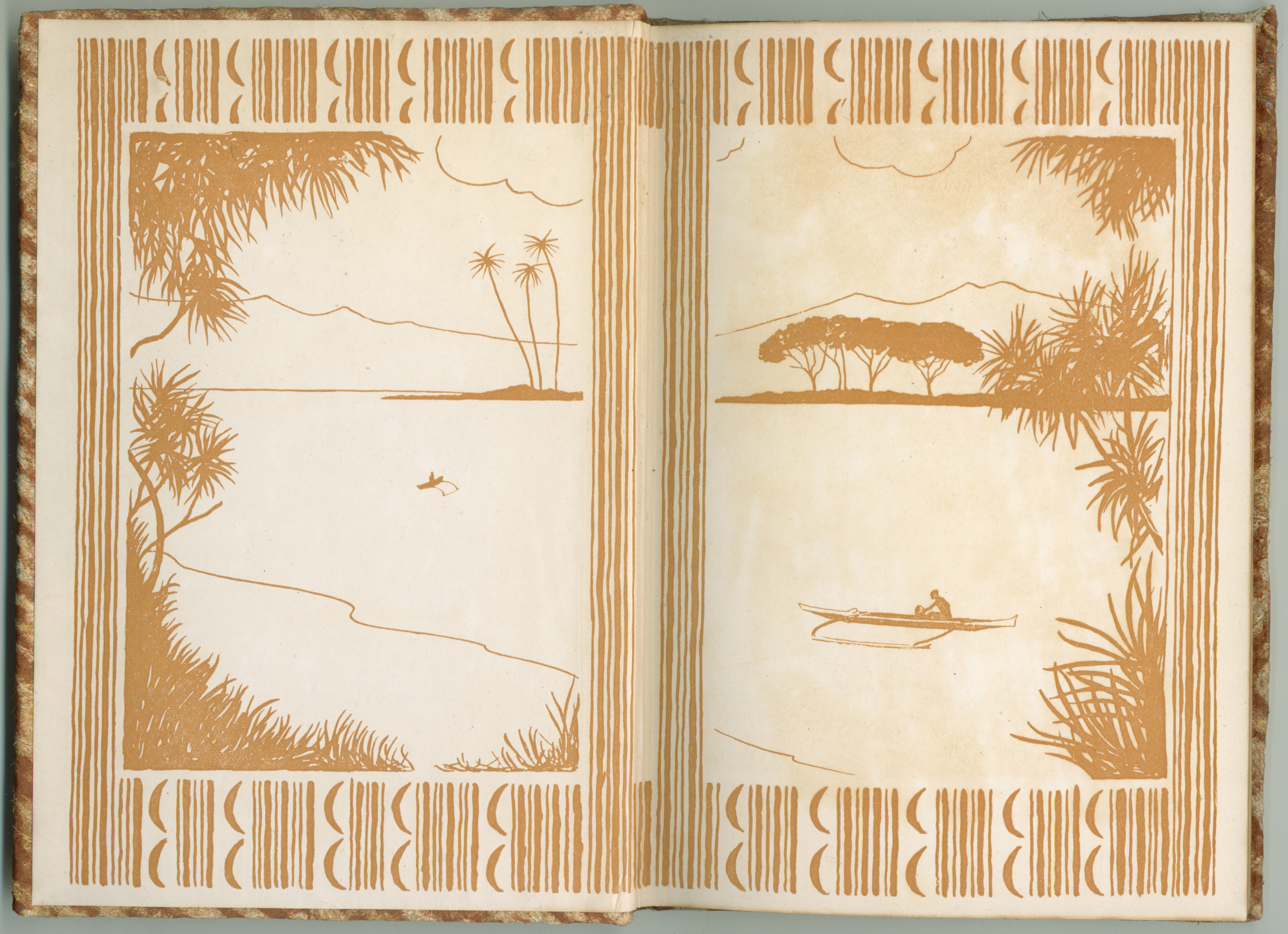
Pages 2-3 of “Menehunes”The decorated endpapers of “Menehunes”
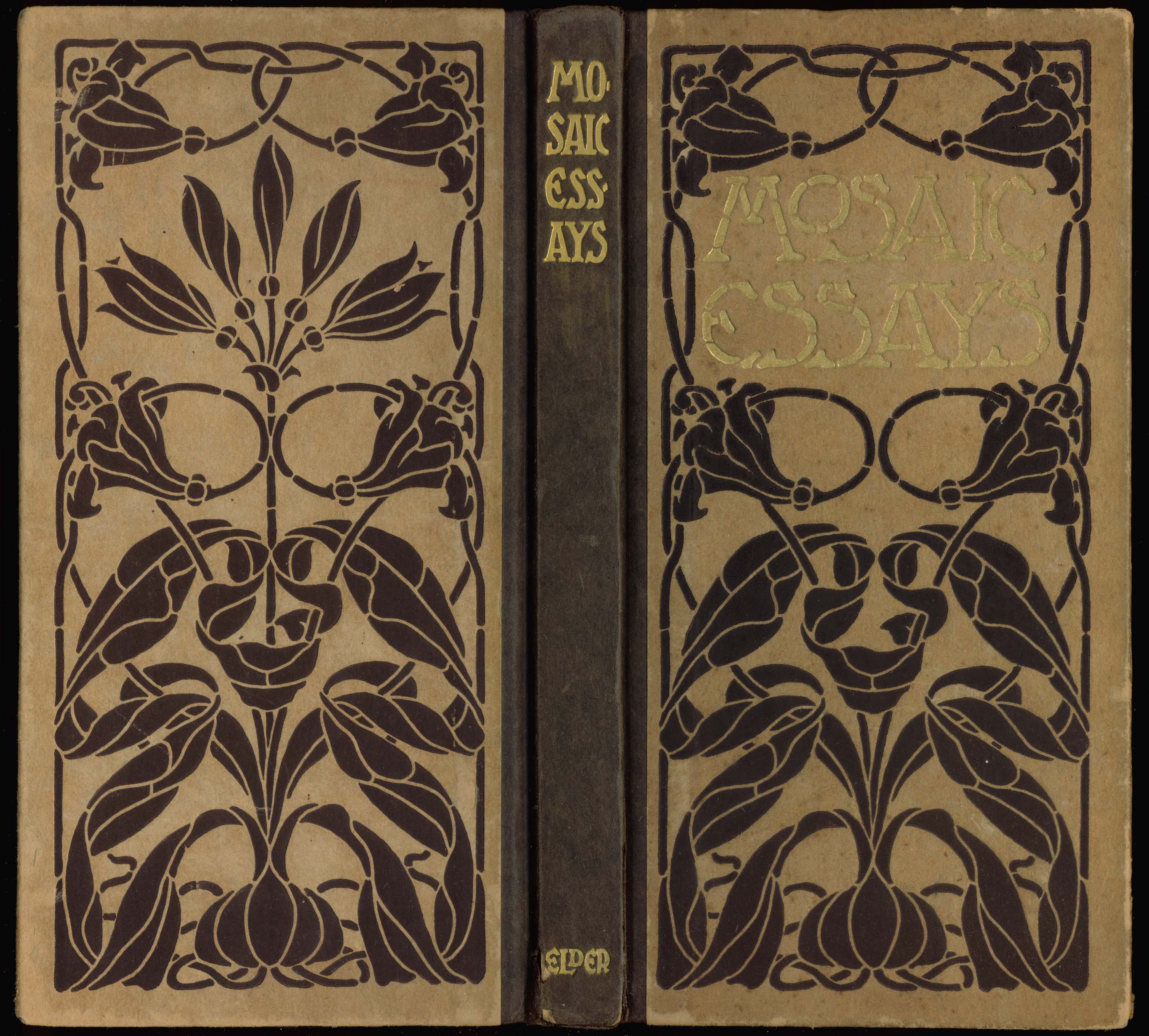
Beginning in 1901, Paul Elder compiled and published a series of booklets of aphorisms, each with a separate theme. Friendship was published first, followed by Happiness, Nature and Success in 1903, and finally byLove in 1905. They were quite successful: over 70,000 copies were sold by 1904. In 1906, while also continuing to sell the booklets individually, Elder packaged up the five booklets and issued them as a single volume entitled Mosaic Essays.
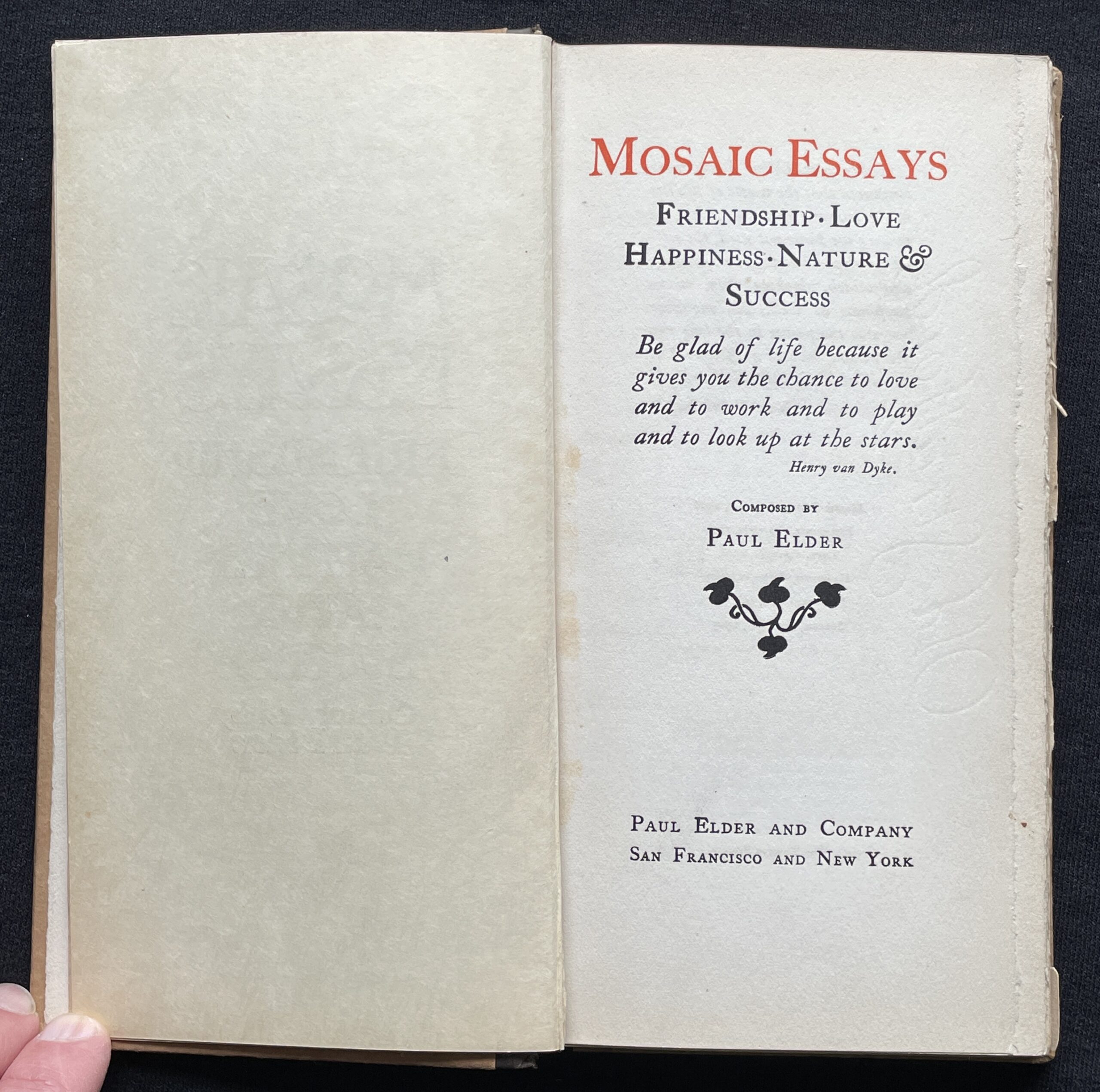
Elder commissioned Santa Barbara artist Robert Wilson Hyde to design the cover and title page, which very cleverly riff on the title by constructing the elements out of small “mosaic” pieces. Elder almost certainly met Hyde while opening the Santa Barbara bookstore in 1904. Hyde would later design Elder’s grand Guest Book and wedding book, The House That Jack Built.
Mosaic Essays, special decorated frontispiece and title page
There are four known bindings:
“Camelot Edition”: flexible red-brown French board, stamped in gold, boxed
(edition name unknown): brown paper over stiff boards, stamped in gold
“Stratford Edition”: flexible leather, boxed
“Craftsman Edition”: heavy leather, hand-modeled and colored (not seen)
Updated 2026-01-25
Formal title page of Mosaic Essays“Stratford Edition” of Mosaic Essays, in flexible leather“Camelot Edition” of Mosaic Essays, in “flexible florentine”
Matching gift box for the Camelot Edition of Mosaic Essays
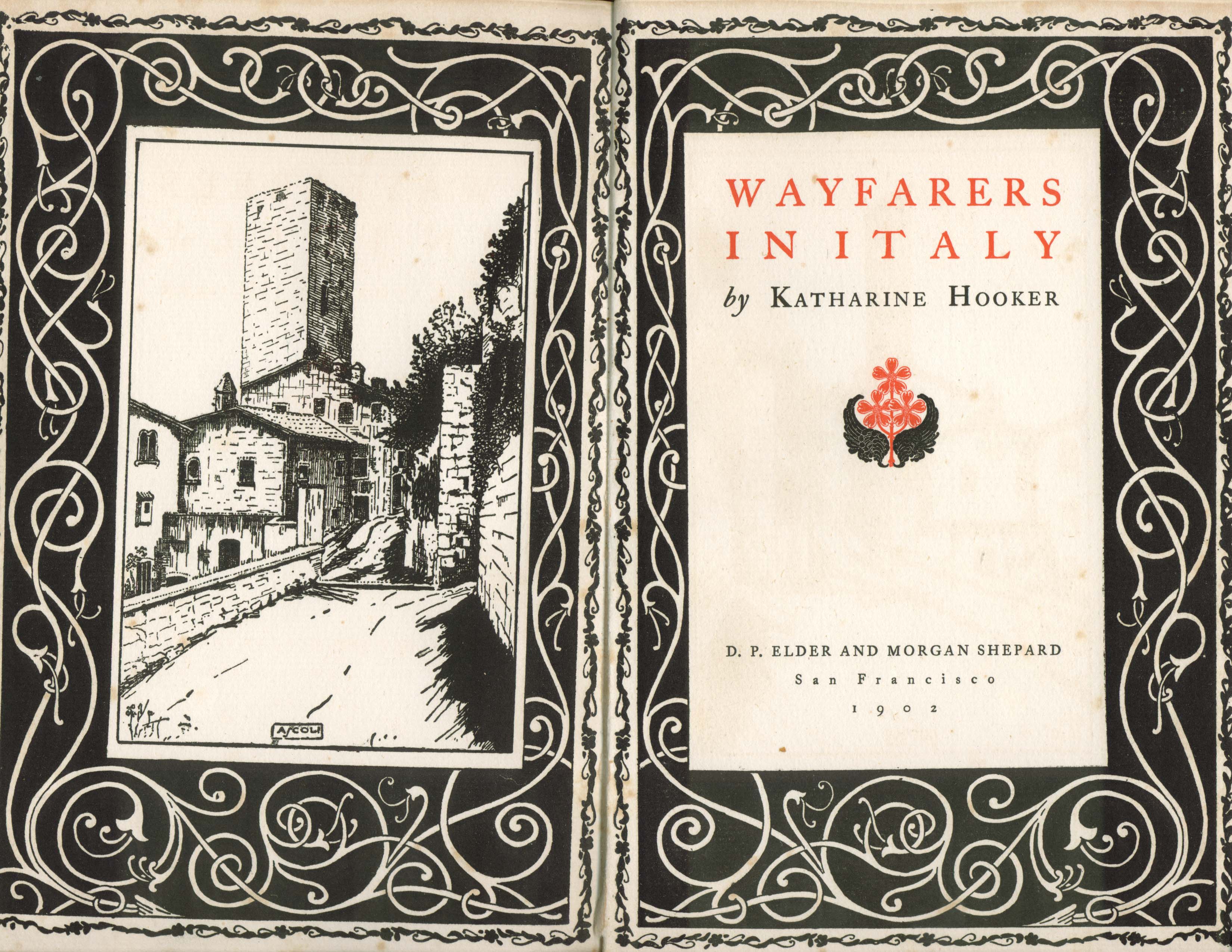
Katharine Hooker’s Wayfarers in Italy is perhaps the finest book issued by Elder & Shepard during their five-year partnership. It was printed in 1901 at the Stanley-Taylor Company on hand-made Ruisdael paper in two different limited editions of 100 and 300 copies. The The title page decorations and illuminated chapter headings were almost certainly designed by Morgan Shepard, and the book contains many photographs taken by Katharine’s daughter Marian. In 1902, Scribner’s bought publication rights the book from Elder; their edition of Wayfarers went through four printings by 1905.
It’s not clear how many copies of Wayfarers in Italy were offered for sale to the public. The colophons suggest that only the fancy 100-copy edition was offered for sale, but the 1902 Elder & Shepard holiday catalog reads “private edition of four hundred copies of which two hundred are for sale.” Even more confusing, my copy of the 300-copy edition has no binding, and appears never to have had one.
Hooker (1849-1935), born Katharine Mussey Putnam in Milwaukee, Wisconsin, grew up privileged and well-connected in turn-of-the-century California. She had an active, athletic youth, climbing Half Dome in Yosemite Valley and hiking the Grand Canyon: feats very rare for a woman in the 1860s. She learned French and German as a teenager, and had a lifelong interest in books.
Title page and frontispiece of “Wayfarers in Italy”
In 1869, Katherine married John Daggett Hooker, who became wealthy in the ironworks industry. This allowed her to take an extended trip to Europe in 1896 with her daughter Marian and family friend Samuel Marshall Ilsley (author of By the Western Sea, Elder & Shepard’s first publication). She and Marian returned to Italy in 1899 (by which time Katherine had also become fluent in Italian), and it was this trip that became the basis for Wayfarers. The commission came to Elder & Shepard through Katharine’s sister Mary Putnam, who was married to Morgan Shepard. Katharine also wrote two other travel books about Italy, Byways in Southern Tuscany (Scribner’s, 1918) and Through the Heel of Italy (Rae D. Henkle Co., 1927).
Map of Italy in 1901, included in the back of the book. The boundaries of several regions have changed since then, and the national border does not yet encompass South Tyrol or Trieste, areas that were annexed to Italy after World War I.
Hooker’s prose is enjoyable, and if she uses the passive voice a bit too often, I forgive her. She is adept at painting a gauzy, romantic picture of warm Italian summer afternoons, while also recounting amusing and interesting conversations with the locals. In Milan’s Museo Poldi-Pezzoli, Hooker and her daughter fail to find a certain Madonna and Child listed in their catalog; they quiz the custodian without success, but later he escorts them into a private room to show them the painting. In Ancona, she delightfully describes a heaping plate of light, fluffy fritto misto. In Venice, they strike up a friendship with their gondolier, Giovanni, who teaches them about the hardships and politics of his profession. Hooker’s visit to Siena can be dated to August 1899 because she witnessed the Palio on August 16th, where the contrada of Lupa was victorious. And if you are an experienced visitor to modern Italy, you will shake your head on almost every page as you think about how much has changed in the last 110 years.
Marian Osgood Hooker (1875-1968) also had a notable life. She became a physician and published numerous medical and scientific books, in addition to being a prominent amateur photographer. In 1903, Marian became the first woman to climb Mt. Whitney (the tallest mountain in the contiguous 48 states, named in honor of her great-uncle Josiah Whitney), in a party that included family friend and famed naturalist John Muir.
Page 3 of “Wayfarers in Italy”
Elder & Shepard’s edition of Wayfarers in Italy is rare because so few were printed, but the Scribner’s edition is easier to find. Here is one vintage book you will enjoy reading.
Pages 88-9 of “Wayfarers in Italy”Pages 242-3 of “Wayfarers in Italy”Pages 244-5 of “Wayfarers in Italy,” with one of Marian Hooker’s photographsPage 279 of “Wayfarers in Italy”Colophon of the edition of 100 copies. The “E” was written by Paul Elder, the “S” by Morgan Shepard.Colophon of the edition of 300 copies